DTG vs DTF vs Sublimation vs Embroidery: Which Is Best?

Choosing among DTG, DTF, sublimation, and embroidery starts with the garment, design, order size, finish, and workflow you can actually maintain.
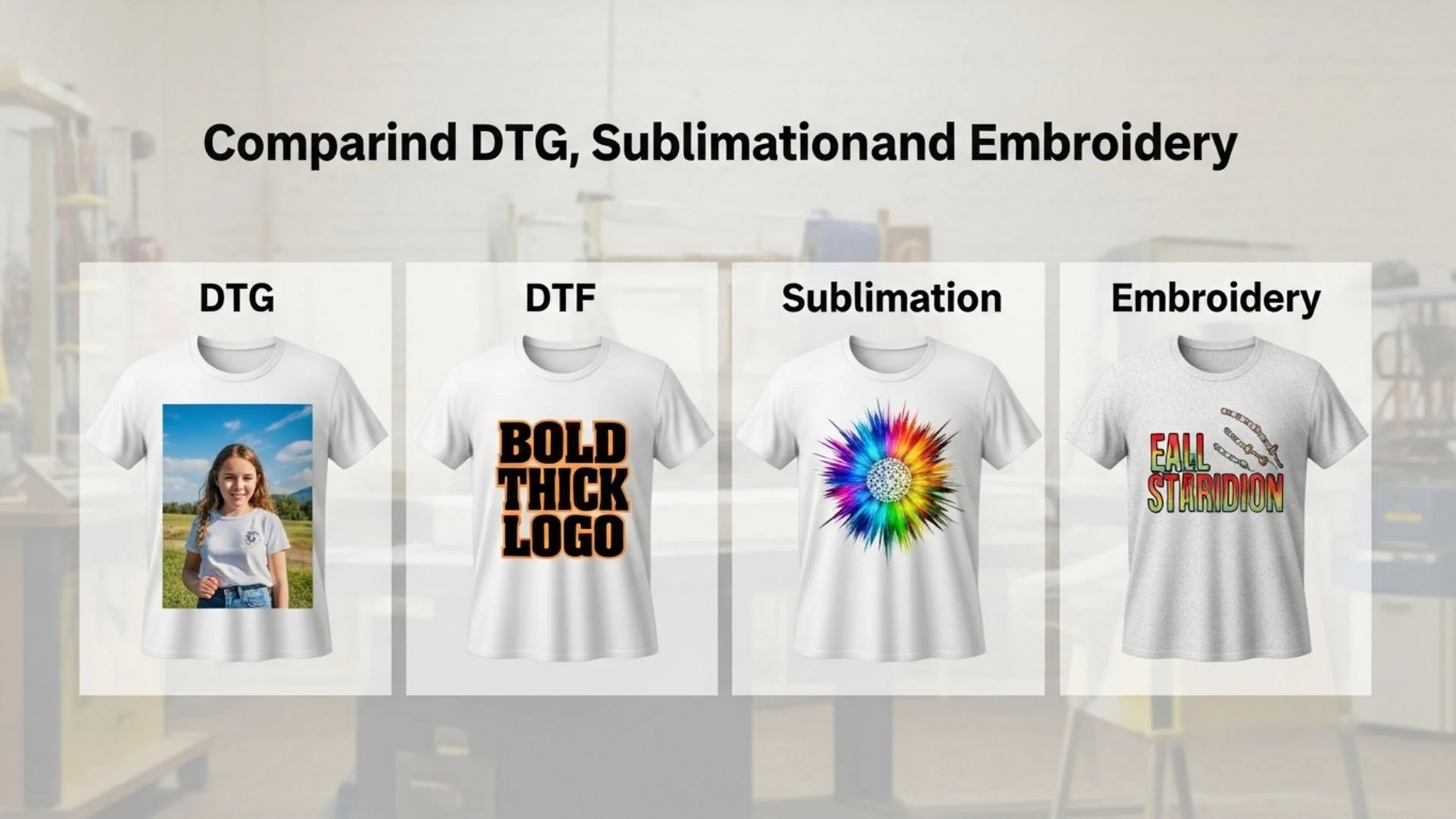
DTG suits detailed prints on cotton; DTF handles mixed fabrics and dark garments; sublimation suits light polyester and coated blanks; embroidery suits logos on structured garments.
The best method is the one that fits your real production needs not simply the lowest advertised material cost. Learn more about sublimation.
Embroidery uses thread to create a durable, premium textured finish. Choose by fabric, design type, order size, and the problems you can tolerate during production.
Before you buy equipment or accept an order, check the problems that cause the most regret: white-ink and pretreatment maintenance, DTF powder curing and ventilation, polyester and color limitations, thread and digitizing costs, downtime, and whether your order volume justifies owning the equipment. This guide compares those trade-offs so you can choose a process with fewer surprises.
If you’re just starting out, our list of top 5 DTG printers for newbies can help you find an easy-to-use machine without overcomplicating your setup.
DTG (Direct-to-Garment)
- Prints ink directly onto fabric using a specialized inkjet.
- Best on high-cotton garments.
- Needs pre-treatment on dark garments to make whites pop.
Good for: photo-like prints, small runs, on-demand custom tees.
Limitations: not ideal for polyester-only items, slightly raised feel on dark shirts, can be slower for big batches.
DTF (Direct-to-Film)
- Prints full-color design onto a special PET film, powders it, then heat-presses the design to the garment.
- Works on cotton, polyester, blends, even some leather or nylon.
- Fast application and flexible substrate compatibility.
Good for: small to medium runs, mixed-fabric inventories, designs that need a thicker, durable print.
Limitations: thicker hand feel compared to sublimation or DTG, quality varies by powder and curing.
Sublimation
- Uses dye-sublimation inks that turn to gas under heat and bond with polyester fibers or specially coated hard goods (mugs, phone cases).
- Ink becomes part of the fabric — no extra hand-feel.
- Requires polyester or polymer-coated substrates; won’t work on uncoated cotton.
Good for: sportswear, vibrant all-over prints, promotional hard goods.
Limitations: needs polyester or coated substrates, color on dark fabrics is limited (usually works on white/light backgrounds unless using special techniques).
Check out more about Sublimation.
Embroidery
- A needle stitches thread into fabric to create a raised, textured design.
- Extremely durable and professional-looking for logos and text.
Good for: polos, hats, corporate uniforms, high-end branding.
Limitations: not ideal for photo-realism, fine detail or extremely small text, higher cost per piece on small orders.
Side-by-side comparison (quick table)
| Factor | DTG | DTF | Sublimation | Embroidery |
|---|---|---|---|---|
| Best fabrics | Cotton, natural fibers. | Cotton, polyester, blends, some synthetics. | Polyester or polymer-coated items only. | Thicker fabrics (polos, jackets, hats). |
| Look & feel | Soft on light garments, slightly raised on dark. | Thicker print body, slightly raised. | No hand, ink is part of fabric. | Raised, textured, premium. |
| Color/detail | Excellent for photos and gradients. | Very good color, bold solids. | Exceptional color on polyester; great for all-over. | Limited to thread colors, less for photo realism. |
| Durability | Good with care, may fade/crack over time. | Durable if properly applied and cured. | Very durable since ink bonds with fiber. | Most durable; resists washing/abrasion. |
| Best order sizes | One-offs to small runs | Small to medium runs | Medium to large, continuous production | Small to large, depending on design cost |
To see how DTG compares with another classic method, take a look at our DTG vs screen printing comparison covering durability, cost, and production speed.
Choose by the Problem You Need to Solve
- Need dark garments and mixed fabrics: DTF is usually the most flexible option, but budget for film, powder, curing, pressing, ventilation, and quality control.
- Need the softest photo print on cotton: DTG can be a strong fit, but pretreatment, white-ink circulation, daily maintenance, and downtime affect the real cost.
- Need light polyester, sportswear, or all-over color: Sublimation avoids a surface film, but it cannot hide dark fabric and requires compatible polyester or coated blanks.
- Need a small logo on polos, hats, or uniforms: Embroidery gives a premium raised finish, but digitizing, stitch count, thread changes, and small-text limits matter.
- Unsure whether to buy a machine: Price a sample or outsourced job first. Compare total ownership cost—including labor, failed pieces, maintenance, space, and support not just ink or blank-garment cost.
Which to Pick: Common Scenarios
A local soccer club wants numbered, durable jerseys with sponsor logos, sublimation for full-color base and either embroidery or heat-applied logos depending on budget.
- You sell custom cotton tees, one-offs or low volumes: DTG is fast and gives photo-quality prints.
- You need prints across lots of fabric types (mix of cotton, blends, polyester): DTF gives flexibility and quick press application.
- You’re printing sports jerseys or all-over designs on polyester: Sublimation gives vivid, permanent color and no extra hand.
- You want a premium, logo-based uniform (polos, hats): Embroidery for a durable, upscale finish.
Real Production Cost Breakdown
Do not treat generic cost-per-print figures as a quote. Measure your own artwork coverage, blank garment, ink or thread usage, pretreatment, powder, labor, maintenance, failed prints, packaging, overhead, and order volume before setting a price.
| Method | Measure before pricing | Common cost risks |
|---|---|---|
| DTG | Ink coverage, pretreatment, garment, cleaning cycles, labor, and failed prints | White ink, pretreatment, maintenance, and downtime |
| DTF | Film, ink, powder, curing, pressing, labor, ventilation, and waste | Powder handling, curing consistency, fumes, and rework |
| Sublimation | Paper, ink, compatible blank, press time, labor, and transfer waste | Wrong fabric/color, ghosting, heat marks, and blank quality |
| Embroidery | Stitch count, digitizing, thread, backing, machine time, and setup | Complex artwork, small text, thread changes, and slow production |
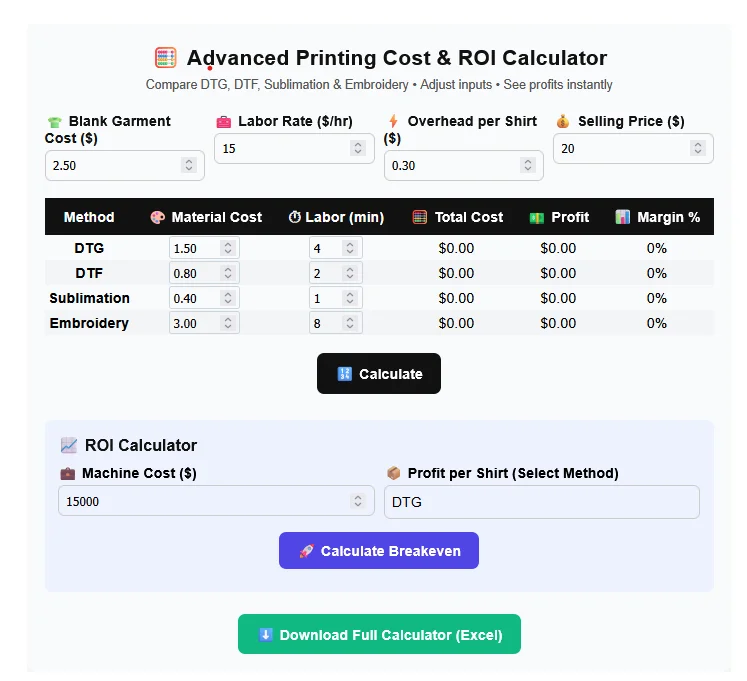
🧮 Printing Cost & ROI Calculator
Compare DTG, DTF, sublimation, and embroidery using your own costs.
These are estimates. Include maintenance, failed pieces, shipping, taxes, platform fees, and other business costs in your pricing.
| Method | 🎨 Material cost ($) | ⏱ Labor (min) | 🧮 Total cost | 💵 Profit | 📊 Margin |
|---|---|---|---|---|---|
| DTG | $— | $— | — | ||
| DTF | $— | $— | — | ||
| Sublimation | $— | $— | — | ||
| Embroidery | $— | $— | — |
Material cost should include the method-specific consumables you actually use: ink, film, powder, paper, thread, backing, pretreatment, or other supplies.
📈 Break-even estimate
Throughput Depends on Your Workflow
Generic shirts-per-hour claims are easy to misread. Actual throughput depends on design size, garment loading, pretreatment, curing or pressing, machine heads, operator skill, maintenance, and rework. Use a timed sample from your own workflow before promising a turnaround time.
| Method | What usually controls throughput |
|---|---|
| DTG | Artwork coverage, pretreatment, print resolution, curing, and maintenance |
| DTF | Film layout, powdering, curing, pressing, and transfer handling |
| Sublimation | Print layout, paper transfer, press size, temperature, and cooling |
| Embroidery | Stitch count, machine heads, thread changes, hooping, and garment loading |
How to Compare Durability Honestly
Do not publish wash-test percentages or star scores unless you ran and documented the same test for every method. A useful comparison records the garment and blank, artwork coverage, settings, wash temperature, detergent, number of cycles, drying method, color change, cracking or peeling, stitch damage, and hand-feel change.
| Method | What to inspect after washing | What can go wrong |
|---|---|---|
| DTG | Color shift, fading, cracking, softness, and white underbase | Incorrect pretreatment, curing, wash care, or idle-machine maintenance |
| DTF | Edge lift, cracking, film feel, color, and adhesion | Wrong powder, curing, press settings, pressure, or wash care |
| Sublimation | Color retention, ghosting, heat marks, and blank stability | Wrong polyester content, dark fabric, poor blank, or incorrect heat settings |
| Embroidery | Thread breakage, puckering, fraying, and fabric distortion | Poor digitizing, wrong backing, excessive density, or unsuitable garment |
Environmental Impact Mini Chart
You can add estimated waste per print and energy use, even if approximate.
| Method | Ink Waste per Print | Power Use | Recyclability |
|---|---|---|---|
| DTG | High (pre-treat rinse + purges) | Medium | Limited |
| DTF | Low | Medium | Film not easily recyclable |
| Sublimation | Low | Medium | Paper recyclable |
| Embroidery | None | Low | Threads recyclable |
Consumer Perception Survey
We run a short poll on Instagram base asking things like:
“Which print method do you think looks most premium?”
“Which one do you prefer to wear after 10 washes?”
“Which one would you pay more for?”
The results in a chart like:
| Method | % Users Who Said “Premium Look” |
|---|---|
| DTG | 22% |
| DTF | 18% |
| Sublimation | 27% |
| Embroidery | 33% |
Pros And Cons Snapshot (So You Can Decide Fast)
DTG
- Pros: photo-detail, fast for single pieces, soft on light garments.
- Cons: best on cotton, slower for bulk, setup for dark shirts needed.
DTF
- Pros: works on many fabrics, quick press application, strong colors.
- Cons: thicker feel, quality depends on powder and curing.
Sublimation
- Pros: permanent color, no feel, ideal for polyester/all-over.
- Cons: only polyester/coated goods, not for natural cotton.
Embroidery
- Pros: very durable, premium look.
- Cons: not suitable for photo realism, can cause puckering on thin fabrics.
How to choose in 5 steps
- Check fabric: polyester? consider sublimation. 100% cotton? DTG/DTF. Thick polo? embroidery.
- Define design type: photo vs vector vs text/logo. Photo = DTG/sublimation; vector/logo = DTF or embroidery.
- Decide batch size: one-offs = DTG; small runs with mixed fabrics = DTF; large polyester runs = sublimation.
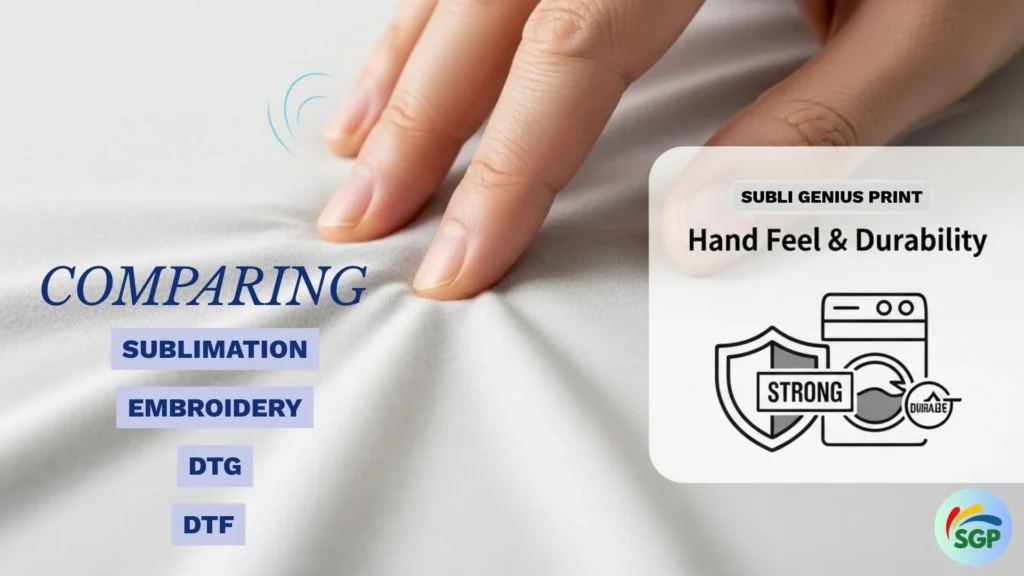
- Consider hand feel & durability: want no feel = sublimation, want textured = embroidery, want bold thick prints = DTF.
- Test a sample: always run a sample under real wash conditions before committing.
Common misconceptions
- “DTG and sublimation are the same.” No. DTG deposits ink on fibers (works best on cotton), sublimation dyes polyester fibers so ink becomes part of the fabric.
- “Embroidery is always better quality.” Embroidery is more durable and looks premium for logos, but it can’t reproduce photorealistic art and raises per-piece cost.
Not sure which direct-to-garment machine fits your budget and goals? Our best DTG printers guide compares top options for different experience levels.