LLC vs Sole Proprietorship for a Print Shop: What’s Right for You?

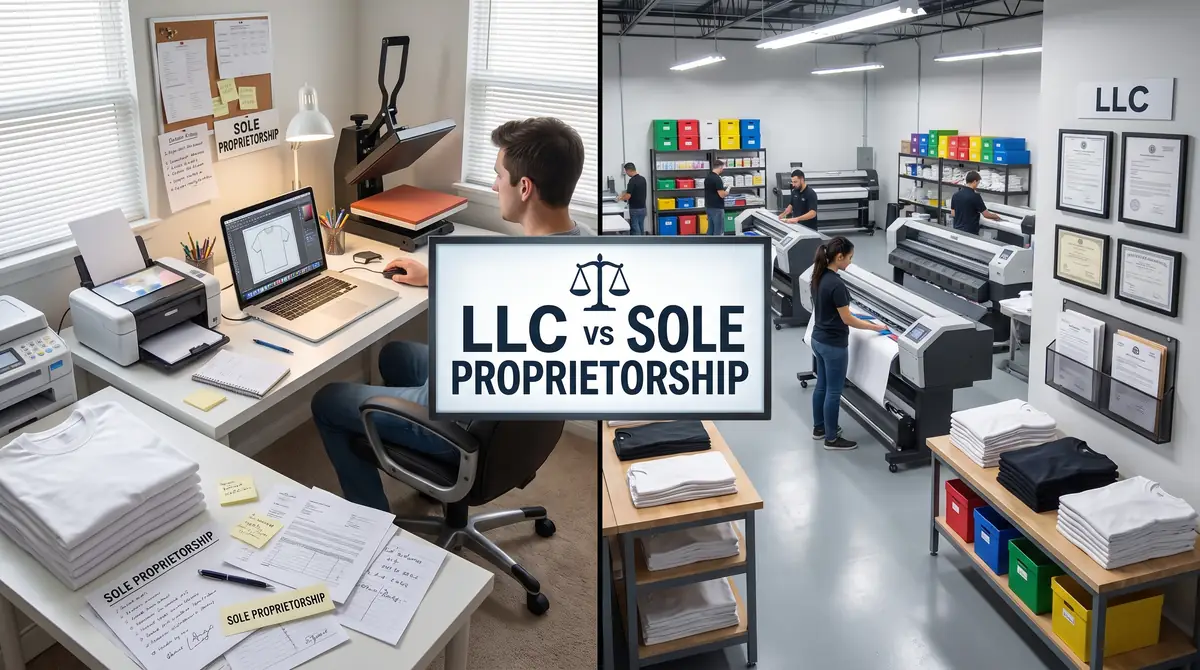
Both business structures can work well for a print shop, but they serve different stages of business growth.
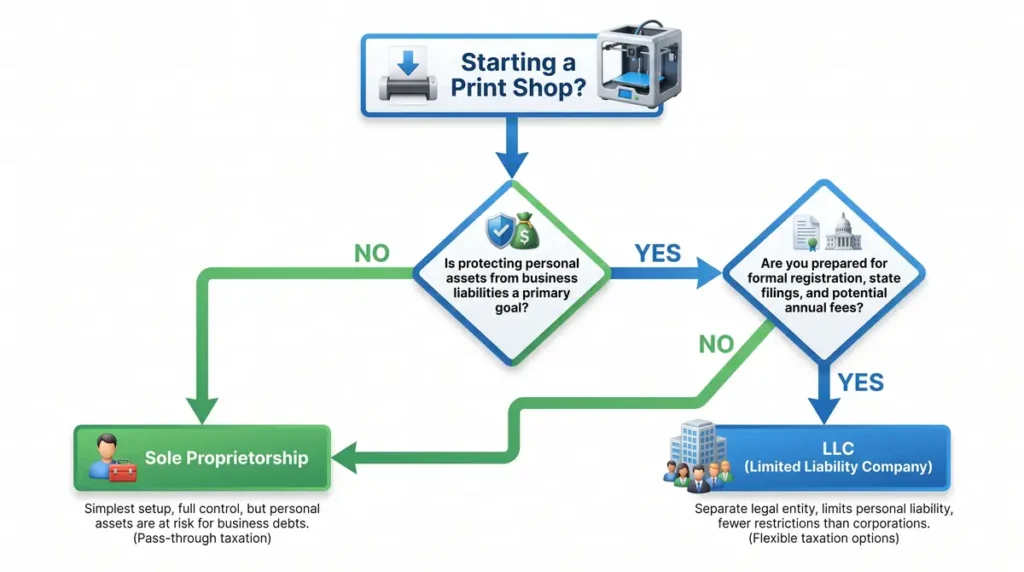
A sole proprietorship is ideal for getting started. It keeps costs low, minimizes paperwork, and lets you validate your business before making additional investments.
An LLC becomes the stronger option once your shop begins growing. It offers liability protection, improves credibility with customers and suppliers, and provides a more solid foundation for long-term expansion.
The best decision depends on your goals, the level of financial risk you’re comfortable with, and how quickly you expect your business to grow. If you’re unsure, speaking with a qualified accountant or business attorney familiar with your state’s requirements can help you choose the right structure.
If you’re still planning your business, our Sublimation Business Guide walks through equipment, startup costs, and common mistakes before you launch.

Quick Answer
| Choose a Sole Proprietorship if… | Choose an LLC if… |
|---|---|
| You’re testing a business idea | You’re planning long-term growth |
| You have minimal startup costs | You’ve invested in expensive equipment |
| You sell part-time | You operate full-time |
| You want the simplest setup | You want personal liability protection |
| You have few business risks | You work with larger customers |
A sole proprietorship works well for getting started, while an LLC is usually the better choice once your print shop begins generating consistent income or takes on greater financial and legal responsibility.
LLC vs Sole Proprietorship Compare Feature
| Feature | Sole Proprietorship | LLC |
|---|---|---|
| Formation | Automatic in most states | State registration required |
| Startup Cost | Very low | Filing fees apply |
| Liability Protection | None | Personal assets generally separated from business liabilities |
| Taxes | Pass-through taxation | Pass-through by default for a single-member LLC |
| Paperwork | Minimal | Ongoing compliance requirements |
| Business Credibility | Basic | Often viewed as more professional |
| Business Bank Account | Recommended | Strongly recommended |
| Best For | New or part-time print shops | Growing and established businesses |
What Is a Sole Proprietorship?
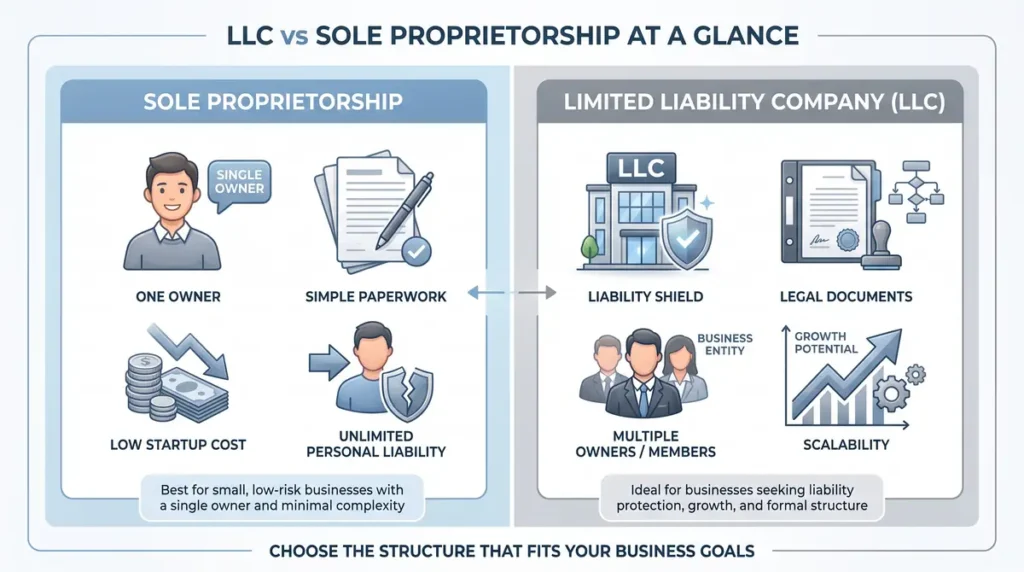
A sole proprietorship is the simplest business structure. If you start selling printed products without forming another legal entity, you’re typically operating as a sole proprietor.
Advantages
- Low startup cost
- Little paperwork
- Easy tax filing
- Complete control over business decisions
- Fast to start
Disadvantages
- No separation between personal and business assets
- Personal responsibility for business debts
- Harder to build business credibility
- Greater financial risk if legal issues arise
Best For
A sole proprietorship is often the best choice if you:
- Run a home-based sublimation business
- Sell occasionally on Etsy or local markets
- Want to validate your business idea before investing heavily
- Have limited startup capital
What Is an LLC?
A Limited Liability Company (LLC) is a separate legal business entity created under state law. Although a single-member LLC is commonly taxed like a sole proprietorship, it generally provides legal separation between the business and the owner’s personal assets.
Advantages
- Personal liability protection
- Increased business credibility
- Easier to work with commercial customers
- Better foundation for business growth
- Flexible tax options as the business expands
Disadvantages
- State filing fees
- Annual reporting requirements in many states
- More record keeping
- Additional administrative responsibilities
Best For
An LLC is a good fit if you:
- Own expensive printing equipment
- Operate a commercial print shop
- Hire employees
- Lease business space
- Plan to expand production
- Work with wholesale or corporate customers
LLC vs Sole Proprietorship: Key Differences
Choosing between these two structures is less about taxes and more about balancing simplicity with protection.
Personal Liability
This is the biggest difference.
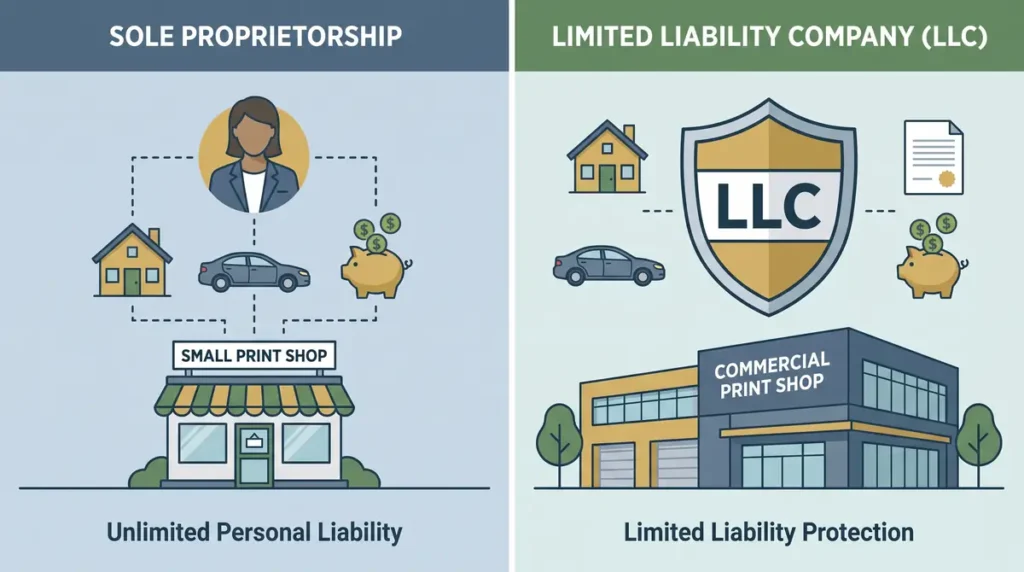
With a sole proprietorship, there is no legal separation between you and your business. If your print shop faces a lawsuit or business debt, your personal assets may be at risk.
An LLC generally separates your personal assets from business obligations, provided you operate the business properly and follow applicable legal requirements.
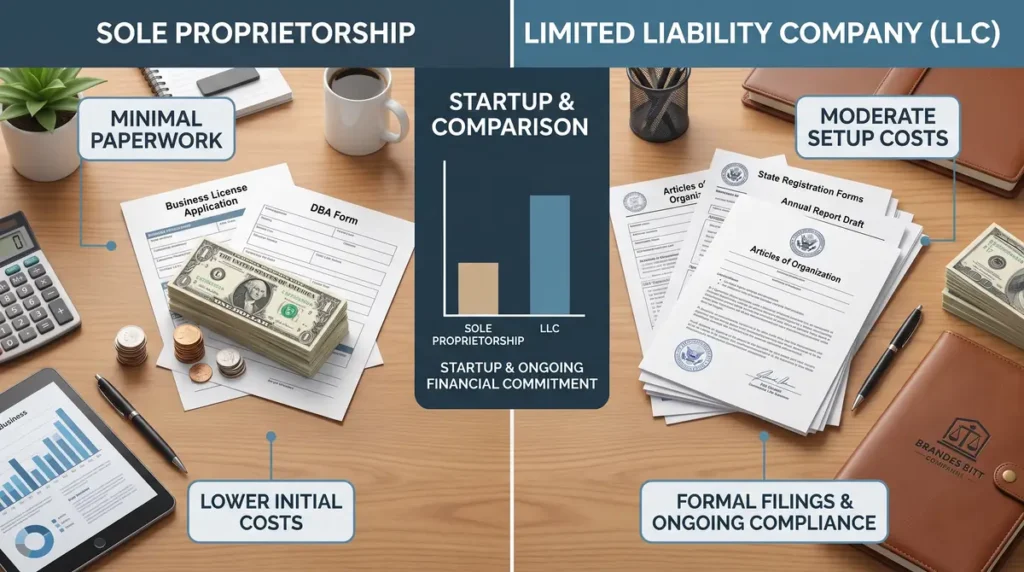
Startup Costs
| Sole Proprietorship | LLC |
|---|---|
| Usually little or no formation cost | State filing fees apply |
| Minimal paperwork | Registration documents required |
| No annual filing in many cases | Some states require annual reports |
If keeping startup costs low is your priority, a sole proprietorship is the simpler option. If long-term protection matters more, many owners consider the extra cost of an LLC worthwhile.
Taxes
Many new business owners assume an LLC automatically reduces taxes.
In reality:
- Sole proprietorships use pass-through taxation.
- Single-member LLCs also use pass-through taxation by default.
- Both generally report business income on the owner’s personal tax return.
Tax savings usually depend on your income level and any tax elections you choose later, not simply on forming an LLC.
Paperwork
A sole proprietorship requires very little ongoing administration.
An LLC usually requires:
- State registration
- Annual reports (where applicable)
- Better financial records
- Separate business documentation
Good bookkeeping benefits either business structure.
For growing businesses, creating a documented print shop workflow also helps keep operations organized as order volume increases.
How to Decide in 60 Seconds
If you’re still unsure, use this checklist.
Choose a Sole Proprietorship if you:
- Are launching your first print shop
- Have a limited startup budget
- Sell part-time or as a side business
- Want minimal paperwork
- Are testing market demand
Choose an LLC if you:
- Plan to grow your business
- Own expensive printing equipment
- Hire employees or contractors
- Work with wholesale or corporate clients
- Want to separate personal and business finances
Tip: If you’re unsure, many successful print shop owners begin as sole proprietors and form an LLC once the business becomes consistently profitable or takes on greater financial responsibility.
Before You Register Your Business
Take a few minutes to review these questions before choosing a business structure.
- How much have you invested in equipment?
- Will you operate from home or lease commercial space?
- Do you expect to hire employees within the next year?
- Will you sell primarily to consumers or business clients?
- Are you comfortable accepting personal liability for business debts?
- Does your state require annual reports or fees for LLCs?
Answering these questions can help you determine whether keeping things simple or adding legal protection makes more sense for your current stage of business.
Which Structure Is Better for Different Types of Print Shops?
The best business structure depends on how you operate, how much you’ve invested, and how much risk your business carries.
| Print Shop Type | Recommended Structure | Why |
|---|---|---|
| Home-based hobby business | Sole Proprietorship | Lowest cost and easiest to start |
| Etsy or small online shop | Sole Proprietorship (initially) | Good for testing demand before investing more |
| Print-on-demand business | Sole Proprietorship or LLC | LLC becomes more attractive as sales grow |
| DTF printing business | LLC | Equipment costs and commercial orders increase risk |
| Screen printing shop | LLC | Employees, inventory, and larger contracts benefit from liability protection |
| Commercial print shop | LLC | Better protection and stronger business credibility |
Home-Based Sublimation Business
If you’re making custom mugs, shirts, or tumblers from home and selling locally or online, a sole proprietorship is often enough during the early stages.
Once you begin investing in additional printers, heat presses, or inventory, forming an LLC becomes a practical next step.
Etsy Sellers
Many Etsy sellers begin as sole proprietors because they have low startup costs and modest order volume.
As your shop grows, an LLC can:
- Separate personal and business finances
- Improve credibility with suppliers
- Protect personal assets if legal issues arise
Print-on-Demand Business
A print-on-demand business can operate under either structure.
A sole proprietorship usually works well if you:
- Have low monthly sales
- Use third-party fulfillment
- Are testing products
An LLC is often the better choice when you:
- Build a recognizable brand
- Generate consistent revenue
- Sign wholesale agreements
- Hire contractors or employees
DTF Printing Business
DTF printing typically requires a larger investment than many beginner sublimation setups.
An LLC is worth considering because it helps protect your personal assets if your business takes on debt, commercial leases, or customer disputes.
Screen Printing Shop
Screen printing businesses often involve:
- Larger equipment
- Inventory storage
- Employees
- Commercial clients
These factors increase operational risk, making an LLC the more suitable option for many established shops.
When Should You Upgrade From a Sole Proprietorship to an LLC?
Many print shops don’t need an LLC on day one. A better approach is to switch when your business reaches a point where additional protection outweighs the extra paperwork.
Common signs it’s time to upgrade include:
- Your monthly sales continue to increase.
- You’ve invested thousands of dollars in equipment.
- You lease a commercial workspace.
- You hire employees or contractors.
- You work with schools, businesses, or government organizations.
- You carry larger inventories.
- Customers sign formal contracts.
- You’re concerned about protecting your personal assets.
Waiting too long can expose you to unnecessary financial risk, while forming an LLC too early may add costs before your business has proven itself.
Cost Comparison
| Expense | Sole Proprietorship | LLC |
|---|---|---|
| Formation fees | Usually minimal | State filing fee required |
| Annual reports | Rarely required | Required in many states |
| Compliance | Very low | Moderate |
| Accounting needs | Simple | More detailed record keeping |
| Legal maintenance | Minimal | Ongoing state compliance may apply |
The actual cost of an LLC varies by state. Before registering your business, check your state’s filing fees and annual reporting requirements.
Pros and Cons
Sole Proprietorship
Pros
- Easy to start
- Low operating costs
- Minimal paperwork
- Complete control of the business
- Straightforward tax filing
Cons
- No personal liability protection
- Personal assets remain exposed
- Less professional image for larger clients
- Harder to attract investors or partners
LLC
Pros
- Personal liability protection
- Greater business credibility
- Better suited for business growth
- Flexible ownership options
- Potential future tax flexibility
Cons
- State filing fees
- Annual compliance requirements
- More administrative work
- Additional record keeping
Common Mistakes Print Shop Owners Make
Mixing Personal and Business Finances
Using one bank account for everything makes bookkeeping difficult and can create legal complications.
Open a dedicated business bank account as soon as possible, regardless of which business structure you choose.
Believing an LLC Automatically Lowers Taxes
Many new owners form an LLC expecting immediate tax savings.
For most single-member businesses, both structures are taxed similarly by default. The primary advantage of an LLC is liability protection, not lower taxes.
Waiting Too Long to Protect the Business
A print shop often starts as a side business but grows quickly.
Once you’re purchasing expensive equipment, accepting larger customer orders, or signing contracts, delaying an LLC may expose you to unnecessary risk.
Ignoring Business Systems
Growth creates more paperwork, artwork approvals, production tracking, and customer communication.
Implementing a documented print shop workflow early helps reduce mistakes as your business expands.
You may also benefit from using order tracking for a sublimation print business to keep customer orders organized as production volume increases.
Decision Guide: Which Business Structure Should You Choose?
If you’re still undecided, use this quick guide.
Choose a Sole Proprietorship If…
A sole proprietorship is usually the better fit when you:
- Are starting your first print shop
- Run the business as a side hustle
- Sell mainly to friends, family, or local customers
- Have invested very little in equipment
- Want the fastest and least expensive way to begin
- Plan to test the market before expanding
Choose an LLC If…
An LLC makes more sense when you:
- Earn consistent monthly revenue
- Own expensive printers, heat presses, or other equipment
- Lease a commercial workspace
- Hire employees or subcontractors
- Sell to businesses, schools, or organizations
- Want to separate personal and business assets
- Plan to grow your print shop long term
Quick Decision Matrix
| Your Situation | Better Choice |
|---|---|
| Testing a new business idea | Sole Proprietorship |
| Home-based hobby business | Sole Proprietorship |
| Etsy or small online shop | Sole Proprietorship (initially) |
| Full-time print business | LLC |
| Wholesale printing | LLC |
| Commercial contracts | LLC |
| Multiple employees | LLC |
| High-value equipment | LLC |
Frequently Asked Questions
Why would someone choose a sole proprietorship over an LLC?
A sole proprietorship is inexpensive, easy to start, and requires very little paperwork. It’s a practical choice for someone testing a business idea or operating on a small scale before deciding whether long-term growth justifies forming an LLC.
Do I need an LLC for a print-on-demand business?
No. You can legally operate many print-on-demand businesses as a sole proprietor. Many owners switch to an LLC once sales increase, they build a recognizable brand, or they want added liability protection.
Does an LLC pay less tax than a sole proprietorship?
Not automatically. A single-member LLC is generally taxed the same way as a sole proprietorship unless you elect a different tax classification. The biggest advantage of an LLC is legal protection rather than lower taxes.
Can I change from a sole proprietorship to an LLC later?
Yes. Many print shop owners begin as sole proprietors and later register an LLC as the business grows. The exact process depends on your state, but it’s a common transition.
Does an LLC protect my personal assets?
An LLC is designed to separate your personal assets from many business liabilities. That protection depends on maintaining the business properly, keeping finances separate, and following your state’s legal requirements.
Is an LLC worth it for a home-based print shop?
It depends on your business. If you’re selling occasionally with little financial risk, a sole proprietorship may be sufficient. If you’ve invested heavily in equipment or handle larger customer orders, an LLC often provides valuable protection.
Can a single-member LLC be taxed like a sole proprietorship?
Yes. By default, many single-member LLCs are treated as pass-through entities for federal tax purposes, so business income is generally reported on the owner’s personal tax return.
As your shop expands, investing in the right business tools becomes just as important as choosing the right legal structure. Our guides on POS systems for print shops and best quoting software for wholesale apparel orders can help you build efficient systems that support long-term growth.