How to Price Sublimation Tumblers: Free True-Cost Worksheet

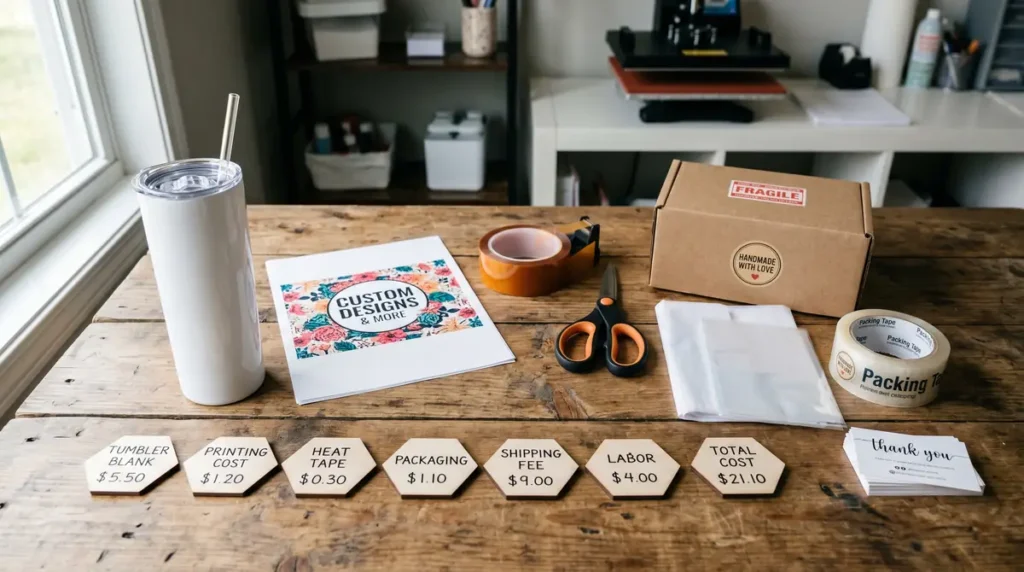
To price a sublimation tumbler accurately, start with the cost of producing one sellable tumbler, not just the advertised blank price. Include landed blank cost, ink, paper, consumables, active labor, packaging, failed-unit allowance, overhead, and selling fees before you set a target margin.
The core formula is simple:
Required selling price = true unit cost ÷ (1 − variable fee rate − target profit margin)
Use your own current costs and fee rates. A price copied from another seller can look profitable while losing money in your workflow.
How to Price a Sublimation Tumbler
Build the price from your own cost structure. Do not begin with a market average and work backward.
| Cost layer | What to include |
|---|---|
| Landed blank | Blank purchase cost, inbound freight, applicable order charges, and unusable units |
| Production materials | Ink, sublimation paper, heat tape, shrink sleeves, protective paper, and other consumables |
| Labor | Artwork, personalization, printing, wrapping, pressing, inspection, and packing |
| Failure allowance | Expected cost of reprints or damaged units based on your own records |
| Packaging and shipping | Boxes, inserts, protection, labels, and any outbound shipping you absorb |
| Selling costs | Current percentage-based and fixed fees that apply to the sale |
| Profit | Your chosen target margin after the other costs are covered |
If you are still organizing the wider business, the sublimation business guide covers equipment, products, pricing, and growth decisions.
Free Sublimation Tumbler True-Cost Worksheet
The True-Cost Worksheet is designed to turn your own supplier and production numbers into a repeatable price. It does not contain preset market prices, platform fee rates, or a recommended profit margin.
| Worksheet input | Why it matters |
|---|---|
| Blank order subtotal | Starting supplier cost |
| Supplier freight and order charges | Converts advertised cost into landed cost |
| Units ordered and unusable units | Calculates cost per usable blank |
| Ink, paper, and consumables | Captures production materials |
| Active labor minutes and hourly rate | Values hands-on work |
| Personalization minutes | Separates custom work from standard production |
| Failure rate | Accounts for expected reprints |
| Packaging and absorbed shipping | Includes costs after pressing |
| Variable and fixed selling fees | Prevents platform fees from being mistaken for profit |
| Target margin | Calculates the selling price required for your goal |
The workbook also includes separate tabs for a bulk quote, supplier landed cost, failure tracking, and usage instructions. Recording real jobs over time is more useful than relying on a generic tumbler price list.
Excel workbook with Tumbler Pricing, Bulk Quote, Supplier Cost, Failure Tracker, and How to Use tabs.
Start With the Landed Cost of the Tumbler Blank
The supplier’s unit price is not always your true blank cost. Inbound freight, order-level charges, and damaged or unusable units can change the amount invested in each sellable blank.
Landed blank cost = total blank order cost ÷ usable blanks
For a dedicated landed-cost calculation, use the sublimation blank cost calculator.
When comparing tumbler suppliers, calculate the usable landed cost from each quote. A lower advertised unit price can lose its advantage once freight or unusable inventory is included.
Calculate Ink, Paper, and Production Consumables
Use your own numbers instead of a universal ink or paper allowance. Print coverage, printer, ink set, paper size, artwork, and production method all affect consumption.
- Sublimation ink
- Sublimation paper
- Heat tape
- Shrink sleeves when used
- Protective paper
- Cleaning and setup consumables
- Other job-specific supplies
If exact ink cost is difficult to measure, start with a documented estimate and update it as your purchasing and print records improve. The important part is using the same method consistently when comparing products or quotes.
Charge for Active Labor
Labor should reflect the time you actively spend producing the order. Machine cycle time and hands-on labor are not always the same thing.
| Labor step | Count it when |
|---|---|
| Artwork preparation | You resize, clean, arrange, or prepare the print file |
| Personalization | You change names, photos, dates, colors, or other customer details |
| Printing and setup | You load media, print, trim, tape, or prepare the blank |
| Pressing | You actively load, rotate, unload, or supervise a manual step |
| Quality control | You inspect seams, color, coating, lid, and finish |
| Packaging | You box, protect, label, and prepare the order for handoff |
Labor cost = active labor hours × hourly labor rate
For batch jobs, divide total active labor by the number of sellable units. This shows whether the batch actually saves enough time to justify a lower unit price.
Add a Failed-Tumbler Allowance
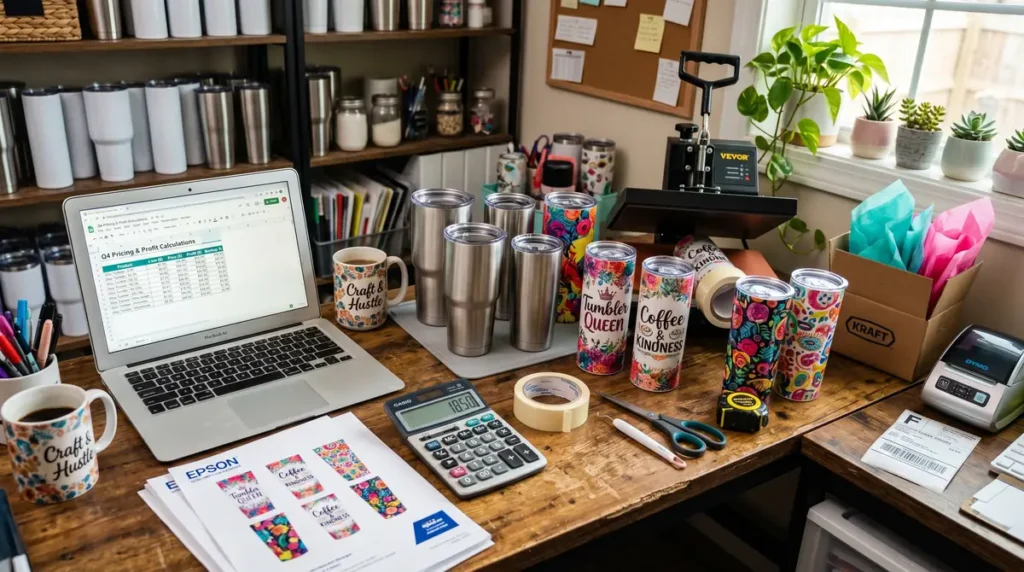
Do not add an arbitrary dollar buffer. Track attempted and failed units, then use your observed reprint rate when enough job history is available.
A practical calculation is:
Failure-adjusted production cost = production cost exposed to failure ÷ (1 − failure rate)
This treats failures as a production cost rather than pretending every blank becomes a sellable product. Packaging and selling fees normally belong after this step because they are usually incurred on the finished sale, not on every failed attempt.
Add Packaging, Selling Fees, and Shipping Correctly
These costs should be separated so you can see what changes between local, marketplace, wholesale, and shipped orders.
- Packaging: box, insert, padding, label, tape, and protective material
- Outbound shipping: include the amount you absorb rather than charge separately
- Variable selling fees: enter the current percentage that applies to order revenue
- Fixed selling fees: allocate any per-order fixed fee across the units in the order
- Advertising costs: include them when they are attributable to the sale and material to your pricing decision
Selling-platform fees can change and may vary by seller location, payment method, advertising participation, or other account conditions. Check the current platform documentation before quoting.
For product presentation costs, the sublimation packaging ideas guide can help you decide what actually belongs in the package.
Markup vs Profit Margin: Do Not Confuse Them
Markup is based on cost. Margin is based on selling price. A markup percentage and a profit-margin percentage are not interchangeable.
| Metric | Formula | Best use |
|---|---|---|
| Markup | (selling price − cost) ÷ cost | Shows how much was added to cost |
| Profit margin | (selling price − costs and applicable selling fees) ÷ selling price | Shows how much of revenue remains as profit |
When a percentage selling fee also applies to revenue, use:
Required selling price = true unit cost ÷ (1 − variable fee rate − target margin)
Use the sublimation profit margin calculator when you want to test how price, cost, and margin interact.
Retail vs Wholesale Tumbler Pricing
A wholesale or bulk order should receive a lower unit price only when the larger order creates real cost or labor savings.
| Bulk factor | Possible effect on unit cost |
|---|---|
| One artwork setup | Setup labor can be spread across more units |
| One customer approval | Less communication per unit |
| Repeated production | Wrapping, pressing, and inspection may become faster per unit |
| Consolidated packaging | Packaging cost may fall if individual gift packaging is not required |
| Supplier quantity break | Landed blank cost may decrease if the larger purchase genuinely costs less per usable unit |
Recalculate the order from the batch inputs. Do not apply an automatic discount percentage to the retail price.
When a Bulk Discount Actually Makes Sense
A lower unit price is easier to justify when the customer orders repeated units with the same artwork and a streamlined workflow.
- Same design on every tumbler
- One proof and approval
- One production batch
- Limited individual personalization
- Consolidated packaging or shipping
- Longer lead time instead of rush production
Individual names, different artwork on each unit, customer-by-customer proofing, rush deadlines, or gift-ready individual packaging can remove much of the expected bulk efficiency.
Personalized Tumblers Need Separate Labor
Personalization can be profitable, but only when the added work is visible in the quote. Track the extra minutes instead of hiding them inside a generic product price.
- Name or date changes
- Photo cleanup or cropping
- Artwork revisions
- Proof creation
- Customer messages and approvals
- Unique file exports for individual units
If a bulk order requires different names on every tumbler, the blank quantity may be bulk but the artwork labor may not be.
Calculate Profit per Tumbler and Profit per Batch
Unit profit tells you whether one sale works. Batch profit tells you whether the whole order is worth the time and capacity it consumes.
Profit per tumbler = selling price − true unit cost − variable selling fees
Batch profit = profit per tumbler × sellable quantity
Also compare the batch against the active labor hours and production capacity it requires. A large order can produce more total profit while earning less per hour if it creates heavy personalization or handling work.
20 oz vs 30 oz and Other Tumbler Sizes
Do not price every tumbler size from one template. Changing the blank can change several parts of the cost model.
- Blank purchase and freight cost
- Printable area
- Paper use
- Ink coverage
- Press or oven capacity
- Packaging dimensions
- Shipping weight or dimensional cost
Use the sublimation tumbler blanks guide when comparing blank types. For artwork dimensions, measure the actual blank and use the tumbler wrap size calculator rather than pricing paper use from the ounce label alone.
Common Sublimation Tumbler Pricing Mistakes
- Pricing from the blank only: freight, materials, labor, failures, packaging, and fees disappear from the calculation.
- Using advertised supplier cost: damaged units and inbound freight can change the usable unit cost.
- Not paying for labor: busy production can still be unprofitable when hands-on time is ignored.
- Confusing markup with margin: the same percentage produces different results.
- Copying competitor prices: their supplier costs, labor, fees, and profitability are unknown.
- Discounting every large order: quantity does not guarantee lower labor per unit.
- Using revenue as profit: revenue still has to cover product, labor, overhead, selling fees, and failures.
- Using an old fee schedule: update selling-platform inputs before quoting.
Tumbler Pricing Checklist Before You Quote
- Confirm the tumbler size, blank, and required quantity.
- Calculate the landed cost per usable blank.
- Add ink, paper, tape, sleeves, and other production materials.
- Estimate active labor and personalization time.
- Add an evidence-based failure allowance when you have production history.
- Add packaging and any outbound shipping you absorb.
- Enter current percentage and fixed selling fees.
- Choose the target profit margin for this product or order.
- Calculate break-even and required selling price.
- Review profit per unit and total batch profit before sending the quote.
Frequently Asked Questions
How do I price a sublimation tumbler?
Calculate the landed blank cost, production materials, active labor, overhead, expected reprints, packaging, shipping you absorb, and selling fees. Then calculate the selling price required for your chosen profit margin instead of copying a market-average price.
How do I calculate the true cost of a tumbler?
Start with the landed cost of a usable blank, then add production materials, labor, overhead, failure allowance, packaging, absorbed shipping, and fixed selling costs. Keep variable percentage selling fees separate because they depend on the final selling price.
Should I charge for my labor?
Yes. Track the active time spent preparing artwork, personalizing, printing, wrapping, pressing, inspecting, and packaging. For batch work, divide total active labor by the number of sellable units rather than guessing a flat labor amount.
How should I price personalized tumblers?
Add the extra time required for name changes, photo work, proofs, revisions, customer communication, and individual file preparation. A bulk order with unique personalization on every tumbler may not have the same labor savings as a repeated-design order.
How should I calculate bulk tumbler pricing?
Recalculate the batch from its actual costs. Spread one-time setup labor across the quantity, use the real production labor per unit, include job-specific overhead and failures, then calculate the revenue required for your margin. Do not apply an automatic bulk discount.
Is markup the same as profit margin?
No. Markup compares profit to cost, while margin compares profit to selling price. A tumbler can have a large markup and still deliver a lower margin than expected after labor, fees, and other costs are included.
Should shipping be included in the tumbler price?
Include any outbound shipping cost that you absorb. If shipping is charged separately, keep it separate in your quote but still account for any selling fees that apply to shipping revenue under your current platform rules.
How do failed tumblers affect pricing?
Failed attempts increase the expected production cost of each sellable tumbler. Track attempted and failed units, calculate your observed failure rate, and use that rate in the cost model instead of adding an arbitrary dollar amount.
Price From Your Costs, Not Someone Else’s Price List
A sustainable tumbler price starts with your supplier quote, your labor, your failure history, your packaging, and your selling costs. Once those numbers are visible, you can set a margin intentionally and see whether retail, personalized, or bulk work makes financial sense.
Use the True-Cost Worksheet for repeatable quotes, then update the inputs whenever supplier costs, production time, failure rates, or selling fees change.