How to Estimate Sublimation Ink Usage Before You Print

Estimating sublimation ink usage before printing helps you make better business decisions, reduce waste, and price products more accurately.
While no estimate will be perfectly precise, combining design dimensions, coverage percentage, and ink cost provides a reliable starting point.
For the best results, use an ink usage estimator alongside your real-world production data. Over time, your estimates become more accurate and your pricing becomes more profitable.
What Is Sublimation Ink Usage?
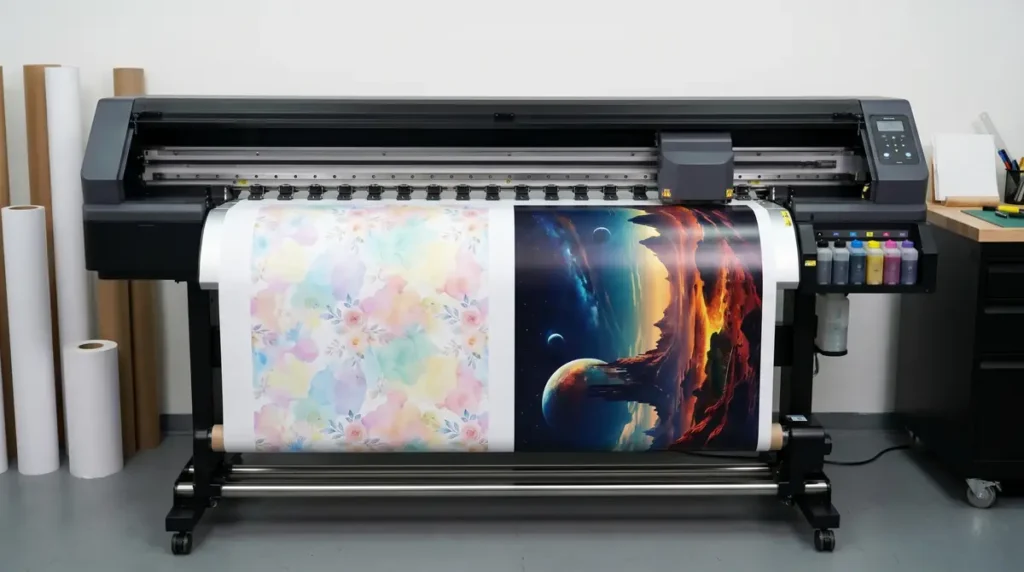
Sublimation ink usage refers to the amount of dye sublimation ink consumed when printing a design onto transfer paper.
The actual amount depends on several factors:
- Design size
- Color coverage
- Ink saturation
- Printer settings
- Print resolution
- Artwork complexity
A small black logo may use very little ink, while a full-color photo covering an entire tumbler wrap can use several times more.
This is why professional print shops track ink consumption rather than relying on guesswork.
If you’re new to sublimation, reviewing this beginner sublimation printing guide can help you understand how the entire printing process works.
What Affects Sublimation Ink Consumption?
1. Design Coverage
Coverage is the biggest factor affecting ink usage.
A design with large colored areas uses significantly more ink than one with white space.
For example:
| Design Type | Coverage |
|---|---|
| Small logo | 10–15% |
| Text design | 15–25% |
| Standard shirt graphic | 30–50% |
| Full-color photo | 60–100% |
The more color you place on the page, the more ink your printer must deposit. For related planning, see Best Sublimation Blank Suppliers in USA.
2. Image Size
Larger prints naturally require more ink.
A 3-inch logo printed on a mug uses far less ink than a full-front 12-inch shirt design.
Always consider both coverage and dimensions when estimating usage.
3. Color Saturation
Highly saturated artwork consumes more ink than muted designs.
Many beginners accidentally increase ink usage by oversaturating graphics during editing.
A common sublimation mistake is boosting colors too aggressively in design software.
4. Printer Settings
Print quality settings can influence ink consumption.
Higher-quality settings often increase:
- Ink density
- Color depth
- Ink laydown
Results vary depending on:
- Epson EcoTank setups
- Sawgrass printers
- ICC profile configurations
5. Paper Size
Printing on larger paper sizes can increase overall usage, especially when multiple designs are printed together.
Efficient layout planning often reduces wasted paper and unnecessary ink consumption.
A Quick Way to Estimate Ink Usage Before Printing
If you need a fast estimate, use this simple rule.
| Coverage Level | Estimated Coverage |
|---|---|
| Light | 10–25% |
| Medium | 25–50% |
| Heavy | 50–75% |
| Full Coverage | 75–100% |
Then estimate usage based on design area.
For most sublimation workflows:
- Light coverage = low ink consumption
- Medium coverage = moderate ink consumption
- Heavy coverage = high ink consumption
- Full coverage = maximum ink consumption
This method isn’t perfect, but it provides a useful starting point before printing.
How to Calculate Sublimation Ink Usage Manually
Step 1: Measure Your Design
Record:
- Width
- Height
Example:
12 inches × 12 inches
Print area:
144 square inches
Step 2: Estimate Coverage
Assume the design covers 50% of the available area.
Coverage area:
144 × 0.50
= 72 square inches
Step 3: Apply an Ink Usage Estimate
Most sublimation workflows use approximately:
0.015 ml of ink per square inch of colored coverage
Estimated ink usage:
72 × 0.015
= 1.08 ml
Step 4: Calculate Ink Cost
Suppose your ink costs:
$0.18 per ml
Ink cost:
1.08 × $0.18
= $0.19
Your estimated ink cost for the design is approximately 19 cents.
Sublimation Ink Usage Examples
Example 1: 11 oz Mug Wrap
Typical wrap size:
8.75 × 3.75 inches
Coverage:
40%
Estimated usage:
Approximately 0.20–0.40 ml
Example 2: Full Front T-Shirt
Design size:
12 × 14 inches
Coverage:
60%
Estimated usage:
1.2–1.8 ml
Example 3: 20 oz Tumbler Wrap
Wrap dimensions:
9.3 × 8.2 inches
Coverage:
70%
Estimated usage:
1.0–1.5 ml
Actual results vary based on printer settings and color density.
How Ink Usage Impacts Your Cost Per Print
Tracking ink consumption becomes increasingly important as your production volume grows.
Even small estimation errors can affect profitability over hundreds of orders.
For example:
- 50 mugs
- 100 shirts
- 200 tumblers
The difference between accurate and inaccurate estimates can easily add up to hundreds of dollars annually.
To build more accurate product pricing, use our sublimation cost estimator and sublimation pricing calculator.
Common Mistakes When Estimating Sublimation Ink Usage
Ignoring Color Saturation
Not all designs use ink equally.
A dark, vibrant image often consumes substantially more ink than a light-colored design.
Forgetting Test Prints
Many beginners overlook:
- Color correction tests
- ICC profile testing
- Print calibration
These additional prints consume ink and should be included in production planning.
For troubleshooting color-related issues, review this sublimation color management guide.
Using One Estimate for Every Product
Mugs, shirts, tumblers, and photo panels all require different calculations.
Avoid using a single average value for every project.
Ignoring Printer Maintenance
Head cleanings consume ink.
In many sublimation setups, maintenance can represent a significant portion of overall ink usage.
Learn more in this sublimation printer maintenance guide.
A Better Method: Use a Sublimation Ink Usage Estimator
Manual calculations work, but they become time-consuming when you’re estimating multiple products daily.
A dedicated calculator can help you:
- Estimate ink usage instantly
- Calculate cost per print
- Compare products
- Improve pricing accuracy
- Reduce waste
- Forecast ink purchases
Many small business owners use estimation tools before accepting large custom orders because it helps maintain healthy profit margins.
Sublimation Ink Usage Estimator
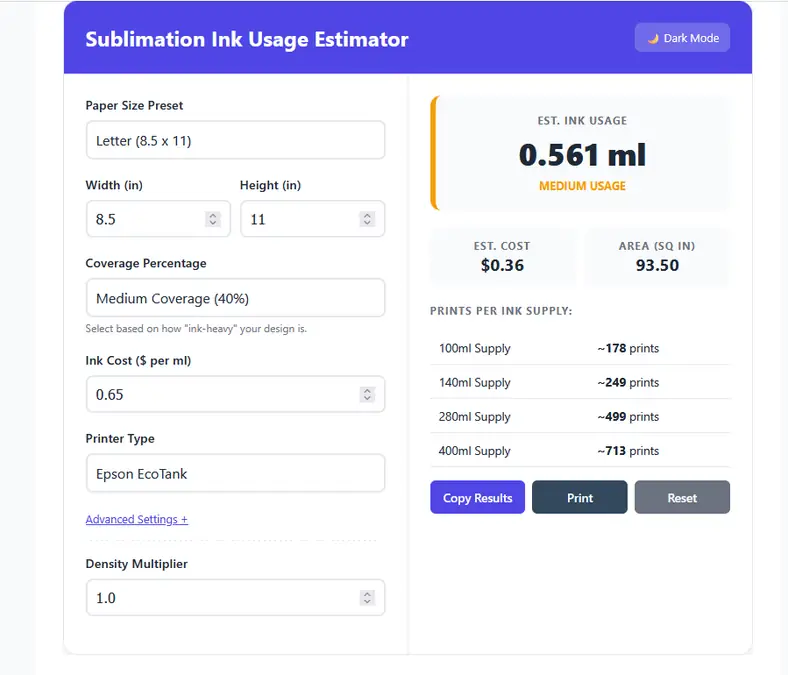
Use the calculator below to estimate:
- Ink consumption
- Ink cost per design
- Coverage area
- Cost per print
- Estimated number of prints from your available ink supply
Simply enter your design dimensions, coverage percentage, and ink cost to generate an estimate before printing.
Sublimation Ink Usage Estimator
Practical Workflow for More Accurate Estimates
If you want the most reliable results:
- Track actual ink purchases.
- Record approximate print counts.
- Measure average design coverage.
- Compare estimates against real production.
- Adjust calculator settings over time.
Many experienced sublimation businesses build their own historical averages rather than relying solely on generic estimates.
This approach produces much more accurate pricing and inventory planning.
Frequently Asked Questions
Can I know exactly how much sublimation ink a design will use?
Not exactly. Every printer, ICC profile, and design differs. Estimators provide a practical approximation rather than an exact measurement.
Does print quality affect ink consumption?
Yes. Higher quality settings often use more ink because the printer deposits more color.
What uses more ink: shirts or mugs?
Most full-front shirt designs use more ink than standard mug wraps because they cover a larger printable area.
Do printer cleanings use sublimation ink?
Yes. Head cleanings consume ink and should be considered when estimating overall operating costs.
Is sublimation ink expensive?
Compared to many other printing methods, sublimation ink is relatively affordable per print, but costs add up when production volume increases.