
Sublimation Wholesale Pricing Calculator

Wholesale pricing gets risky when the discount comes first and the math comes second. A large sublimation order can look profitable while setup time, failed blanks, payment fees, packaging, shipping, and active labor quietly erase the margin.
The calculator below builds each wholesale tier from your actual costs. Enter your materials, labor, spoilage allowance, fees, shipping, and target margin, then compare several order quantities before you send a quote.
Sublimation Wholesale Pricing Calculator
Use your own costs. The calculator adjusts material and active-labor costs for expected failed pieces, spreads fixed setup costs across each quantity tier, and solves for the unit price needed to reach your selected profit margin.
Per-piece costs
Labor, spoilage and order costs
Fees, shipping and target margin
Quantity tiers
| Tier | Quantity | Blank cost at this tier ($) | Note |
|---|---|---|---|
| Tier 1 | Editable starting tier | ||
| Tier 2 | Enter case-price savings if applicable | ||
| Tier 3 | Recalculate from real costs | ||
| Tier 4 | Do not force a discount |
| Quantity | True cost / item | Break-even / item | Recommended wholesale / item | Customer total | Batch profit | Margin | Profit / labor hr | Status |
|---|
Profit per labor hour is business profit after the labor cost entered above has already been treated as an expense. It is not the same as your hourly wage.
Calculator note: this is a planning tool, not tax, legal, or accounting advice. Use your own business costs and confirm tax, resale, and payment requirements for your location and sales channel.
How Wholesale Sublimation Pricing Should Work
A larger order should get a lower unit price only when the larger quantity creates a real saving. Setup time can be spread across more pieces. Blank pricing may improve at a case quantity. Packaging may get simpler. Repeating the same design can reduce handling time.
Costs that do not fall should not be discounted just because the customer ordered more pieces.
That is why this calculator works from the bottom up. It calculates the batch cost first, then solves for the selling price needed to reach your selected margin after percentage fees.
Do Not Start With a Random Bulk Discount
Taking 20% off a retail price feels easy, but it tells you nothing about the profit left after production. A large order can require more labor, more reprints, extra packing, rush work, or a supplier order with expensive inbound shipping.
Build the quantity tier from actual costs instead. If the calculated unit price drops, you have a defensible discount. If it does not drop, the order has not created enough savings to justify a lower price.
Bulk Order Is Not Always Wholesale
A customer buying 40 matching tumblers for an event is placing a bulk order. A retailer buying products to resell may be a wholesale customer. The production math can overlap, but the business terms may not.
Wholesale relationships can involve minimum order quantities, repeat-order expectations, reseller paperwork, different packaging, payment terms, and stricter product consistency. Keep those terms separate from the basic unit-price calculation.
What Costs Belong in a Wholesale Sublimation Quote?
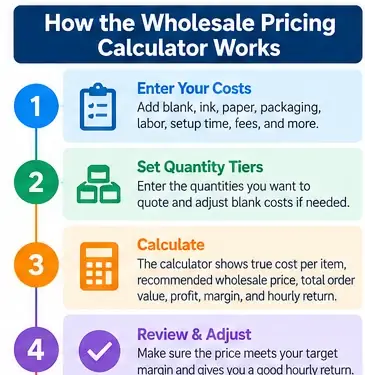
The safest wholesale quote starts with the cost of producing one sellable item, then adds the costs that belong to the whole order.
Landed Blank Cost
Do not use the supplier’s advertised unit price if freight, taxes, import charges, damaged pieces, or case-pack losses change what the blank really costs when it reaches your shelf.
The Sublimation Blank Cost Calculator is the better place to calculate that landed usable cost. Bring the result back here as the blank-cost input.
Ink, Paper and Consumables
Count the materials that are consumed on each attempt, not just the blank. Depending on the product, this may include sublimation ink, paper, heat tape, protective paper, shrink film, butcher paper, or other job-specific supplies.
Ink can vary substantially by artwork coverage. Use the Sublimation Ink Coverage Calculator when you want a more precise ink-cost input instead of guessing.
Labor and Setup Time
Separate fixed setup time from active production time.
- Setup time can include artwork cleanup, proofing, file preparation, machine setup, customer-specific paperwork, and staging.
- Active production time can include printing, trimming, taping, pressing, unloading, inspection, and packing work that scales with quantity.
That distinction matters because a 30-minute setup costs the same order-level amount whether you make 12 pieces or 100 pieces. The setup cost per unit falls as quantity rises. Active per-piece labor usually does not disappear.
Failed Blanks and Reprints
A failed piece consumes more than a blank. It may also consume ink, paper, consumables, equipment time, and labor.
The calculator handles this with a failure-rate input. Use your own observed rate. Do not copy someone else’s percentage because product type, operator experience, blank quality, and workflow all change the result.
Packaging, Fees, Shipping and Overhead
Packaging belongs in the per-item cost when each finished product needs its own box, bag, insert, label, or protective wrap. Order-level overhead can cover costs that apply once to the whole job.
The percentage-fee field is useful for card-processing or marketplace fees that scale with the amount collected. The fixed-fee field handles an order-level transaction charge. Enter shipping paid by the seller separately from shipping charged to the customer so the calculator does not treat them as the same thing.
Why Wholesale Unit Prices Can Fall as Quantity Rises
| Possible saving | What to verify before lowering the unit price |
|---|---|
| Lower blank cost | Supplier case price, inbound freight, MOQ, and usable-unit cost |
| Lower setup allocation | Same artwork, same product, and limited variation between units |
| Better batching | Actual hands-on time per unit really falls at the larger quantity |
| Simpler packaging | Bulk cartons replace individual retail packaging |
| Fewer transactions | One invoice or payment replaces many separate sales |
A quantity tier should reflect one or more of those savings. If none of them apply, a lower wholesale unit price may not make sense.
How to Build Profitable Quantity Tiers
1. Choose Quantities That Match Your Real Orders
The calculator starts with editable tiers of 12, 24, 50, and 100 only as convenient placeholders. Change them to quantities that fit your actual customers, supplier case packs, press capacity, and product type.
A mug business, a shirt shop, and a photo-panel supplier may need very different tier breaks.
2. Recalculate the Blank Cost at Each Tier
If the supplier price drops at a higher case quantity, enter that lower landed blank cost in the corresponding tier row. If the blank cost stays the same, leave the tier field empty and the calculator will use your base cost.
When sourcing in the US, the Best Sublimation Blank Suppliers in USA comparison can help you evaluate MOQ, shipping, and bulk-buying considerations before you assume a supplier discount is really cheaper.
3. Apply a Target Margin to the Full Batch Cost
The calculator solves backward from your target profit margin. Percentage payment fees are included in that calculation, so the recommended selling price is not based on cost alone.
If you want to test one selling price rather than build multiple wholesale tiers, use the Sublimation Profit Margin Calculator.
4. Check Batch Profit and Profit per Labor Hour
A lower unit price can still produce a strong job when the batch is efficient. The reverse can also happen. A high-margin order may occupy so much active labor that it blocks better work.
The calculator shows profit per labor hour after the labor rate you entered has already been treated as a production expense. This is useful for comparing two jobs that have similar margins but very different workload.
5. Set an MOQ From Your Own Economics
Your minimum order quantity should protect setup effort and production capacity. If very small orders require the same proofing, artwork preparation, customer communication, and machine setup as a larger batch, the unit price may need to rise sharply at the first tier.
Do not choose an MOQ only because another seller uses that number.
Wholesale Pricing vs Retail Pricing
Wholesale is not automatically half of retail.
Retail pricing often carries the cost of individual marketing, customer service, payment processing, packaging, fulfillment, and one-piece handling. A wholesale order can remove some of those costs, but it can create others, such as case packing, reseller requirements, longer production runs, or tighter deadlines.
Use the actual order structure to decide how far the unit price can fall. A retailer buying a simple repeat design may create meaningful efficiency. A 75-piece order with a different name on every item may not.
Margin vs Markup for Wholesale Sublimation Orders
Markup and margin are not the same calculation.
Markup compares profit with cost. Profit margin compares profit with selling revenue.
If a shop chooses a target margin, the required selling price has to be solved from revenue, not created by adding the same percentage to cost. The calculator uses target profit margin because it makes quantity tiers easier to compare on the same basis.
Production Capacity Can Change the Right Wholesale Price
Large orders expose bottlenecks that small orders hide. The press cycle is only one part of the job. Printing, trimming, taping, loading, unloading, cooling, inspection, sorting, personalization, and packing can take more time than expected.
Use the Sublimation Production Time Calculator before quoting a quantity that will push your normal schedule. It can help separate theoretical press capacity from the time the whole order will actually consume.
When a Larger Order Should Not Get a Lower Price
- The deadline requires overtime or rush production.
- Extra equipment must be rented or outsourced.
- Every item needs different personalization.
- Individual retail packaging is still required.
- The blank cost does not improve at the higher quantity.
- The customer requires extra proofs, sorting, labeling, or kitting.
- The order displaces more profitable work during a busy period.
- The failure risk rises because the workflow is being pushed beyond normal capacity.
How the Tier Calculation Changes as Quantity Grows
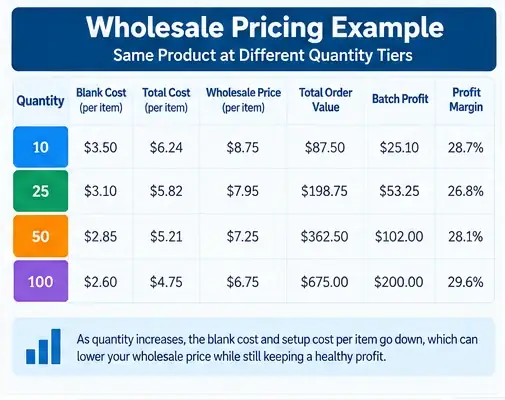
Suppose the product, artwork, and production method stay the same across several quantities. The fixed setup labor is spread across more units as the order grows. If the supplier also offers a lower landed blank cost at a larger case quantity, the true cost per sellable unit falls again.
The calculator reflects both changes separately. It does not assume the 50-piece tier deserves a certain discount just because it is larger than the 24-piece tier.
If the blank cost stays the same and the active labor per item stays the same, the unit-price reduction may be smaller than a customer expects. That result is useful. It tells you the economics of the order instead of forcing a discount that the production process did not earn.
Common Wholesale Pricing Mistakes
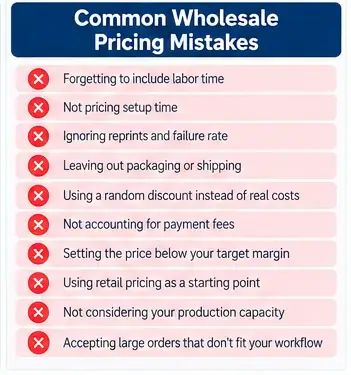
Discounting Before Calculating Costs
Starting with retail and subtracting a percentage hides the cost structure. Calculate the wholesale tier first, then compare it with retail.
Ignoring Owner Labor
Your time still has a cost when you own the business. Leaving owner labor at zero can make an order look profitable while paying nothing for the work required to produce it.
Forgetting Setup and Artwork Time
Proofs, mockups, artwork cleanup, customer changes, and order staging happen before the first product is pressed. Put that time in the order-level setup field.
Using Supplier List Price Instead of Landed Cost
A lower case price can lose its advantage after inbound freight or damaged units are included. Compare usable landed cost, not the catalog price alone.
Ignoring Reprints
A realistic failure allowance can protect the quote from normal production waste. Use your own records instead of guessing a universal percentage.
Confusing Margin With Markup
A markup percentage does not produce the same selling price as the same margin percentage. Decide which measure you use internally and stay consistent.
Ignoring the Deadline
A 100-piece order with a comfortable deadline is a different production job from the same 100 pieces needed tomorrow. Rush work, overtime, or outsourced steps should change the quote.
What to Put in a Wholesale Sublimation Quote
A calculator gives you the number. The written quote tells the customer what that number includes.
- Product and blank specification
- Quantity
- Unit price
- Total order price
- Artwork or personalization included
- Number of proofs or revisions included
- Packaging included
- Setup or artwork fee when applicable
- Shipping treatment
- Turnaround time
- Deposit or payment terms
- Quote expiration date
- Change-order or quantity-change terms
For a broader view of pricing, equipment, suppliers, workflow, and business planning, use the Sublimation Business Guide.
Frequently Asked Questions
How do I calculate wholesale prices for sublimation products?
Add the real production cost of the sellable item, including the blank, ink, paper, consumables, packaging, active labor, expected reprints, and any equipment allocation. Add order-level setup labor, overhead, shipping, and fixed fees. Then calculate the selling price needed to cover percentage fees and reach your target margin.
What is a good wholesale discount for sublimation?
There is no universal discount that works for every sublimation product. The discount should come from real savings created by the larger order, such as lower blank cost, lower setup cost per piece, simpler packaging, or faster batching. If those savings do not exist, forcing a large discount can make the order unprofitable.
What should my minimum order quantity be?
Set the MOQ where the order begins to cover your setup effort and produce an acceptable total profit and labor return. Supplier case quantities and production capacity can also affect the best minimum. The right MOQ is business-specific.
Should wholesale pricing be 50% of retail?
Not automatically. Retail and wholesale orders have different cost structures. Calculate the wholesale job from its own costs rather than assuming it must be a fixed percentage of your retail price.
How do I price a bulk sublimation order with personalization?
Increase the active labor input to account for name changes, number changes, artwork swaps, sorting, or individual packaging. If personalization also adds proofing or file-preparation work, add that time to the setup input.
Should shipping be included in wholesale pricing?
Either approach can work if the quote is clear. The calculator separates shipping paid by the seller from shipping charged to the customer so you can see whether freight is being absorbed, passed through, or partly subsidized.
How do I know if a large wholesale order is worth taking?
Check more than unit margin. Compare total batch profit, active labor hours, profit per labor hour, required turnaround time, cash needed for materials, and whether the order will block other profitable work.
Build the Quote From the Cost Up
A wholesale order earns a lower unit price when the larger quantity makes the job more efficient. Let the calculator show where that efficiency actually appears.
Start with landed blank cost, labor, consumables, failure allowance, and order-level expenses. Compare several quantities, then send the tier that protects both the customer relationship and the economics of the job.
For other production and pricing tools, visit the Sublimation Calculator Hub.