Sublimation Blank Cost Calculator | True Unit Cost

A blank advertised at $4 can cost considerably more by the time it reaches your shelf. Supplier shipping, taxes, import charges, and damaged pieces all change the amount you have invested in each usable item.
Use this calculator to convert a supplier order into two useful figures: the landed cost of the order and the effective cost of each usable blank. It works for shirts, mugs, tumblers, ornaments, coasters, keychains, photo panels, and other sublimation-ready products.
This is a sourcing calculator. It does not calculate ink, transfer paper, labor, selling fees, markup, or profit.
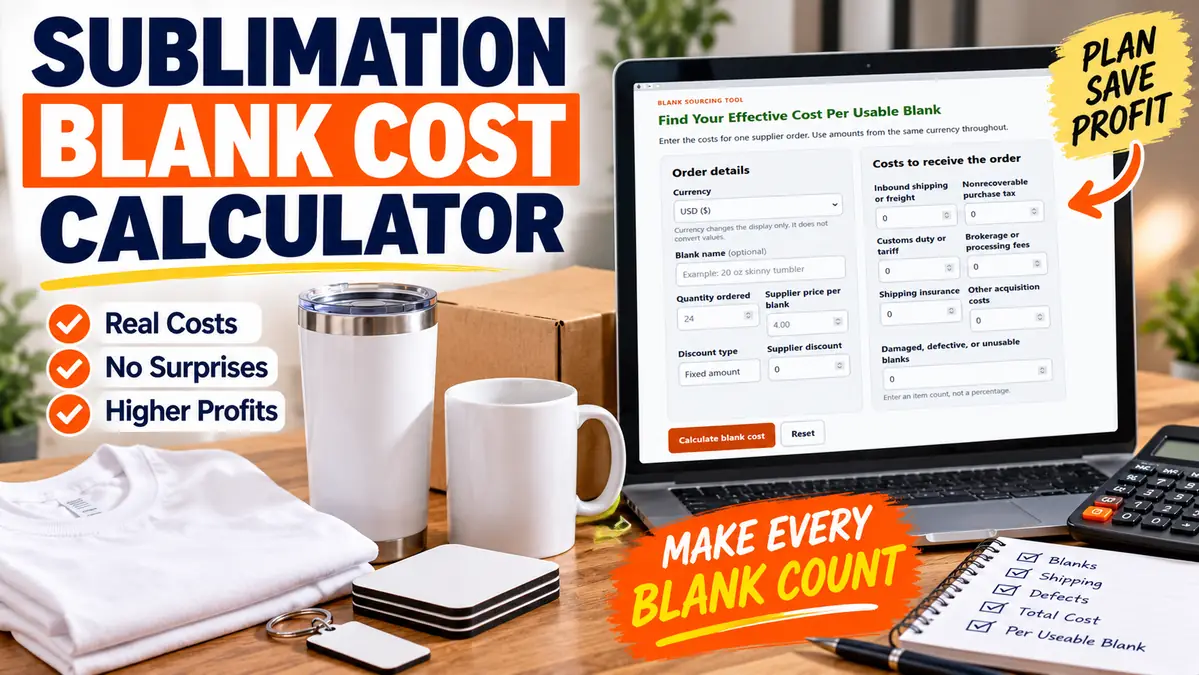
Sublimation Blank Cost Calculator
Blank sourcing tool
Find Your Effective Cost Per Usable Blank
Enter the costs for one supplier order. Use amounts from the same currency throughout.
Order details
Currency changes the display only. It does not convert values.Costs to receive the order
Primary result
Effective cost per usable blank
Enter your order details and calculate the result.
Estimate only: This tool does not provide accounting, tax, customs, or legal advice. Confirm charges using supplier, carrier, broker, and government records.
How the Blank Cost Calculator Works
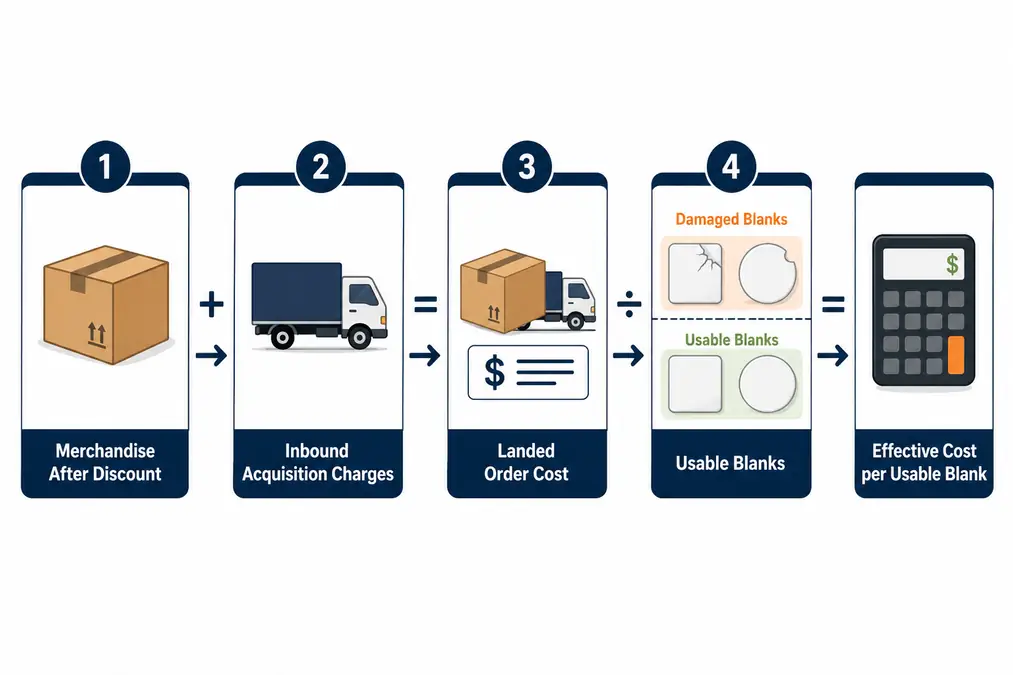
The calculator begins with the price of the blanks themselves. It then adds the costs required to receive that inventory and divides the result by the number of usable items.
Merchandise Subtotal
The merchandise subtotal uses this formula:
Quantity × supplier price per blank − supplier discount
Use the actual supplier price for the order. If the invoice includes a trade discount, case discount, or coupon, enter it as a fixed amount or percentage.
Total Landed Cost
The landed order cost uses this formula:
Merchandise subtotal + inbound shipping + tax + duty + brokerage + insurance + other acquisition costs
These charges belong to the purchase order because the inventory could not reach your business without them. The IRS includes freight-in on merchandise purchased for resale in cost of goods sold. Accounting systems also commonly allocate shipping, customs duties, insurance, and related charges to inventory as landed costs.
Usable Blank Quantity
The usable quantity is:
Quantity ordered − damaged, defective, or unusable blanks
A case of 24 mugs does not give you 24 sellable mugs when two arrive chipped. Those two pieces still consumed part of the merchandise and shipping budget.
Effective Cost Per Usable Blank
The primary result is:
Total landed order cost ÷ usable blank quantity
This is the figure to carry into a production-cost or pricing calculation. It is more useful than the advertised unit price because it reflects what happened to the complete order.
What Should Be Included in Blank Cost?
Only include costs connected to buying the blank and getting it into usable inventory. Production and selling expenses belong in later calculations.
Supplier Purchase Price
Use the amount actually paid for the merchandise. A supplier may advertise a standard price but apply case pricing, a coupon, a wholesale discount, or an order-level rebate.
Enter the price after any unit-level discount. Use the separate discount field when the reduction applies to the whole order.
Inbound Shipping and Freight
Inbound shipping moves blanks from the supplier to your business. This can include parcel shipping, pallet freight, local delivery, or the inland portion of an imported order.
Do not enter the postage used to send a finished product to a customer. That is an order-fulfillment or selling expense, not a blank acquisition cost.
Purchase Tax
Enter tax only when it becomes part of what the blank costs your business. If a tax is recoverable, credited, or avoided through a valid resale certificate, ask your accountant how it should be recorded rather than automatically adding it here.
The calculator accepts a fixed amount because the invoice total is more reliable than a universal percentage.
Customs Duty, Tariffs, and Processing Fees
Imported blanks can generate duty, tariffs, customs-processing charges, brokerage, and carrier disbursement fees. The amount depends on factors such as product classification, country of origin, destination, shipment value, and the rules in effect when the goods enter the country.
Enter the estimate supplied by the carrier or broker before ordering. Replace it with the invoiced amount after the shipment clears customs. The calculator does not determine tariff classifications or duty rates.
Shipping Insurance
Insurance can be part of the landed cost when it protects a specific inventory shipment. Enter the amount assigned to the blank order rather than a general annual business-insurance premium.
Other Acquisition Costs
Use this field for a cost required to receive the inventory that does not fit another field. Examples can include inspection charges, port handling, or a supplier’s mandatory order fee.
Do not use it as a catch-all for ordinary business overhead.
Damaged and Unusable Blanks
Count blanks that cannot become normal finished products. Depending on the item, this may include:
- Chipped or cracked mugs
- Dented tumblers
- Shirts with stains, holes, or incorrect sizes
- Blanks with damaged coatings
- Warped panels or ornaments
- Products that do not match the ordered specification
Subtract replacements or supplier credits when they are confirmed. Do not assume every damaged item will be refunded.
Worked Example: Advertised Price Versus Usable Cost
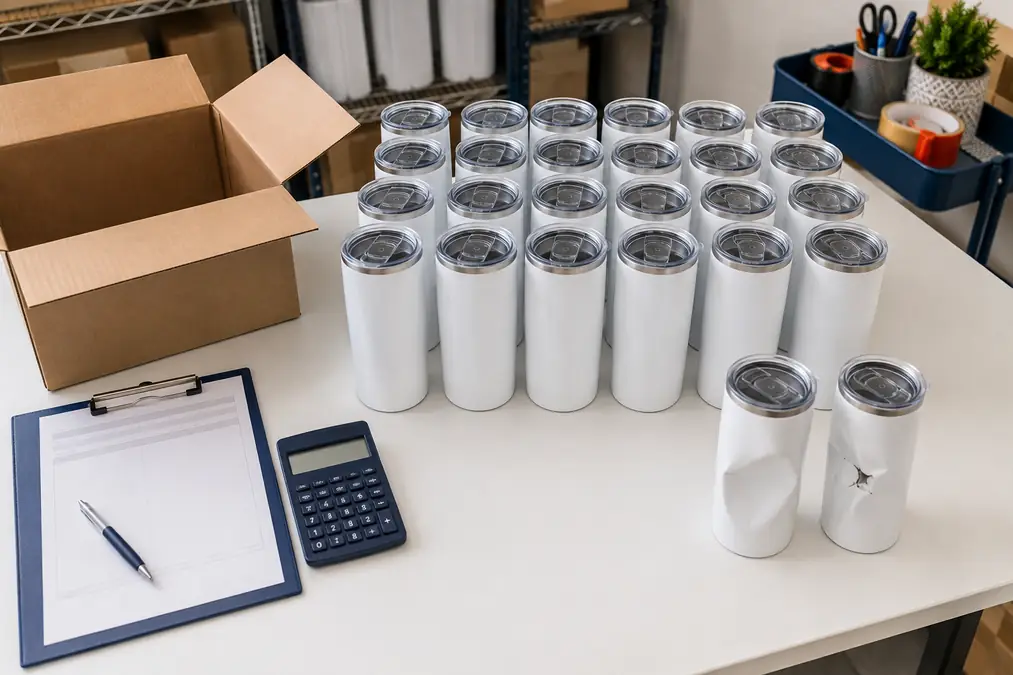
Consider a hypothetical order of 24 tumblers priced at $4 each.
- Merchandise before discount: 24 × $4 = $96
- Supplier discount: $6
- Merchandise subtotal: $90
- Inbound shipping: $18
- Other acquisition charges: $6
- Total landed order cost: $114
- Unusable tumblers: 2
- Usable tumblers: 22
Dividing $114 by all 24 ordered tumblers produces $4.75 per item. That figure is not the cost of a usable tumbler because only 22 can be sold.
The effective cost is:
$114 ÷ 22 = $5.18 per usable tumbler
The supplier price was $4, but the working cost for production planning is approximately $5.18. This example is illustrative. Use your own invoices, credits, and inspection results.
How to Compare Two Blank Suppliers
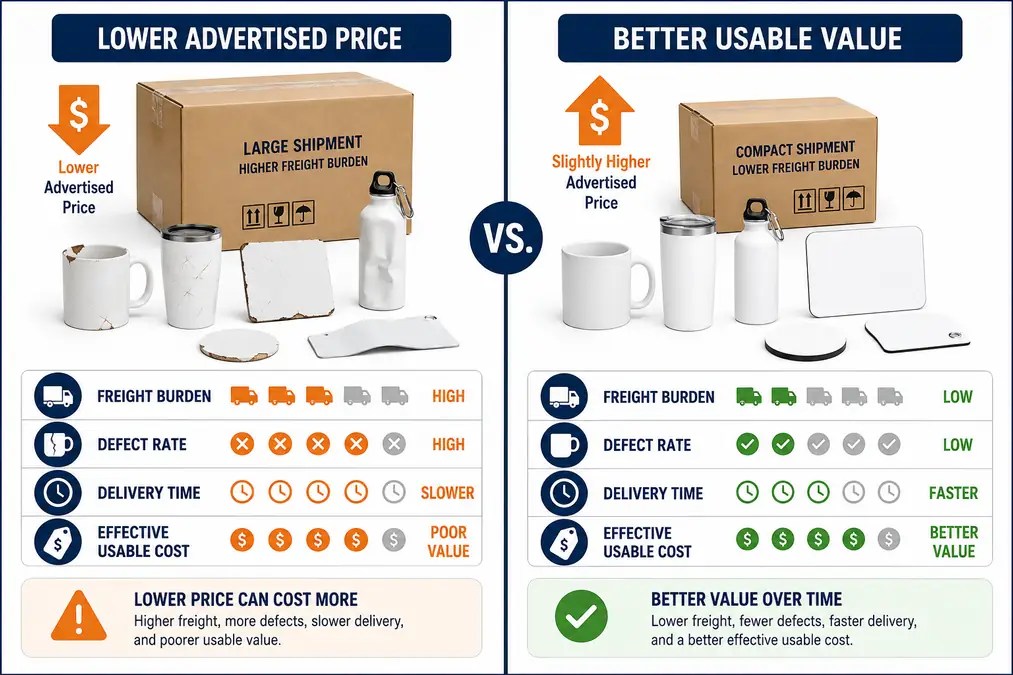
Run each quote through the calculator separately. Use the same product specification and the same treatment of taxes and fees so the results are comparable.
Compare more than the supplier’s unit price:
- Effective cost per usable blank
- Minimum order quantity
- Shipping and import charges
- Historical defect rate
- Replacement and refund policy
- Delivery time
- Coating and sizing consistency
- Packaging quality
A higher-priced supplier can be less expensive when the shipment has lower freight, fewer defects, or a reliable replacement policy. A cheap case is not a saving when several pieces cannot be sold.
If you are deciding which products deserve inventory space, review the best sublimation blanks for Etsy sellers after calculating the sourcing cost.
Costs This Calculator Does Not Include
This tool stops when the blank becomes usable inventory. It intentionally excludes:
- Sublimation ink
- Transfer paper
- Heat tape and protective sheets
- Design and production labor
- Electricity
- Equipment depreciation and maintenance
- Product packaging
- Customer delivery
- Marketplace and payment fees
- Selling price, markup, and profit
Keeping these categories separate avoids counting the same expense twice. Use the sublimation ink-usage guide to estimate ink independently.
After calculating the complete production cost, use the sublimation profit margin calculator or the guide to calculating sublimation profit margins.
Common Blank-Cost Mistakes
Dividing by Everything Ordered
Ordered quantity and usable quantity are not always identical. Inspect the delivery before finalizing the cost. Count damaged pieces and record supplier credits separately.
Ignoring Supplier Freight
Free-shipping thresholds, residential surcharges, liftgate fees, and international freight can change which supplier has the lower effective price. Compare landed costs rather than product subtotals.
Mixing Inbound and Customer Shipping
Inbound freight brings inventory to the business. Outbound shipping sends a finished order to the customer. Combining them makes it harder to compare suppliers and fulfillment methods accurately.
Guessing Import Charges
Duty and processing fees can change with the product, origin, destination, and current regulations. Use a written estimate from the carrier or customs broker, then update the calculation when the final invoice arrives.
Using the Advertised Price Instead of the Invoice
The advertised price may exclude discounts, fees, taxes, and freight. Save the completed calculation with the purchase invoice so the inputs can be checked later.
Treating the Result as a Selling Price
The effective blank cost is only one part of production cost. Selling at that figure would leave ink, paper, labor, packaging, overhead, and fees uncovered.
When to Recalculate Your Blank Cost
Update the calculation whenever the purchase conditions change. Recalculate when:
- The supplier changes its price
- You move to a different case quantity
- A discount begins or expires
- Freight rates change
- You order from a different country
- Duties or brokerage charges change
- Packaging quality affects the damage rate
- The supplier changes its replacement policy
- You replace sample orders with bulk purchasing
For frequently purchased blanks, keep the last several order calculations. A single damaged shipment should not automatically become the permanent expected cost, but a repeated pattern should influence supplier comparisons and pricing decisions.
Frequently Asked Questions
How Do I Calculate the Real Cost of a Sublimation Blank?
Add the merchandise subtotal, inbound shipping, nonrecoverable purchase tax, duties, brokerage, insurance, and other acquisition charges. Divide the total by the number of usable blanks received.
Should Shipping Be Included in Blank Cost?
Include shipping from the supplier to your business. Do not include the cost of shipping a finished product to a customer in this calculator.
How Do I Account for Broken or Defective Blanks?
Subtract unusable items from the ordered quantity before dividing the landed order cost. If the supplier issues a refund or credit, also subtract that confirmed amount from the applicable cost.
What Is the Difference Between Supplier Price and Landed Cost?
Supplier price covers the merchandise. Landed cost also includes expenses required to receive the inventory, such as freight, duty, brokerage, and insurance.
Should Ink and Transfer Paper Be Included?
No. This calculator isolates the blank’s acquisition cost. Calculate ink, paper, labor, and other production expenses separately.
Can I Use the Calculator for Different Types of Blanks?
Yes. The same method works for shirts, mugs, tumblers, coasters, ornaments, keychains, photo panels, and other purchased blanks. Use one consistent currency for each calculation.
Should I Include Sales Tax or Import Duty?
Include amounts your business actually bears as part of acquiring the inventory. Tax and customs treatment varies, so confirm uncertain charges with a qualified accountant, customs broker, carrier, or government source.
Can This Calculator Determine My Selling Price?
No. It calculates the effective blank cost. Add production materials, labor, packaging, overhead, and selling fees before choosing a price or measuring profit.
Use the Result in Your Pricing Workflow
Record the effective cost per usable blank with the supplier name, order date, invoice, and quantity. Next, add the ink, paper, labor, packaging, and other costs required to make the finished product.
Once the complete production cost is known, calculate the selling price and profit margin separately. This sequence keeps sourcing, production, and sales figures clear enough to update when one cost changes.