
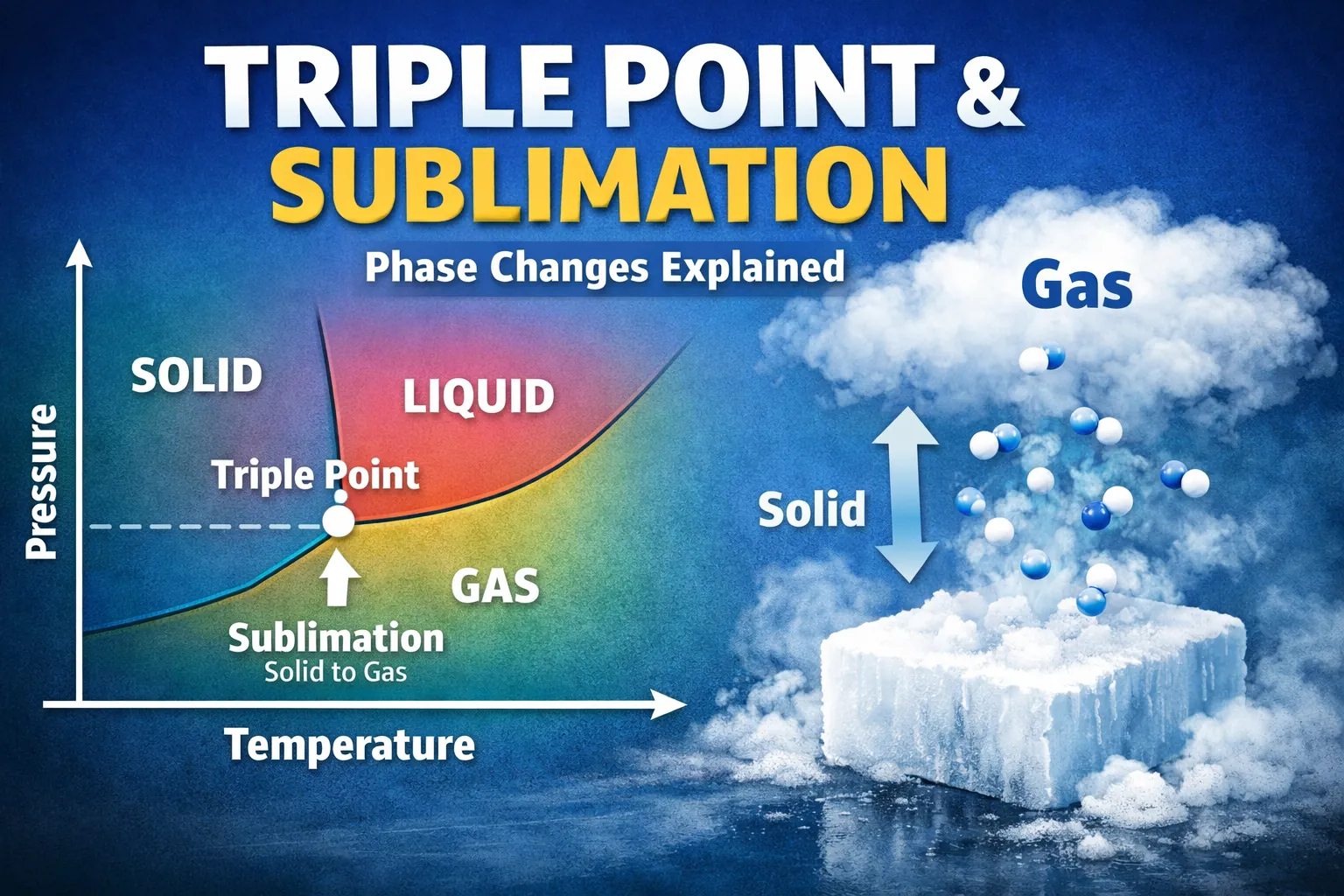
Triple Point and Sublimation: Why Pressure Determines Phase Change

The triple point is the exact temperature and pressure where solid, liquid, and gas coexist. Sublimation occurs only below the triple-point pressure because the liquid phase cannot exist under those conditions. As a result, solids like dry ice change directly into gas without melting. See which sentence describes an example of sublimation for a concise explanation of this change.
Have you ever wondered why dry ice turns directly into gas without leaving behind a puddle? The answer lies in the triple point, a unique combination of temperature and pressure that determines whether a substance exists as a solid, liquid, or gas.
Understanding this relationship explains why sublimation occurs under some conditions but not others.
If you’re new to the topic, our guide on the sublimation process explains how sublimation works before exploring the science behind phase diagrams and pressure.
Introduction to Phase Transitions
Matter exists in three main states: solid, liquid, and gas. A phase transition occurs when a substance changes from one state to another because of changes in temperature or pressure.
While temperature changes molecular energy, pressure determines which phase is stable.
The triple point is the unique temperature and pressure where all three phases exist in equilibrium, making it essential for understanding why sublimation occurs.
What Is the Triple Point?
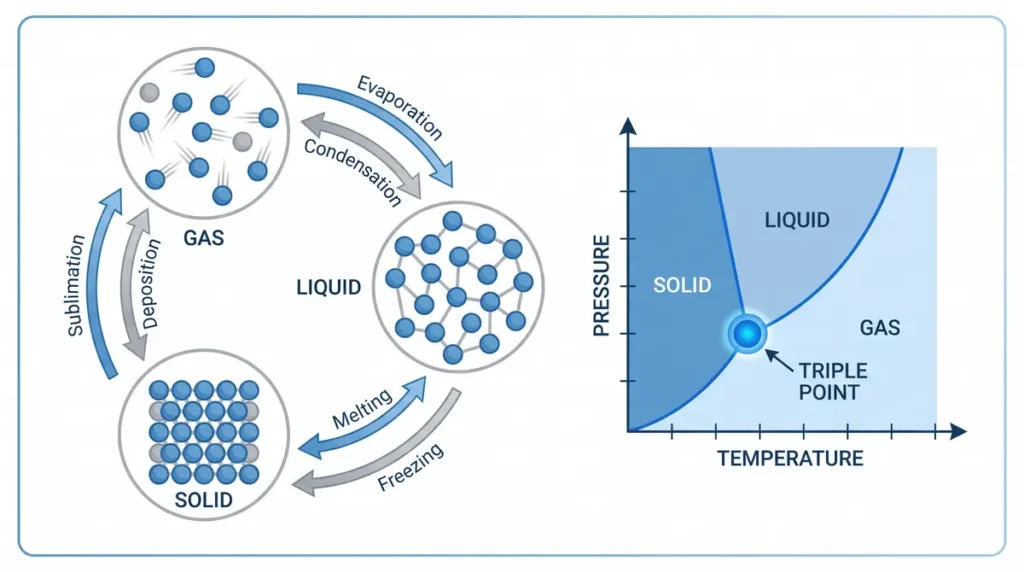
The triple point is the exact temperature and pressure at which a substance’s solid, liquid, and gas phases coexist in thermodynamic equilibrium.
At this point:
- The rates of melting and freezing are equal
- The rates of evaporation and condensation are equal
- The rates of sublimation and deposition are equal
Because these processes balance perfectly, the substance can exist in all three states at the same time without any net change.
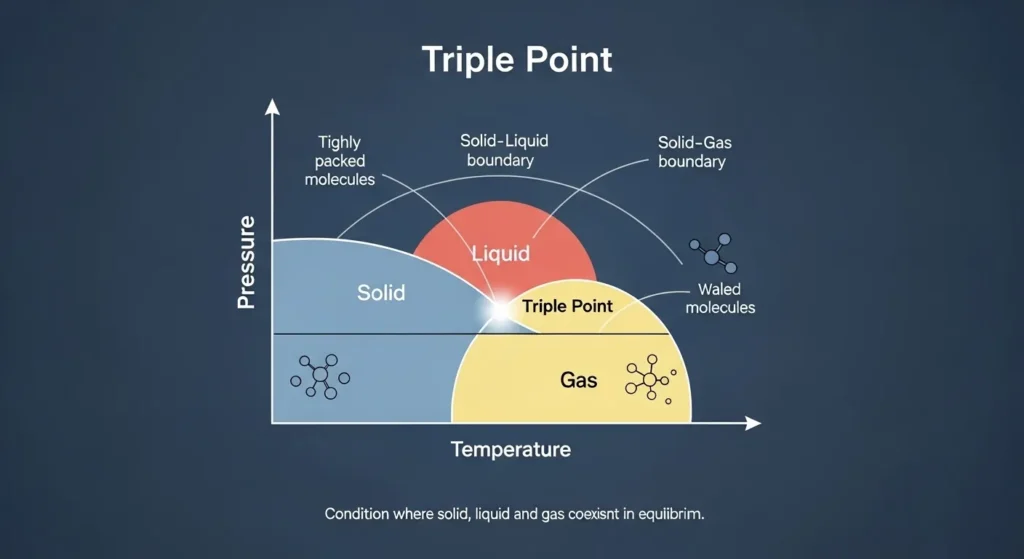
Each substance has a unique triple point determined by its molecular structure and intermolecular forces. For example, the triple point of water occurs at 0.01°C and 611.657 pascals. At this precise condition, ice, liquid water, and water vapor can coexist in equilibrium.
The triple point serves as a fundamental reference in thermodynamics because it defines the boundary conditions between phase transitions.
What Is Sublimation?
Sublimation is the direct transition of a substance from the solid phase to the gas phase without passing through the liquid phase.
This process occurs when molecules in a solid gain enough energy to escape directly into the vapor phase. Unlike melting, sublimation does not require the substance to become liquid first.
For sublimation to occur:
- The pressure must be below the substance’s triple-point pressure
- The temperature must be high enough to provide sufficient molecular energy
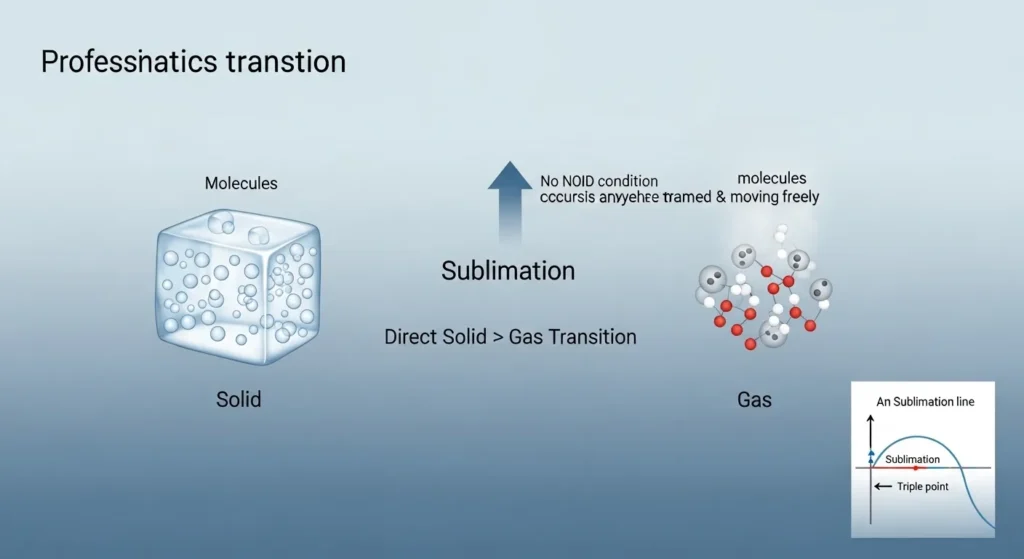
If the pressure is above the triple-point pressure, the substance must melt before it can become a gas. Therefore, sublimation is only possible under specific thermodynamic conditions.
Sublimation is a direct result of how temperature and pressure interact on a substance’s phase diagram.
If you want a deeper scientific breakdown of how this works, you can explore our full guide on the sublimation process,
How Pressure and the Triple Point Determine Sublimation
The triple point marks the minimum pressure at which a liquid phase can exist. Below this pressure, the liquid state becomes unstable and disappears from the phase diagram.
As a result, a solid cannot melt into a liquid and instead changes directly into a gas through sublimation.
Pressure plays a key role because it determines which phase is thermodynamically stable. At higher pressures, molecules are packed closely together, allowing liquids to form.
When pressure drops below the triple-point pressure, the liquid phase can no longer exist, leaving sublimation as the only pathway between the solid and gas phases.
This relationship explains why changing pressure can completely alter how a substance behaves, even if the temperature remains the same.
What Happens Above and Below the Triple Point?
| Condition | Result |
|---|---|
| Above the triple-point pressure | The solid melts into a liquid before becoming a gas. |
| At the triple point | Solid, liquid, and gas coexist in equilibrium. |
| Below the triple-point pressure | The liquid phase disappears, allowing the solid to sublimate directly into a gas. |
The phase diagram clearly illustrates this behavior by showing how the stable phase changes with both temperature and pressure. Understanding this relationship is essential for explaining why substances such as dry ice sublimate at normal atmospheric pressure while most solids melt before vaporizing.
Triple Point vs. Critical Point
Although both are important points on a phase diagram, they describe completely different conditions.
| Triple Point | Critical Point |
|---|---|
| Solid, liquid, and gas coexist in equilibrium. | Liquid and gas become indistinguishable. |
| Occurs at one exact temperature and pressure. | Occurs at the highest temperature and pressure where a liquid can exist. |
| Determines when sublimation is possible. | Marks the beginning of the supercritical fluid region. |
| All substances have one unique triple point. | All substances also have one unique critical point. |
The triple point helps explain sublimation, while the critical point is important for studying supercritical fluids used in industrial and scientific applications.
Common Misconceptions About Triple Point and Sublimation
Several misconceptions make this topic seem more complicated than it really is.
The triple point is not the temperature where sublimation always happens.
Sublimation can occur across a range of temperatures, provided the pressure stays below the triple-point pressure.
Every substance has the same triple point.
Each material has its own unique triple-point temperature and pressure based on its molecular structure.
All solids can easily sublimate.
Only certain substances readily undergo sublimation under everyday conditions. Dry ice and iodine are common examples, while most metals and minerals do not.
Sublimation and evaporation are the same process.
They are different phase changes. Sublimation occurs when a solid changes directly into a gas, while evaporation occurs when a liquid changes into a gas. If you would like to learn more about the energy involved, read Is Sublimation Endothermic or Exothermic?.
Phase Diagram Explanation (Simple Overview)
A phase diagram is a graphical representation of the states of matter under different temperature and pressure conditions.
The diagram contains three main regions:
- Solid region
- Liquid region
- Gas region
These regions are separated by phase boundary lines:
- Solid–liquid boundary (melting/freezing line)
- Liquid–gas boundary (evaporation/condensation line)
- Solid–gas boundary (sublimation/deposition line)
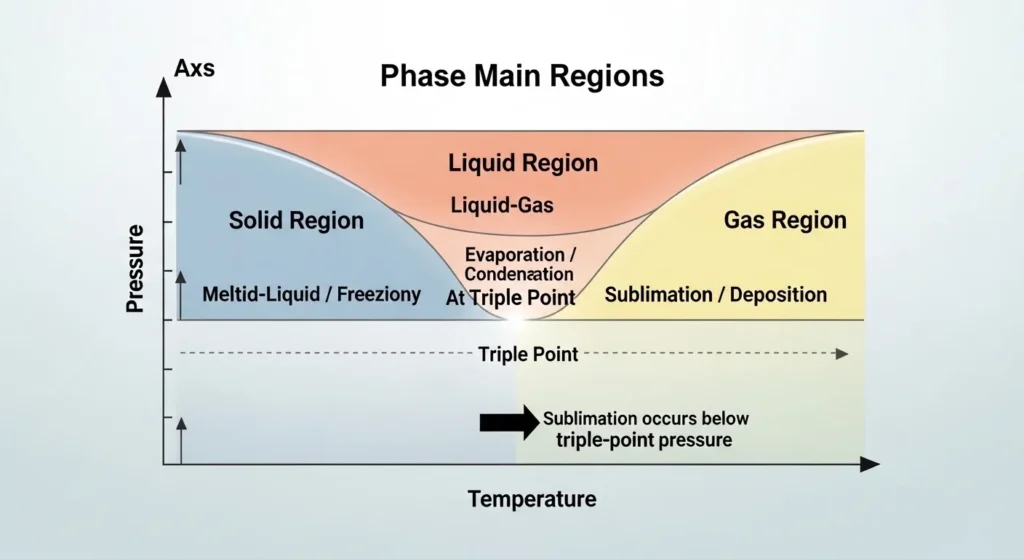
The triple point is the single point where all three boundary lines intersect.
Below the triple-point pressure, the liquid region disappears. This means that increasing temperature causes a solid to move directly into the gas region which is sublimation.
Thus, the phase diagram visually demonstrates how the triple point controls the conditions required for sublimation.
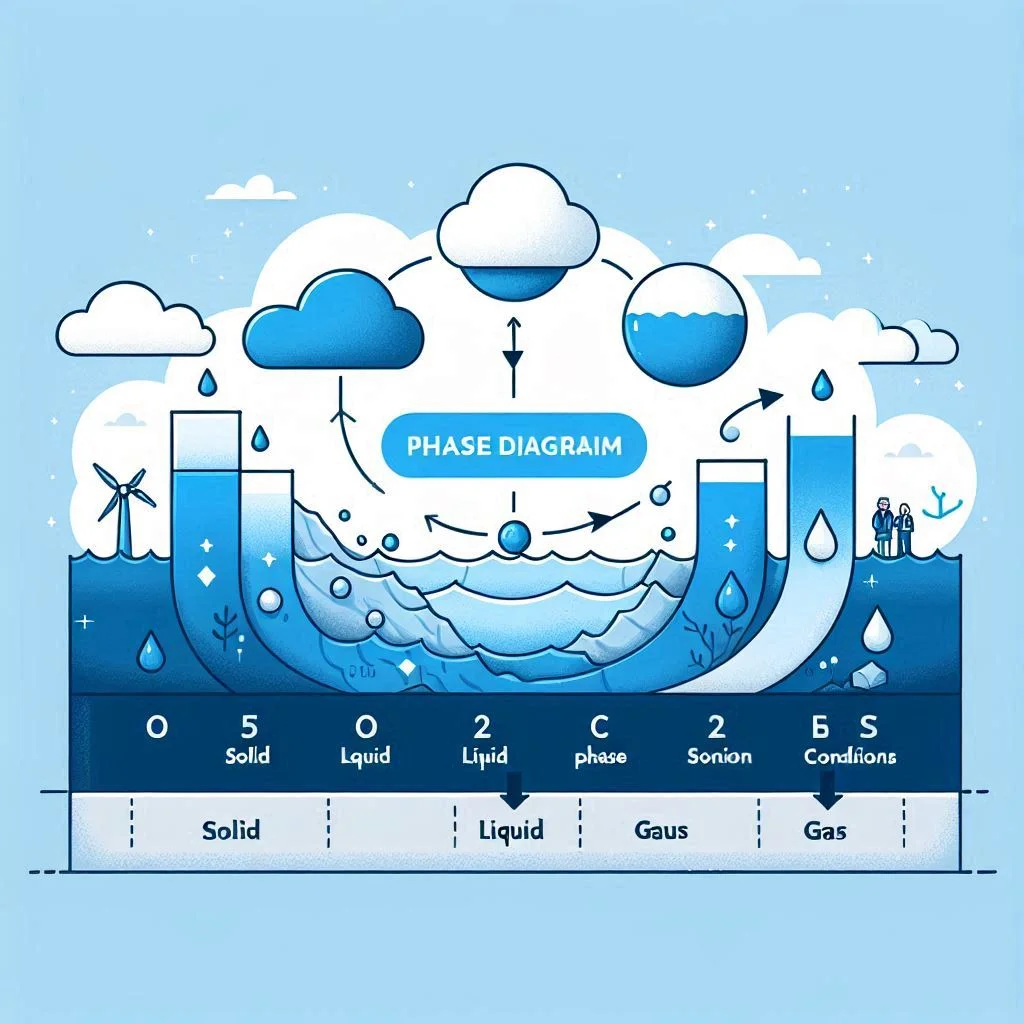
Real Scientific Examples (Water, CO₂, Iodine)
Water (H₂O)
The triple point of water occurs at 0.01°C and 611.657 pascals. Below this pressure, water cannot exist as a liquid. Ice exposed to sufficiently low pressure can sublimate directly into water vapor.
This principle is important in atmospheric science and high-altitude environments.
This principle is important in atmospheric science, freeze-drying technology, and high-altitude environments. You can also explore more real-world cases in our article on sublimation in nature, where we explain how these transitions happen outside the lab.
Carbon Dioxide (CO₂)
Carbon dioxide has a triple point at −56.6°C and 5.11 atmospheres.
At standard atmospheric pressure (1 atmosphere), carbon dioxide cannot exist as a liquid. Because this pressure is below its triple-point pressure, solid carbon dioxide (dry ice) sublimates directly into gas at −78.5°C.
This makes carbon dioxide one of the most commonly observed examples of sublimation.
Iodine (I₂)
Iodine sublimates at relatively low temperatures, producing a characteristic violet vapor.
Its triple point occurs at a pressure higher than typical atmospheric conditions. As a result, iodine can transition directly from solid to gas when gently heated under normal pressure.
This behavior is frequently demonstrated in laboratory experiments to illustrate sublimation clearly.
Frequently Asked Questions
What is the triple point in simple terms?
The triple point is the exact temperature and pressure where a substance’s solid, liquid, and gas phases exist together in thermodynamic equilibrium. Every substance has its own unique triple point based on its physical properties.
How does the triple point affect sublimation?
The triple point determines whether a liquid phase can exist. When pressure falls below the triple-point pressure, the liquid phase becomes unstable. As a result, a solid changes directly into a gas through sublimation instead of melting first.
Why does sublimation only occur below the triple-point pressure?
Below the triple-point pressure, the liquid state cannot exist. When a solid is heated under these conditions, it transitions directly into a gas because melting is no longer thermodynamically possible.
Does every substance have the same triple point?
No. Every substance has its own unique triple-point temperature and pressure. These values depend on the material’s molecular structure and intermolecular forces.
Can water undergo sublimation?
Yes. Ice can sublimate directly into water vapor when the surrounding pressure is below water’s triple-point pressure. This process occurs naturally in cold, dry climates and is widely used in freeze-drying.
Why does dry ice sublimate instead of melt?
Dry ice is solid carbon dioxide (CO₂). At normal atmospheric pressure, carbon dioxide cannot exist as a liquid because the pressure is below its triple-point pressure. Instead of melting, dry ice changes directly into carbon dioxide gas.
What is the difference between the triple point and the critical point?
The triple point is the only condition where solid, liquid, and gas coexist in equilibrium. The critical point is the temperature and pressure where the distinction between liquid and gas disappears, creating a supercritical fluid.
Is sublimation possible above the triple-point pressure?
Generally, no. Above the triple-point pressure, the liquid phase becomes stable. Under these conditions, a solid typically melts into a liquid before it vaporizes, rather than sublimating directly into a gas.
Why is the triple point important in science?
The triple point is an important thermodynamic reference used to study phase transitions, calibrate scientific instruments, interpret phase diagrams, and understand processes such as freeze-drying, atmospheric science, and material behavior under different pressures.
What are some real-world examples of sublimation below the triple point?
Some of the best-known examples include dry ice turning directly into carbon dioxide gas, ice sublimating during freeze-drying, snow slowly disappearing in cold and dry weather, and iodine crystals producing a violet vapor when gently heated.







One Comment