Sublimation Profit Margin Explained (Real Numbers for Beginners)

If you’ve started a sublimation business or you’re planning to you’ve probably asked yourself:
“Am I actually making profit… or just making sales?”
This is where most beginners get stuck.
You might be selling T-shirts, mugs, or tumblers, but without understanding your real costs, your profit margin can quietly disappear.
In this guide, you’ll learn:
- What sublimation profit margin really means
- Real cost and profit examples
- What a good margin looks like
- How to increase your profit without guessing
By the end, you’ll be able to price confidently and actually keep more money from every sale.
What Is a Sublimation Profit Margin? (Simple Explanation)
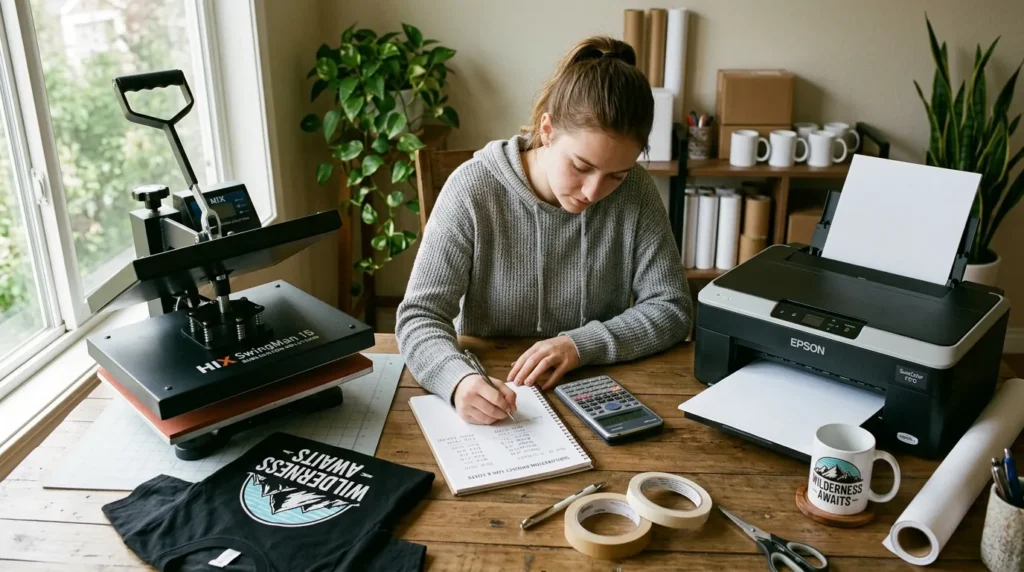
Profit margin is the percentage of money you keep after covering all costs.
Here’s the simple breakdown:
- Revenue = what you charge the customer
- Cost = what you spend to make the product
- Profit = Revenue – Cost
Formula:
- Profit = Selling Price – Total Cost
- Profit Margin = (Profit ÷ Selling Price) × 100
Why This Matters
You can sell a product for $25…
…but if it costs you $20 to make, your profit is only $5.
That’s just a 20% margin, which is very low for a sustainable business.
Understanding basic profit margin concepts can also be helpful. According to Investopedia’s guide on profit margin, it’s a key metric used to measure how efficiently a business turns revenue into profit.
Real Sublimation Cost Breakdown (What You Actually Spend)
Many beginners underestimate their real costs. Let’s break it down clearly.
Fixed Costs (One-Time Setup)
These don’t apply to each item directly but affect long-term profitability:
- Sublimation printer
- Heat press machine
- Initial ink and paper
- Workspace setup
These costs get spread over time, so your goal is to recover them through consistent sales.
Variable Costs (Per Product)
These are the most important for calculating profit margin.
Typical costs include:
- Blank product (shirt, mug, tumbler)
- Sublimation ink
- Transfer paper
- Packaging (boxes, bags, labels)
- Electricity (small but real cost)
👉 These costs determine whether your product is profitable or not.
Real Profit Margin Examples (Shirts, Mugs, Tumblers)
Let’s look at realistic beginner-level numbers.
Example 1 — Sublimation T-Shirt
Costs:
- Shirt blank: $4.50
- Ink + paper: $1.50
- Packaging: $1.00
Total Cost: $7.00
Selling Price: $20
Profit: $13
Profit Margin: 65%
Example 2 — Sublimation Mug
Costs:
- Mug blank: $2.50
- Ink + paper: $1.00
- Packaging: $1.50
Total Cost: $5.00
Selling Price: $15
Profit: $10
Profit Margin: 66%
Example 3 — Sublimation Tumbler
Costs:
- Tumbler blank: $8.00
- Ink + paper: $2.00
- Packaging: $2.00
Total Cost: $12.00
Selling Price: $25
Profit: $13
Profit Margin: 52%
What These Numbers Actually Mean
- Mugs and shirts often give higher margins
- Tumblers have higher costs but still strong profit
- Lower-cost items are easier for beginners to scale
👉 The goal is consistency not just high price.
To better understand how to set profitable prices, follow this guide on how to price sublimation products.
What Is a Good Profit Margin in Sublimation?
A good sublimation profit margin is typically between 40% and 60%.
Here’s a quick guide:
- 20–30% → Too low (risky)
- 40–60% → Healthy and sustainable
- 60%+ → Strong and scalable
Many beginners fall below 30% because they:
- copy competitor prices
- ignore real costs
- undervalue their work
Why Many Sublimation Businesses Lose Money
Even with good sales, profit can disappear quickly.
Underpricing Products
Trying to compete on price usually leads to low margins.
Ignoring Hidden Costs
Things like:
- failed prints
- wasted blanks
- test prints
These add up over time.
Poor Product Selection
Some products simply don’t offer strong margins.
Not Tracking Costs
Guessing instead of calculating is one of the biggest mistakes.
How to Increase Your Sublimation Profit Margin
Improving your margin doesn’t mean raising prices blindly it means working smarter.

Choose Higher-Margin Products
Focus on:
- personalized items
- bundles (e.g., mug + shirt sets)
- niche designs
Reduce Material Waste
You may notice that small mistakes can eat into profit.
Fix this by:
- dialing in your heat press settings
- testing designs before bulk production
Buy Supplies in Bulk
Lower your cost per item by buying:
- blanks
- sublimation ink
- transfer paper
Price Based on Value (Not Just Cost)
Custom designs and branding allow you to charge more.
Customers don’t just buy products they buy personalization.
If you want a faster way to calculate your expenses, try using a sublimation cost estimator to avoid underpricing.
Simple Profit Margin Formula You Can Use Daily
Use this simple process:
- Add all product costs
- Set your selling price
- Subtract cost from price
- Calculate your margin percentage
👉 Doing this for every product helps you stay profitable long-term.
Beginner Profit Strategy (What Actually Works)
If you’re just starting, keep it simple:
- Focus on 1–2 products
- Aim for consistent margins above 40%
- Avoid chasing too many product ideas
- Improve efficiency before scaling
This approach helps you build a stable foundation.
Expanding Beyond Basic Materials
One way to increase profit is by expanding what you can sell.
For example, instead of limiting yourself to polyester blanks, you can learn how to work with more surfaces using this guide on making any material sublimation ready.
This opens up:
- wood products
- metal items
- coated surfaces
👉 More product options = more profit opportunities.
Common Profit Mistakes to Avoid
- Pricing too low to compete
- Ignoring failed prints in cost
- Not adjusting prices over time
- Copying competitors without analysis
Avoiding these mistakes alone can significantly improve your margins.
Frequently Asked Questions
Can I make money with sublimation printing?
Yes, but only if you track your costs and maintain healthy profit margins.
What is a good profit margin for beginners?
A margin between 40% and 60% is a strong starting point.
Why are my sublimation profits so low?
Most likely due to underpricing, hidden costs, or poor product selection.
Do I need to calculate profit for every product?
Yes. Each product has different costs, so tracking them individually is important.
Is sublimation still profitable in 2026?
Yes, especially if you focus on niche products, personalization, and efficient production.
Final Thoughts
Sublimation profit isn’t about guessing it’s about understanding your numbers.
When you know your real costs and price correctly, your business becomes much easier to grow.
Start simple, track everything, and focus on consistent margins.
That’s how you turn sublimation into a reliable income not just a hobby.