How to Price Sublimation T-Shirts: Cost, Labor & Profit

A sublimation T-shirt quote needs to cover more than the blank shirt. Add the ink and transfer paper, hands-on labor, artwork or order setup, packaging, an allowance for failed pieces, overhead, and any fees charged when you collect payment. Then set a price that leaves the margin your shop needs.
There is no single correct price for every sublimation shirt. A one-off personalized shirt and 24 identical team shirts use different amounts of setup time and labor. Use the same pricing method for both, but enter the actual costs for each order. All dollar amounts in the examples below are hypothetical US-dollar inputs, not surveyed market prices, vendor quotes, or results from our own production tests.
How Much Should You Charge for a Sublimation T-Shirt?
Start with the cost to deliver one sellable shirt, then decide what margin you need and whether the customer will accept the resulting price. For a simple order with no percentage-based payment fees, use:
Selling price = cost per sellable shirt / (1 – target margin).
For example, a $12.00 all-in shirt cost and a 25% target margin produce a $16.00 price before any percentage-based selling fees: $12 / 0.75 = $16. The $4.00 left is 25% of the $16 selling price. This is a modeled order margin, not the business’s final after-tax net margin.
If the seller pays a fee that changes with the selling price, account for it in the denominator. The worked example later shows how. A marketplace fee, customer-paid shipping, rush delivery, or promotional discount can change what you keep even when the shirt itself costs exactly the same.
Before quoting, make sure the blank is suitable for direct sublimation. White or light-colored high-polyester shirts are the safer starting point for conventional sublimation; do not quote the same workflow for a dark cotton shirt. The best shirts for sublimation comparison explains that material decision.
Calculate Your True Cost per Shirt
A useful cost estimate separates per-shirt expenses from costs that belong to the whole order. A shared artwork setup should not be charged as though it happens again for every identical shirt.
| Cost category | How to calculate it | Commonly missed detail |
|---|---|---|
| Shirt blank | Actual SKU price plus inbound freight allocated to the order | Sizes and colors may have different costs |
| Ink and transfer paper | Measured or estimated cost for the design actually printed | A small chest logo and a full-front image use different coverage |
| Consumables | Tape, protective paper, printer-cleaning allowance, or other consumed materials | Do not count the same supply twice |
| Hands-on labor | Active minutes per shirt × hourly labor rate / 60 | Include inspection, wrapping, unloading, and packing time |
| Setup or artwork | One-time artwork and order-preparation cost / sellable shirts in the batch | Personalized names may require extra work per shirt |
| Packaging and overhead | Packaging per shirt plus a reasonable shop/equipment allocation | Equipment wear and workspace costs do not disappear in a home shop |
| Failed pieces | Expected cost of unusable blanks, transfers, and rework allocated to sellable output | Use actual reject records when available |
| Selling and delivery | Percentage and fixed payment fees, plus seller-paid shipping | Avoid mixing sales tax collected for remittance with business revenue |
Labor example: At a hypothetical $18 per active labor hour, 12 minutes of hands-on work costs $3.60 per shirt: $18 × 12 / 60. If the print takes longer, recalculate. Do not price unpaid owner labor at zero simply because no employee received a paycheck.
Failure allowance: If a job has 25 attempted shirts but only 24 pass inspection, the consumed materials and labor for all 25 attempts belong in the cost of the 24 sellable units. Track the cause of the failure instead of using one universal waste percentage.
Example: one personalized shirt
The following is an illustrative calculation for one shirt. It assumes seller-paid inbound shipping is already included in the blank estimate and excludes outbound shipping and sales tax.
| Cost input | Hypothetical amount |
|---|---|
| Compatible polyester blank | $4.50 |
| Ink and transfer paper | $0.90 |
| Tape and protective supplies | $0.20 |
| Active labor, 12 minutes at $18/hour | $3.60 |
| Packaging | $0.75 |
| Shop and equipment overhead allocation | $1.05 |
| Expected waste/reprint allowance | $0.50 |
| Order artwork and setup | $2.00 |
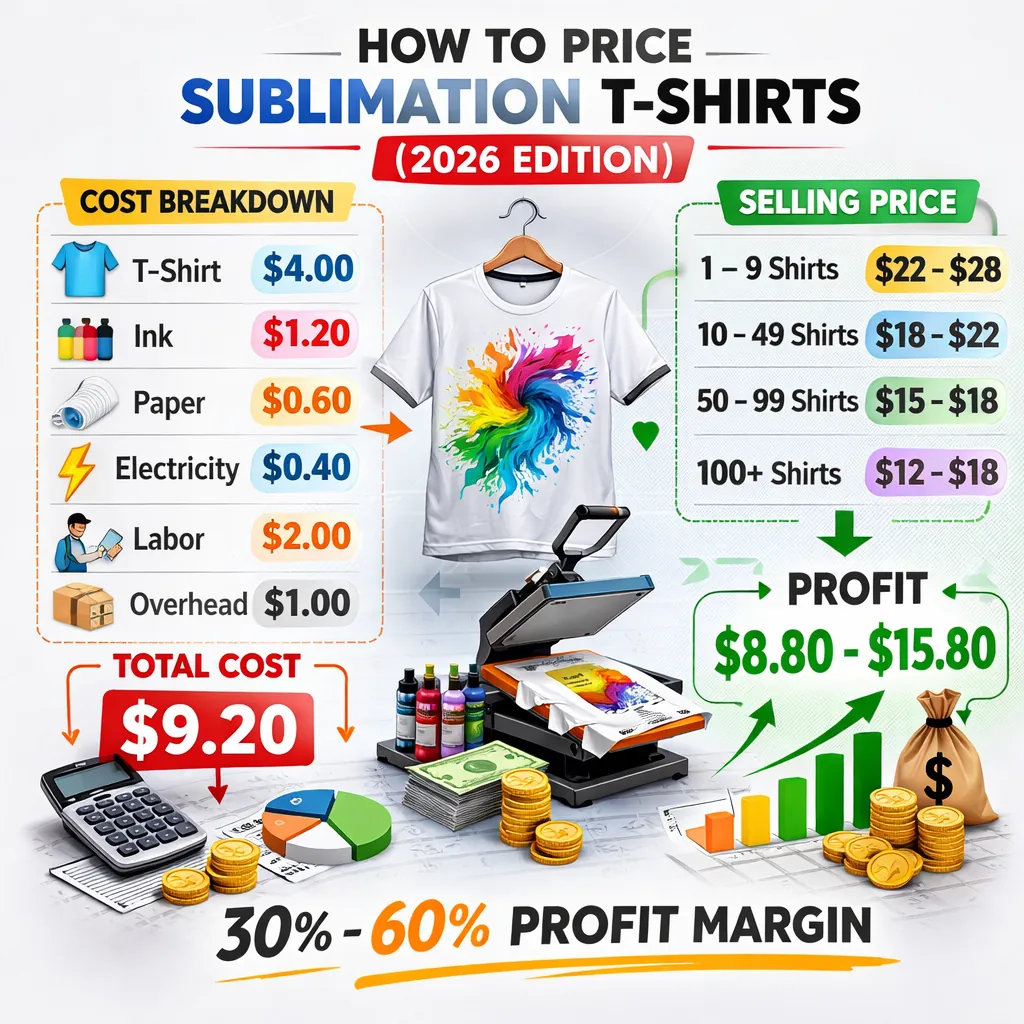
| Modeled cost before transaction fees | $13.50 |
The values are inputs selected to demonstrate the method. They are not a recommendation that your blank, labor rate, or waste allowance should match this example.
Markup vs Profit Margin: Use the Correct Formula
Markup measures profit against the cost; margin measures it against the selling price. Confusing them can cause a quote to miss its intended margin.
| Pricing method, using a $10 cost | Selling price | Profit before selling fees | Margin on price |
|---|---|---|---|
| Add a 25% markup | $12.50 | $2.50 | 20.0% |
| Target a 25% margin | $13.34, rounded up | $3.34 | About 25.0% |
To calculate a price when you also pay a percentage fee, define:
- C: Total cost per sellable shirt before percentage-based selling fees.
- F: Fixed selling fee allocated to one shirt. For a single payment covering several shirts, divide the fixed order fee by the number of shirts in that order.
- r: Percentage selling fee as a decimal, such as 0.08 in an illustrative 8% scenario.
- m: Your target contribution or modeled order margin as a decimal, such as 0.25 for 25%.
Required unit selling price = (C + F) / (1 – r – m).
This assumes the percentage fee applies to the shirt price being modeled and all other included costs have already been counted in C. The denominator must be greater than zero. If a selling platform also charges fees on shipping or collected sales tax, calculate those separately using that platform’s current rules.
For the $13.50 example, suppose a hypothetical transaction charges 8% of the shirt selling price plus $0.30 once for the order, and you want a 25% margin after the modeled costs and fees:
($13.50 + $0.30) / (1 – 0.08 – 0.25) = $20.60, rounded up.
At $20.60, the percentage fee is $1.65 after rounding and the fixed fee is $0.30. That leaves approximately $5.15 per shirt, or 25.0% of the selling price. The 8% is a teaching assumption, not a claim about Etsy, Stripe, PayPal, Square, or another provider.
For marketplace orders, review the official Etsy fees overview or your own selling platform’s documentation. Etsy’s transaction, processing, listing, advertising, and other charges can have different bases and should not be replaced by one guessed rate. Shopify’s markup and margin explanation also distinguishes the two calculations.
Price Shirts With Labor, Fees, Waste, and Overhead Included
Shirt cost is more than the blank. Ink, paper, labor, packaging, failed prints, selling fees, and overhead can change the amount you actually earn from each order.
The Subli Genius Pricing & Profit Toolkit combines those costs and shows true cost, profit, margin, target price, break-even price, and order-level profit before you quote the customer.
Retail vs Bulk Sublimation Shirt Pricing
Quantity alone does not justify a discount. A discount makes sense only if costs or the required margin change enough to support it. The main opportunities are shared design setup, repeatable layouts, shorter handling time per shirt, and one customer transaction instead of many separate orders.
Here is a hypothetical comparison using the same $4.50 blank and other base supplies as the one-shirt example. In the 24-shirt case, active labor is assumed to fall from 12 minutes to 7 minutes per shirt, and the $2 artwork/setup expense is spread across the 24 identical pieces. Packaging, overhead, ink, and waste allowance are deliberately left unchanged.
| Assumption | One custom shirt | 24 identical shirts, one order |
|---|---|---|
| Labor per shirt | 12 minutes = $3.60 | 7 minutes = $2.10 |
| Artwork/setup per shirt | $2.00 | $2 / 24 ≈ $0.08 |
| Other modeled per-shirt costs | $7.90 | $7.90 |
| Modeled unit cost before selling fees | $13.50 | About $10.08 |
| Fixed fee allocation | $0.30 | $0.30 / 24 = $0.0125 |
| Hypothetical variable fee and target margin | 8% fee, 25% margin | 8% fee, 25% margin |
| Illustrative minimum unit quote at that target | $20.60 | $15.07 |
The $7.90 ‘other’ total is blank, ink/paper, tape, packaging, overhead and waste combined. No bulk discount from a blank supplier was assumed. If a bulk order needs multiple shirt sizes, names, extra art revisions, or individual packaging, its labor and setup savings may be smaller.
Retail, personalized, and wholesale decisions
For a one-off retail shirt, allocate all order setup to that unit. For a personalized team order, spread the shared design setup across the batch but charge for names or numbers separately. For a wholesale order, quote the expected actual run size and confirm the minimum order, payment terms, proofing, shipping and reprint policy before agreeing to a lower price.
A rush job can require extra paid labor or opportunity cost. Include that as a quoted rush fee rather than assuming every shop should apply the same percentage surcharge. If the customer supplies shirts, establish a written replacement and misprint policy before accepting the blanks.
Small Chest Logo vs Full-Front Print Cost
Print area can change paper usage, ink usage and production time. It does not create an automatic industry-wide price multiplier. Record the exact print coverage and transfer-sheet count instead of assuming that all full-front art costs twice as much as a chest design.
| Quote question | Small chest design | Full-front design |
|---|---|---|
| Artwork | A small layout may need less design time | A large photo may need cropping, proofing and color review |
| Transfer | Check how many designs fit on one sheet | Larger artwork can use more printable area and paper |
| Pressing | Verify positioning and effective heat area | Check platen coverage and possible multi-step placement |
| Labor | Measure wrapping, alignment and inspection time | Measure actual handling, including extra positioning |
| Customer quote | Price from the recorded costs | Recalculate rather than reusing the small-logo price |
The site’s T-shirt sublimation calculator offers a quick estimate using a shirt blank cost, base ink/paper, labor, quantity, design-size assumptions and either a target margin or a chosen selling price. It does not separately collect packaging, overhead, waste, marketplace fees or seller-paid shipping. Add those costs to your wider quote before presenting the estimate as fully loaded profit. Its preset design-size multipliers are adjustable assumptions, not measured ink-coverage standards.
For a more detailed blank-cost input, use the sublimation blank cost calculator. For an independent check of the difference between profit and margin, use the sublimation profit margin calculator. Do not count the same overhead or selling fee twice when moving values between tools.
How to Build a Customer Quote
Use a repeatable quote process rather than changing the price based on how complicated the request sounds.
- Confirm the order. Record shirt style, sizes, colors, polyester content, quantity, design placement and the deadline. Quote separate sizes when the blank supplier charges different amounts.
- Record the transfer cost. Include the correct paper size, ink estimate, test transfer or proof, tape and consumables for the chosen design.
- Time the work. Separate one-time proof/setup from per-shirt handling, pressing, inspection and packing. Recalculate if the order requires personalization.
- Allow for failed units. Use your own past rejects or label the assumption clearly. If the customer supplies blanks, agree on who pays for replacements.
- Add order and selling costs. Include packaging, overhead, seller-paid delivery, fixed and percentage payment fees, and any relevant promotion or discount.
- Test the target margin. Apply the correct price formula, check the realistic customer budget, and decide whether to revise the product, quantity, service or margin.
- Put boundaries in writing. Specify quantity, artwork revisions, approved proof, turnaround, deposit, shipping, taxes and expiry date of the quote. Avoid vague unlimited-change promises.
Reusable quote check: Cost per sellable piece; total job setup; per-unit active minutes; selling fees; customer-paid versus seller-paid shipping; price per shirt; total invoice; expected profit; proof and reprint terms. Record each input before sending the quote.
Common Sublimation Shirt Pricing Mistakes
- Using the blank price as the entire cost. A $4.50 shirt is not a $4.50 finished product after transfer supplies, labor and fulfillment.
- Treating a markup percentage as margin. A 25% markup yields a 20% margin before fees, not 25%.
- Offering blanket quantity discounts. If each shirt has different artwork, production time may not fall with quantity.
- Assuming all sales channels charge the same fees. A local cash order, card payment and marketplace sale have different costs. Verify each channel’s current schedule.
- Claiming one average retail price is right for every shop. Blank quality, location, customer expectations and customization vary. Compare like-for-like competing offers, then check your own numbers.
- Quoting before checking garment compatibility. Dark cotton garments need a different decoration method from conventional direct sublimation on light polyester.
- Mixing tax and shipping into margin without checking the fee base. Separate pass-through sales taxes from revenue and document who pays shipping.
Frequently Asked Questions
How much does one sublimation T-shirt cost to make?
There is no verified universal average. Record the actual blank, transfer, labor, setup, packaging, overhead and expected waste for the specific shirt. The $13.50 worked example here is hypothetical, not a typical seller cost.
What profit margin should I charge for sublimation shirts?
Choose a target based on your real expenses, selling channel, order volume and customer demand. A 25% margin is used in this article only to demonstrate the math; it is not an industry benchmark or guarantee of business profitability.
Do I charge extra for personalized names or artwork?
Charge for additional time if personalization, proofing, layout changes or individual packing takes more work. A one-time setup charge and a per-name charge are different costs, so list them separately when appropriate.
Is a 50% markup the same as a 50% profit margin?
No. A 50% markup on $10 of cost gives a $15 selling price and a 33.3% margin before fees. A 50% margin on the same $10 cost requires a $20 price before fees.
Should I discount a 24-shirt team order?
Only if the batch is more efficient or you deliberately accept a lower margin. Check whether the design is identical, whether shirt sizes cost more, whether every shirt needs personalization, and whether you are charging one payment or many.
Is sublimation cheaper than screen printing for T-shirts?
There is no universal winner. Compare the quote for the same garment, number of pieces, number of print locations and artwork. Screen printing has different setup costs, while sublimation depends on compatible light polyester and your equipment and labor workflow. A small, full-color sublimation run may fit one shop; a large, simple-color screen-print run may fit another.
A better T-shirt quote starts with an exact blank and a measured workflow, not a universal price list. Save the cost details for each order and compare your estimate with what the job actually cost after production.