Calendar Heat Press vs Flat Heat Press: Which Is Better for Bulk Orders?

Choosing between a calendar heat press and a flat heat press is one of the biggest equipment decisions a growing sublimation business will make. While both machines use heat and pressure to transfer designs, they are built for different production environments.
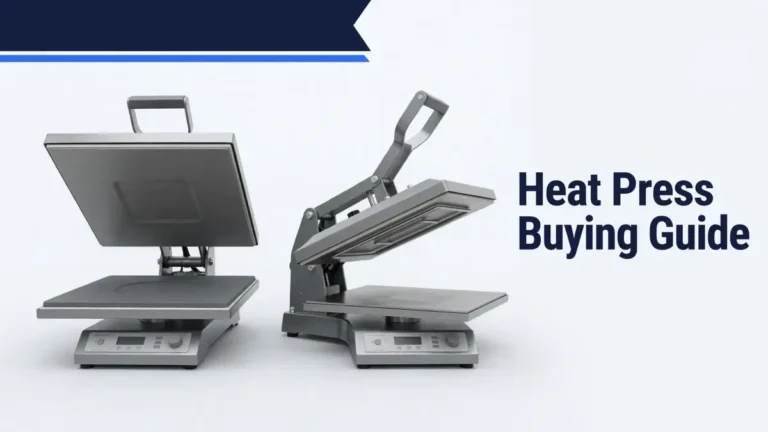
For a broader overview before choosing a press style, see our Heat Press Buying Guide for sublimation.
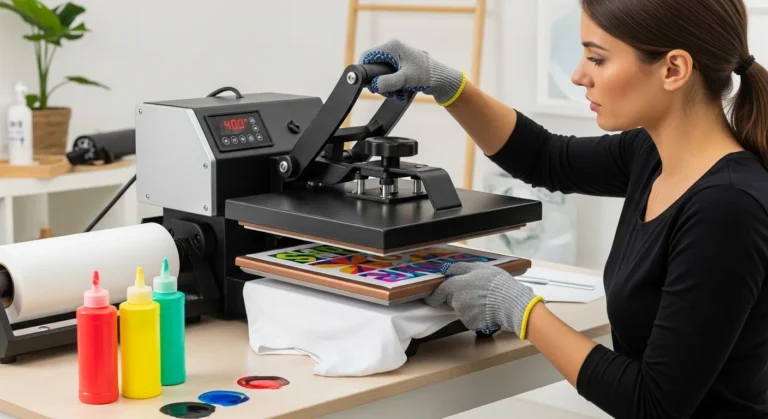
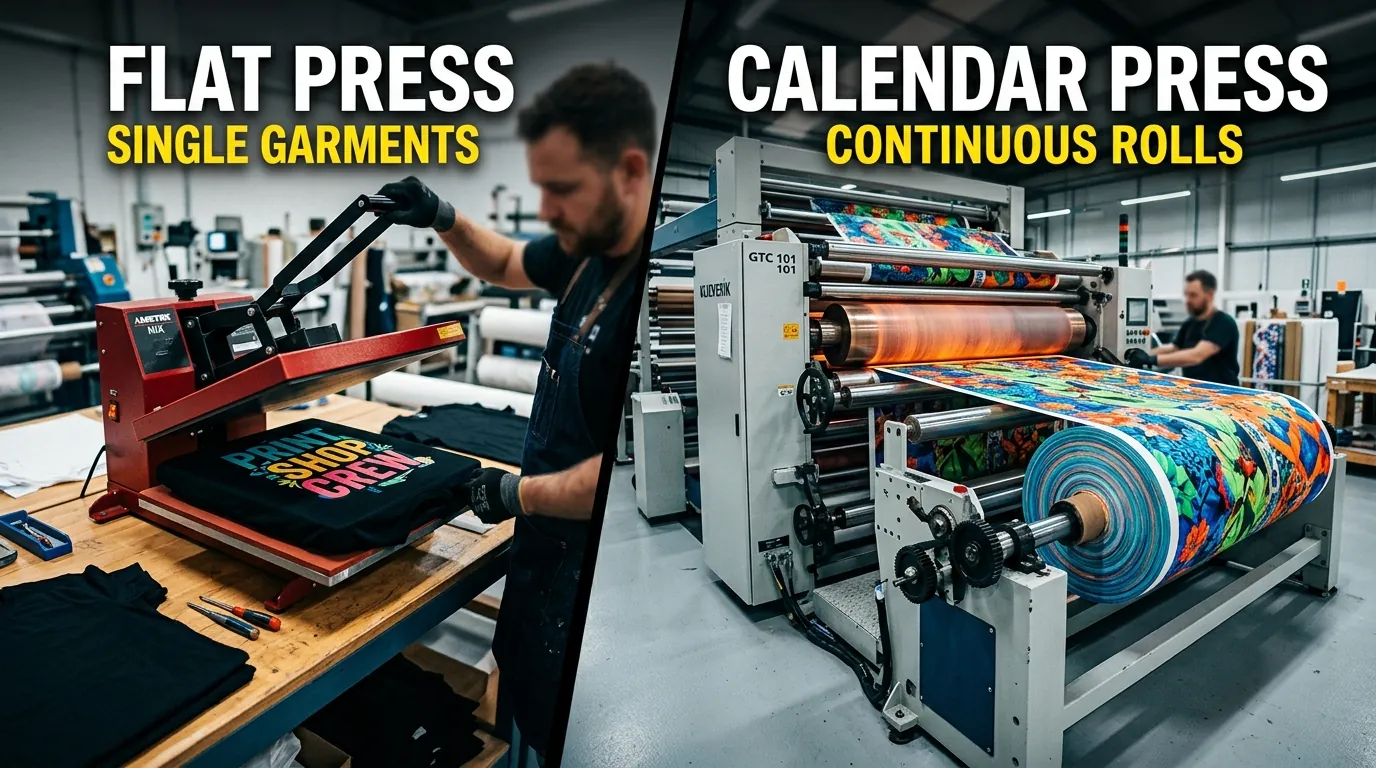
A flat heat press is ideal for pressing individual items such as T-shirts, mugs (with specialized attachments), mouse pads, and other finished products.
A calendar heat press, sometimes called a rotary heat press, is designed for continuous production of fabrics and large-format textiles.
Instead of pressing one item at a time, it feeds transfer paper and material through a heated drum for consistent, high-volume production.
If you’re still learning the fundamentals of sublimation, our Introduction to Sublimation Printing provides a helpful foundation before choosing commercial equipment.
Quick Answer
For most hobbyists and small businesses, a flat heat press offers the best balance of affordability, flexibility, and ease of use.
For commercial textile production, sportswear manufacturers, and businesses producing continuous fabric runs, a calendar heat press delivers greater efficiency, more consistent pressure, and significantly higher production capacity.
| Need | Best Choice |
|---|---|
| Beginner sublimation | Flat heat press |
| Small print shop | Flat heat press |
| Apparel decoration | Flat heat press |
| Large fabric production | Calendar heat press |
| Continuous roll-to-roll printing | Calendar heat press |
| Soft signage and textile manufacturing | Calendar heat press |
| Lower upfront investment | Flat heat press |
| High-volume commercial production | Calendar heat press |
Calendar Heat Press vs Flat Heat Press at a Glance
| Feature | Calendar Heat Press | Flat Heat Press |
|---|---|---|
| Heating system | Heated rotating drum | Heated flat platen |
| Production method | Continuous | Batch |
| Best for | Textile rolls and large fabrics | Individual products |
| Speed | Very high | Moderate |
| Pressure consistency | Excellent over long runs | Excellent on individual items |
| Typical users | Commercial manufacturers | Hobbyists, small businesses, print shops |
| Initial investment | Higher | Lower |
| Floor space | Larger | Smaller |
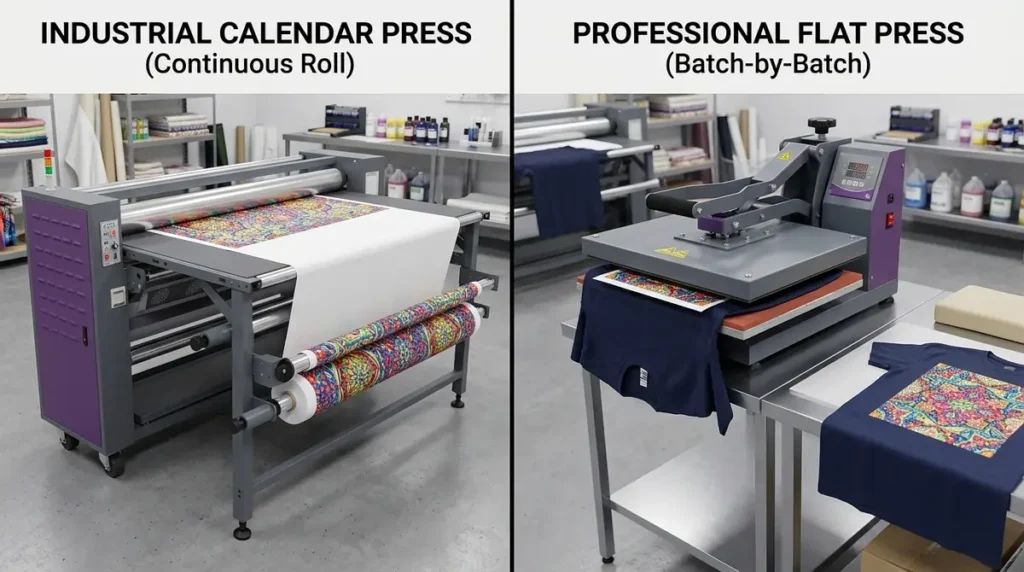
Although both machines perform heat transfers, the way they handle production is fundamentally different. Your daily workload usually determines which one provides the better return on investment.
What Is a Calendar Heat Press?
A calendar heat press uses a large heated drum combined with continuous pressure to transfer designs from sublimation paper onto fabric or other compatible materials. Both the transfer paper and substrate move together through the machine, creating an uninterrupted production process.
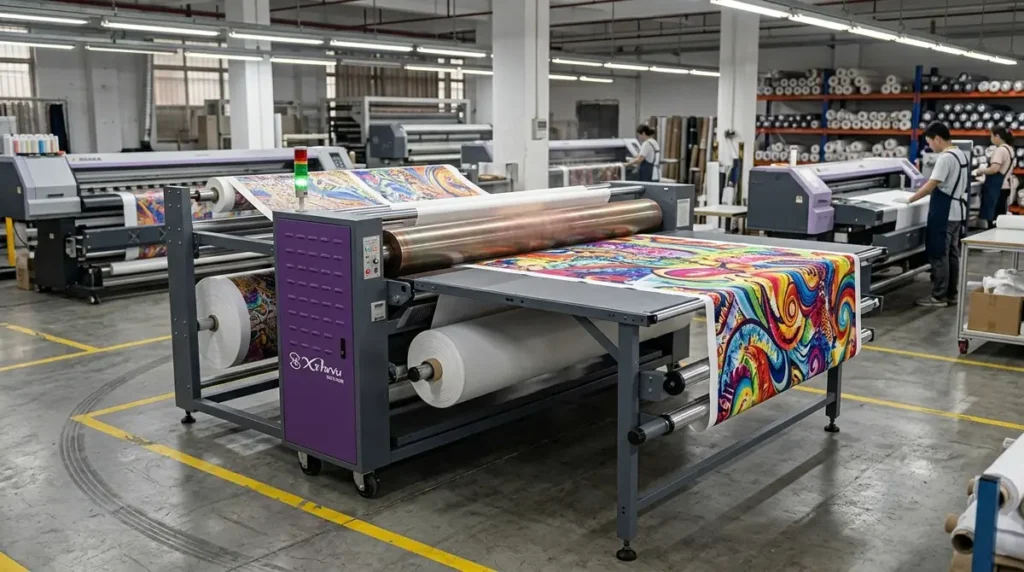
This design makes calendar presses especially valuable for businesses producing long fabric rolls where stopping after every transfer would dramatically reduce productivity.
How a Calendar Heat Press Works
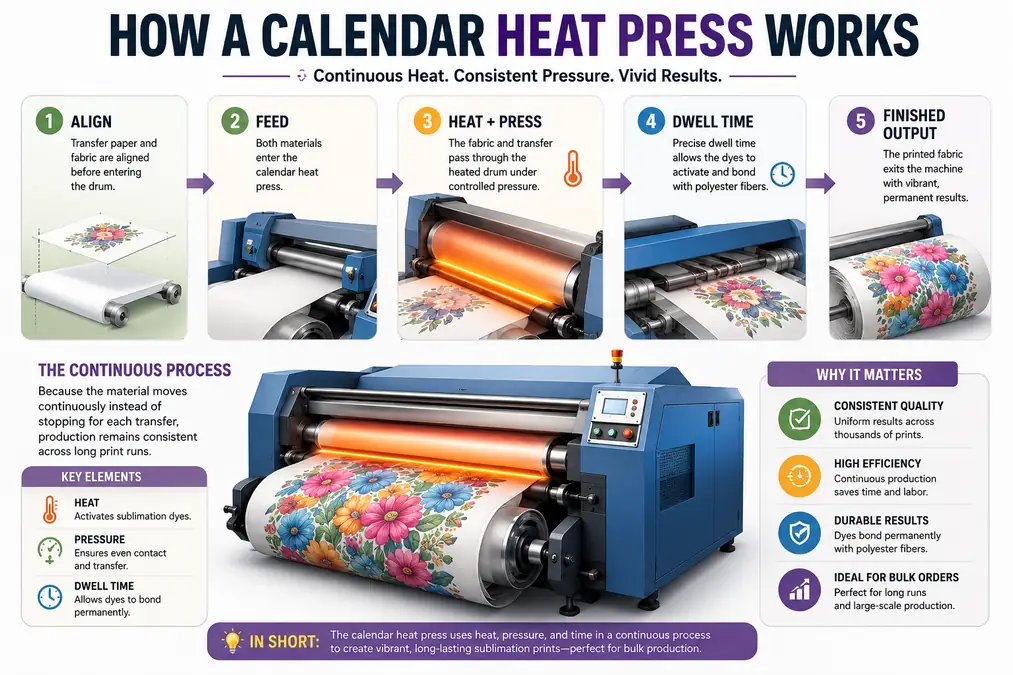
The transfer paper and fabric are carefully aligned before entering the heated drum. As both materials travel through the machine, controlled heat, pressure, and dwell time activate the sublimation dyes and permanently bond them with the polyester fibers.
Because the material moves continuously instead of stopping for each transfer, production remains consistent across long print runs.
Common Applications
Calendar presses are commonly used for:
- Sportswear manufacturing
- Dye-sublimated apparel
- Soft signage
- Trade show graphics
- Home décor textiles
- Flags and banners
- Fabric rolls for commercial sewing operations
Many commercial print facilities choose calendar presses because they can maintain consistent production throughout an entire workday without repeatedly loading and unloading individual items.
Advantages
A calendar heat press offers several strengths:
- Continuous production improves efficiency.
- Consistent drum pressure helps reduce transfer variation.
- Large-format textiles are easier to process.
- Better suited for production scaling.
- Excellent for roll-fed workflows.
Limitations
Despite their capabilities, calendar presses are not the right choice for every shop.
Common limitations include:
- Higher purchase price.
- Larger installation footprint.
- Greater power requirements.
- Longer learning curve.
- Less practical for pressing one-off promotional products.
For businesses primarily producing custom shirts, mugs, coasters, or gifts, much of a calendar press’s capacity may go unused.
What Is a Flat Heat Press?
A flat heat press uses two flat platens to apply heat and pressure directly onto a single item. The operator positions the substrate manually, closes the press for the required time, then removes the finished product before repeating the process.
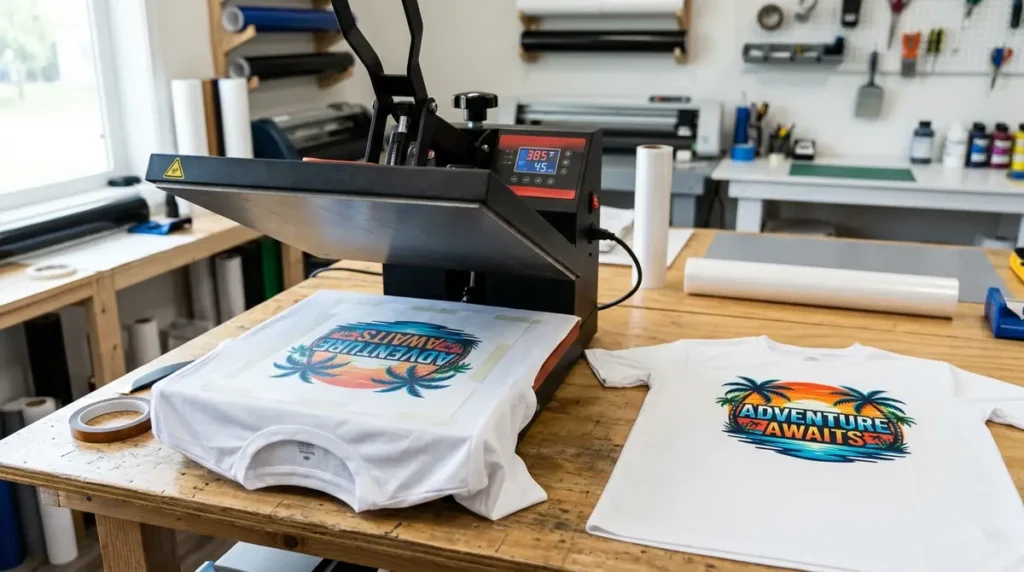
This straightforward workflow explains why flat presses remain the most common choice for small businesses entering sublimation.
How a Flat Heat Press Works
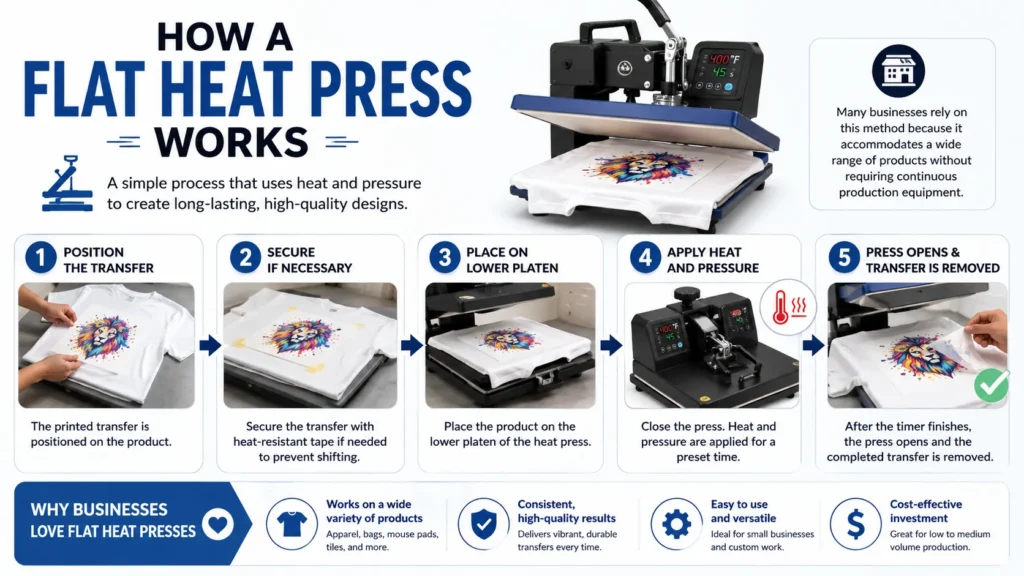
The printed transfer is positioned on the product, secured if necessary, and placed on the lower platen. Once the press closes, heat and pressure are applied for a preset duration. After the timer finishes, the press opens and the completed transfer is removed.
Many businesses rely on this method because it accommodates a wide range of products without requiring continuous production equipment.
Common Applications
Flat heat presses are widely used for:
- T-shirts
- Hoodies
- Tote bags
- Mouse pads
- Ceramic tiles
- MDF products
- Aluminum panels
- Promotional products
- Small textile runs
Correct temperature and pressure settings play a significant role in transfer quality. A dedicated Heat Press Sublimation Settings guide can help fine-tune results for different substrates.
Advantages
A flat heat press remains popular because it offers:
- Lower upfront cost.
- Compact footprint.
- Simple operation.
- Versatility across many blank products.
- Easy maintenance.
- Faster setup for small production batches.
Limitations
Flat presses also have practical constraints:
- Each transfer requires manual loading.
- Productivity decreases as order volume grows.
- Large fabric pieces become more difficult to handle.
- Production consistency depends more heavily on operator workflow.
- Scaling often requires multiple presses or additional operators.
Print Quality Comparison
Both machines are capable of producing excellent sublimation transfers when used correctly. The difference is not whether they can produce vibrant colors, but how consistently they maintain those results throughout production.
Pressure Consistency
A calendar heat press applies pressure through a rotating heated drum, creating uniform contact as the material moves through the machine. This continuous pressure is especially valuable for long fabric runs, where even small inconsistencies can become noticeable over several meters of printed material.
A flat heat press applies pressure across a stationary platen. High-quality presses distribute pressure evenly, but consistency depends on proper adjustment and correct product placement. As production volume increases, operator technique plays a larger role in maintaining repeatable results.
Color Consistency
Both machines can achieve vibrant sublimation colors when the artwork, printer, ink, paper, and color management settings are properly calibrated.
For larger commercial jobs, a calendar press often delivers more consistent color from the beginning to the end of a production run because heat exposure remains steady as the material passes through the heated drum.
Flat presses can produce equally impressive results on individual items, although variations in pressure, positioning, or pressing time may become more noticeable during large batches.
If color accuracy is a priority, it’s worth reviewing your printer profiles and transfer settings before adjusting your press. Our guide to Heat Press Temperature for Sublimation explains how temperature influences transfer quality.
Large-Format Transfers
This is where the differences become much more apparent.
Calendar presses are specifically designed for wide-format fabrics, banners, soft signage, and textile rolls. Since the material feeds continuously, there are no visible seams or overlapping press marks that can occur when using multiple presses on oversized pieces.
Flat presses, on the other hand, are limited by the size of the platen. Larger graphics often require repositioning, increasing the possibility of alignment errors or inconsistent heating.
Repeatability
Commercial production relies on repeatable results.
A calendar heat press excels at producing hundreds or thousands of nearly identical transfers with minimal variation once the machine has been configured correctly.
A flat press can also produce consistent work, but maintaining that consistency across large production runs requires disciplined workflows, experienced operators, and regular quality checks.
Production Speed Comparison
Production speed is often the deciding factor for businesses considering an upgrade.
If your shop regularly experiences equipment bottlenecks, replacing a flat press with a calendar press may dramatically increase daily output. On the other hand, businesses producing custom orders one piece at a time may see little advantage from continuous production.
Batch Production
Flat heat presses operate one product at a time.
The typical workflow includes:
- Position the blank.
- Align the transfer.
- Close the press.
- Wait for the timer.
- Remove the finished item.
- Repeat.
This process works well for personalized products and smaller order quantities because each item can be inspected before moving to the next.
Continuous Roll-to-Roll Production
A calendar heat press keeps production moving without stopping after every transfer.
Instead of pressing individual pieces, the operator feeds transfer paper and fabric continuously through the heated drum. Once production begins, the machine maintains a steady workflow that is difficult for flat presses to match.
This approach is particularly valuable for:
- Sports jerseys
- Performance apparel
- Flags
- Exhibition graphics
- Upholstery fabrics
- Home décor textiles
Daily Production Capacity
Exact production capacity depends on machine size, operator experience, and product type, but the overall trend is consistent.
A flat press is well suited to businesses producing dozens or a few hundred items each day.
A calendar press is designed for much larger production volumes where stopping between every transfer would reduce efficiency.
Rather than focusing only on machine speed, consider your average daily workload. Purchasing equipment that exceeds your current production requirements can increase costs without improving profitability.
Workflow Efficiency
Many growing businesses discover that the heat press itself is not the only production bottleneck.
Artwork preparation, printing, paper handling, quality control, and packaging all influence overall throughput. Before investing in larger equipment, documenting a repeatable workflow can often improve efficiency across the entire production process. The guide on How to Create a Print Shop Workflow offers practical ideas for organizing production as order volume grows.
Materials Each Machine Can Handle
The materials you work with every day should heavily influence your buying decision.
Although both machines rely on heat transfer, they are optimized for different types of substrates.
Polyester Fabrics
Calendar presses are built for polyester fabric production.
Their continuous feeding system makes them ideal for:
- Fashion fabrics
- Sportswear
- Performance apparel
- Fabric rolls
- Textile panels
For manufacturers producing garments at scale, this workflow provides excellent efficiency while maintaining consistent transfer quality.
Apparel
Flat presses remain the preferred choice for decorating finished garments.
They easily accommodate:
- T-shirts
- Hoodies
- Sweatshirts
- Tote bags
- Aprons
- Baby clothing
Because each garment is loaded individually, it’s easier to align designs for personalized or short-run orders.
Home Décor Textiles
Products such as cushion covers, pillowcases, table runners, curtains, and fabric wall art can be produced with either machine.
Small businesses making limited quantities often find a flat press sufficient, while manufacturers producing continuous fabric rolls typically benefit from a calendar press.
Soft Signage
Soft signage is one of the strongest use cases for a calendar heat press.
Large exhibition graphics, retail displays, trade show backdrops, and promotional banners are easier to produce using continuous roll-fed equipment than by pressing individual sections.
Rigid Blanks
Flat heat presses are far more versatile for rigid sublimation products.
Examples include:
- Ceramic tiles
- Aluminum panels
- MDF photo panels
- Mouse pads
- Coasters
- Hardboard products
These items require a stable flat surface, making them a natural fit for traditional flat presses.
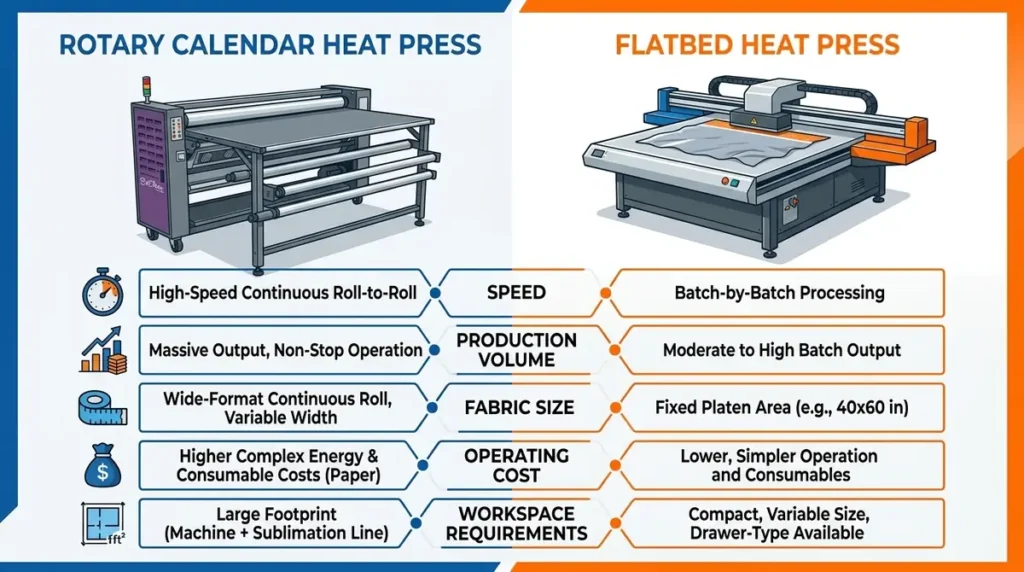
Cost Comparison
Purchase price is only one part of the investment.
Long-term ownership costs often have a greater impact on profitability than the machine itself.
Initial Investment
Flat heat presses are considerably more affordable, making them accessible to beginners and small businesses.
Calendar heat presses represent a significantly larger investment because of their industrial construction, larger heating systems, and continuous production capabilities.
Operating Costs
Operating expenses may include:
- Electricity
- Maintenance
- Replacement parts
- Production space
- Operator training
- Downtime
Calendar presses typically consume more power but can offset those costs by increasing output in high-volume environments.
Maintenance Costs
Both machines require routine maintenance, although the complexity differs.
Flat presses generally need periodic inspection of heating elements, pressure adjustments, and surface cleaning.
Calendar presses add components such as heated drums, belts, rollers, and feeding systems, which require scheduled maintenance to keep production running smoothly.
Return on Investment
The best return on investment depends on production volume rather than machine price.
For businesses producing custom products in relatively small quantities, a flat heat press often reaches profitability much sooner.
For companies manufacturing large quantities of textile products every day, a calendar heat press can justify its higher purchase cost through increased productivity, reduced manual handling, and more efficient long-run production.
Which Heat Press Is Better for Sublimation?
The right machine depends less on which one is “better” and more on the type of work your business produces every day.
If your orders mainly consist of personalized T-shirts, tote bags, photo panels, and promotional products, a flat heat press is usually the more practical investment. It offers flexibility, requires less space, and handles a wide variety of substrates without the complexity of industrial equipment.
If your business focuses on sportswear, fashion textiles, soft signage, or continuous fabric printing, a calendar heat press becomes the stronger choice. Its roll-fed design allows for faster production, consistent transfer quality, and reduced handling during long production runs.
Best for Small Businesses
A flat heat press is often the ideal starting point because it offers:
- Lower startup costs
- Easier operation
- Faster setup
- Compatibility with many sublimation blanks
- Room to expand with additional specialty presses
For many small businesses, increasing efficiency through better workflow and production planning provides a greater return than purchasing industrial equipment too early.
Best for Growing Print Shops
As production volume increases, the decision becomes less about equipment price and more about throughput.
Growing businesses should evaluate:
- Average daily production
- Number of operators
- Available floor space
- Product mix
- Future growth plans
If most orders involve finished products, adding another flat press may be more cost-effective than replacing the entire workflow with a calendar press.
Best for Commercial Textile Production
Businesses producing:
- Sports uniforms
- Performance apparel
- Fashion fabrics
- Soft signage
- Exhibition graphics
- Home décor textiles
will typically benefit from the continuous production capabilities of a calendar heat press.
Its ability to process long fabric runs without repeated loading helps reduce labor while maintaining consistent output.
Best for Promotional Product Businesses
Companies producing customized gifts, corporate merchandise, and small-batch orders usually gain more value from a flat heat press.
Its flexibility makes switching between products quick and efficient, which is especially important when every order is different.
Decision Guide
If you’re still deciding, the following framework can simplify the choice.
Choose a Calendar Heat Press if…
- You print large volumes of polyester fabric.
- Most production involves continuous textile rolls.
- Your business supplies apparel manufacturers or commercial clients.
- Production speed is becoming a bottleneck.
- You have sufficient workspace and electrical capacity.
- Your long-term goal is industrial-scale textile production.
Choose a Flat Heat Press if…
- You create personalized products.
- Your orders are relatively small.
- You decorate a wide range of sublimation blanks.
- Budget is an important consideration.
- You want equipment that’s easy to learn and maintain.
- Flexibility matters more than maximum throughput.
Upgrade Considerations
Many successful sublimation businesses begin with one or more flat heat presses before investing in a calendar press.
That progression allows owners to build a customer base, refine production processes, and confirm that demand justifies the higher investment.
Upgrading too early can tie up capital in equipment that remains underused, while upgrading too late may limit your ability to accept larger commercial orders.
Common Buying Mistakes
Buying Industrial Equipment Too Early
A calendar heat press is impressive, but purchasing one before production volume requires it can delay profitability.
Evaluate your current workload rather than the workload you hope to have in the future.
Ignoring Workflow Bottlenecks
Many production delays originate outside the heat press.
Artwork preparation, printing, trimming, quality inspection, and packaging often consume more time than the transfer process itself.
Improving those stages may increase productivity without replacing existing equipment.
Underestimating Space Requirements
Calendar presses require considerably more installation space than flat presses.
Before purchasing, consider:
- Machine dimensions
- Material loading areas
- Safe operator access
- Ventilation
- Electrical requirements
- Future expansion
Comparing Only Purchase Price
The least expensive machine isn’t always the lowest-cost solution.
Also consider:
- Maintenance requirements
- Operator training
- Downtime
- Replacement parts
- Productivity gains
- Expected lifespan
A machine that improves production efficiency may provide better long-term value despite a higher initial investment.
Skipping Heat Press Calibration
Even premium equipment can produce disappointing results if temperature or pressure is inaccurate.
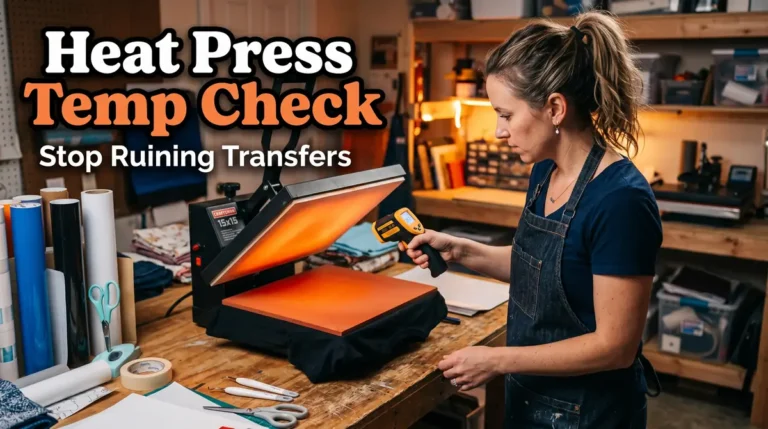
Regularly checking your equipment helps maintain consistent transfer quality. Our guide on Check Heat Press Temperature explains practical ways to verify heat accuracy before production.
Frequently Asked Questions
Is a calendar heat press better than a flat heat press?
Not necessarily. Calendar presses excel in continuous textile production, while flat presses are more versatile for individual products and small-batch work.
Which produces better sublimation quality?
Both can produce excellent results when temperature, pressure, and time are correctly configured. The main difference lies in production efficiency and consistency during long runs.
Can a calendar press replace a flat heat press?
For businesses focused on fabric production, it may handle most transfer work. However, many commercial shops continue using flat presses for rigid substrates, customized products, and specialty applications.
Which machine lasts longer?
Service life depends more on build quality, maintenance, and workload than machine type. Proper maintenance significantly extends the lifespan of both calendar and flat heat presses.
Which heat press is better for beginners?
A flat heat press is generally easier to learn, requires less investment, and supports a wider variety of beginner-friendly sublimation projects.
Do professional print shops use both?
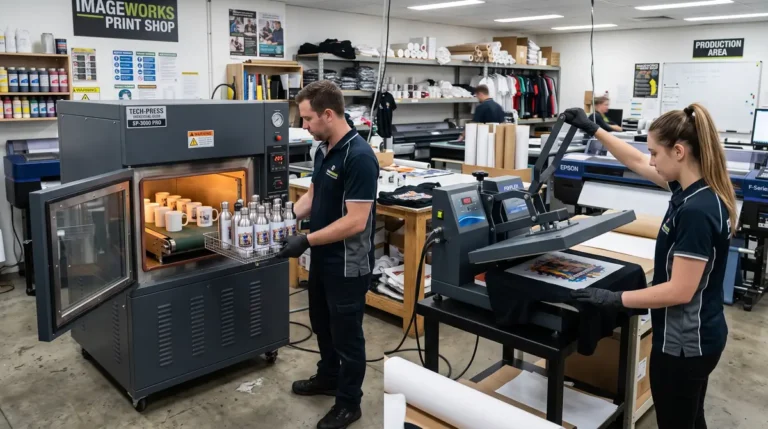
Yes. Many established businesses use flat presses for customized products and calendar presses for large-format textile production, allowing them to serve a broader range of customers.
Final Recommendation
There isn’t a universal winner because these machines are designed for different production goals.
Choose a flat heat press if your business focuses on custom apparel, promotional products, and smaller production runs. It provides excellent versatility, lower startup costs, and an easier learning curve.
Choose a calendar heat press if your business specializes in high-volume textile production, soft signage, sportswear, or continuous fabric printing. Its speed and consistency make it an excellent investment once production reaches commercial scale.
Before making a purchase, evaluate your average order size, daily production volume, available workspace, and long-term growth plans. The machine that best supports your actual workflow, rather than your future ambitions alone, is usually the smartest investment.
For additional guidance on optimizing transfer quality after choosing your equipment, see our Sublimation Heat Guide for recommended temperature, pressure, and timing practices across common sublimation substrates.