How Much Does Print Shop Business Insurance Cost?

Print shop business insurance cost depends on the policies your operation actually needs, not one universal industry price.
Current printing-industry benchmarks provide a useful starting point:
- General liability: about $44/month
- BOP: about $107/month
- Workers’ compensation: about $98/month
- Cyber insurance: about $129/month
- Commercial auto: about $169/month
Those are reference figures from policies purchased through one insurance marketplace, not guaranteed quotes.
Build your budget around your real risks. Record your equipment value, employees, revenue, products, customer traffic, vehicles, and contract requirements. Then compare quotes using the same limits and deductibles.
Most importantly, do not buy the cheapest policy until you know why it is cheaper. A lower premium is useful only when the coverage still protects the losses your print shop cannot afford to handle on its own.
Quick answer: Do not add every published insurance average together and assume that is your print shop’s cost. First identify the policies your business actually needs, then compare quotes using the same limits, deductibles, equipment values, and business information.
Average Print Shop Business Insurance Costs by Policy
The most useful way to estimate print shop business insurance cost is to separate the major policies. Not every shop needs every type of coverage, and some policies bundle several protections together.
| Insurance type | Reported monthly cost | Reported annual cost |
|---|---|---|
| General liability | $44 | $531 |
| Business owner’s policy | $107 | $1,283 |
| Workers’ compensation | $98 | $1,173 |
| Cyber insurance | $129 | $1,552 |
| Commercial auto | $169 | $2,030 |
| Errors & omissions | Varies | Varies |
These figures come from Insureon’s printing-industry customer data. The company says pricing depends on factors such as printing services, income, business property, equipment value, location, number of employees, policy limits, and deductibles.
Why You Shouldn’t Add All These Costs Together
Adding $44 + $107 + $98 + $129 + $169 would give the wrong impression.
A print shop may not need all five policies. More importantly, a business owner’s policy already combines general liability with commercial property insurance, so buying a BOP can change what you need to purchase separately.
For example:
- A solo home-based sublimation seller may have no commercial vehicle.
- A storefront may benefit from a BOP because it owns equipment and inventory.
- A business with employees may need workers’ compensation based on applicable state requirements.
- A shop that stores substantial customer data may consider cyber coverage.
- A commercial printer making deliveries in company vehicles has a different auto exposure.
Bottom line: Use industry pricing as a benchmark, not as your final insurance budget.
How Much Does General Liability Insurance Cost for a Print Shop?
Printing and copying businesses purchasing general liability through Insureon currently pay about $44 per month or $531 per year according to its published customer data.
General liability mainly addresses third-party risks such as customer bodily injury and property damage. A customer slipping over a cable inside your shop is a typical example of the type of exposure this policy addresses.
Pricing can change based on:
- shop size
- customer foot traffic
- location
- coverage limits
- business activities
- endorsements
A home-based seller who rarely receives customers will not necessarily receive the same quote as a busy retail print shop.
I cover the actual protection in more detail in the general liability insurance for print shops guide. Keeping that discussion separate also makes it easier to compare insurance costs without repeating every coverage detail here.
How Much Does a Business Owner’s Policy Cost?
A business owner’s policy, usually called a BOP, is worth comparing when your print shop needs both liability and property protection.
Insureon’s printing-industry customers pay about $107 per month or $1,283 per year for a BOP based on its published figures.
What Does a BOP Usually Combine?
A typical BOP combines:
- general liability insurance
- commercial property insurance
For a print shop, the property side can be particularly important because the business may own printers, presses, computers, cutters, inventory, furnishings, and other production equipment.
The SBA also identifies a BOP as a packaged form of small-business insurance rather than treating every risk as a completely separate purchase.
What Can Make a BOP More Expensive?
Common pricing factors include:
- value of your building or workspace
- value of printing equipment
- location
- number of employees
- business specialty
- previous claims
- extra endorsements
Insureon notes that equipment breakdown or business interruption coverage can be added to some arrangements, which can affect the premium.
Practical decision: If you need both property and general liability protection, compare a BOP against buying the two policies separately. Compare the coverage itself, not just the price.
How Much Does Workers’ Comp Cost for a Printing Business?
Printing and copying businesses buying workers’ compensation through Insureon pay about $98 per month or $1,173 per year according to its published customer data.
Workers’ comp pricing is heavily affected by the workforce rather than simply the value of your printers.
Factors can include:
- employee count
- payroll
- job duties
- workplace risk
- claims experience
- state rules
A designer working at a computer and a production employee operating heavy printing equipment do not necessarily present the same workplace exposure.
For private-sector employees, workers’ compensation systems are primarily administered through state programs, so requirements and coverage rules must be checked for the state where the employee works.
The dedicated workers’ comp article in this insurance cluster should handle those requirements in greater detail rather than forcing state-by-state rules into a cost article.
How Much Does Equipment Coverage Add?
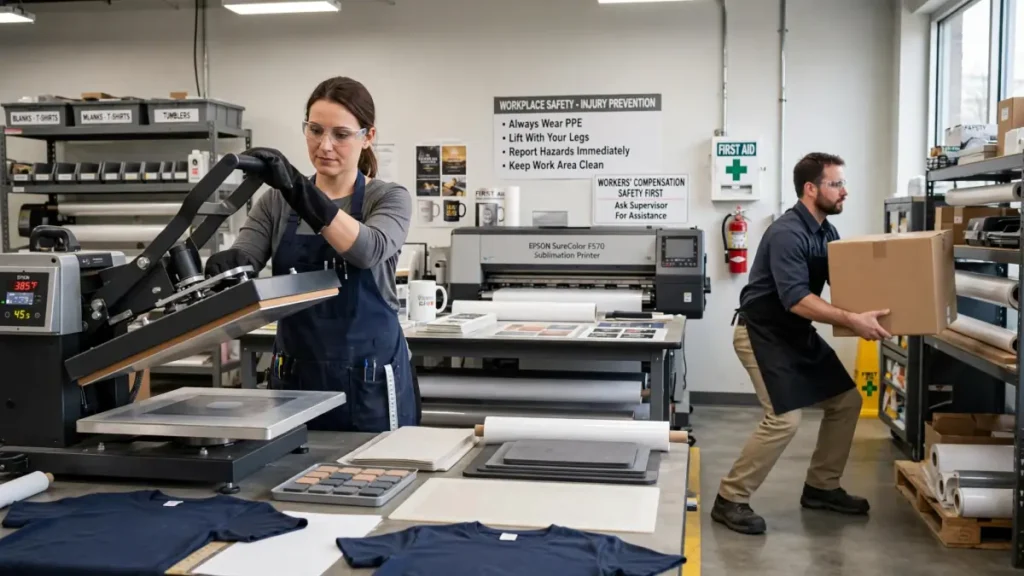
There is no useful flat price for insuring every printer or heat press. Equipment value, the type of loss covered, your deductible, and whether protection sits inside commercial property, a BOP, or an equipment-breakdown endorsement can all change the cost.
Printing businesses can have significant investments in:
- heat presses
- sublimation printers
- DTF printers and curing equipment
- DTG printers
- embroidery machines
- vinyl cutters
- wide-format printers
- computers
- finishing equipment
Insureon specifically lists business property and equipment value, along with optional equipment-breakdown coverage, among the factors affecting printing-business insurance premiums.
Sentry likewise identifies equipment breakdown as a distinct risk for printers and publishers.
Don’t Judge Equipment Insurance by Premium Alone
Suppose Shop A pays less each month than Shop B. That does not automatically mean Shop A found the better policy.
Check:
- What equipment is actually covered?
- What events trigger coverage?
- Is mechanical or electrical breakdown included?
- What deductible applies?
- What valuation method is used?
- Are portable or off-site machines treated differently?
- Is lost income from downtime addressed anywhere?
A low premium can become expensive if your most important production machine falls outside the policy.
Other Insurance Costs a Print Shop May Need to Budget For
General liability, property, and workers’ comp are not the only possible costs. The right mix depends on how your print shop operates.
| Coverage | When to consider it |
|---|---|
| Product liability | You manufacture, customize, distribute, or retail physical products |
| Cyber insurance | You handle sensitive customer or payment information |
| Commercial auto | The business owns vehicles used for work |
| Errors & omissions | A professional printing or design error could create client financial loss |
| Umbrella/excess liability | You need liability limits above underlying policies |
| Business interruption | A covered event could shut down production |
The SBA separates general liability, product liability, professional liability, commercial property, home-based business insurance, and BOP coverage because they address different risks.
Printing businesses can also face industry-specific errors and omissions exposure. Sentry, for example, identifies printing and graphic-art E&O as coverage for damages connected with printing or design mistakes that cause customer financial losses.
Bottom line: Buy coverage around the risks your operation actually creates. Do not build the policy list by copying another print shop.
What Makes Print Shop Insurance More Expensive?
Insurance usually becomes more expensive as the insurer sees more property, more people, more activity, or greater potential claim severity.
Insureon’s print-shop guidance lists printing services, property and equipment, income, added coverages, policy limits, and deductibles among the major pricing factors.
Business Factors
Your quote can be influenced by:
- annual revenue
- number of employees
- payroll
- location
- claims history
- customer traffic
- years in operation
Production Factors
The insurer may also need to understand:
- what printing methods you use
- value of production equipment
- products you sell
- whether customers visit the premises
- whether you deliver or install products
- inventory levels
- additional production activities
Do not describe a commercial print shop as simply an “online T-shirt business” to obtain a cheaper quote. An inaccurate business description can create problems when you need the policy most.
Policy Factors
You also control several pricing decisions:
- coverage limits
- deductibles
- endorsements
- property limits
- number of policies
- optional protections
Raising a deductible can reduce the premium in some cases, but it also means accepting more out-of-pocket cost when a covered claim occurs.
Home-Based Print Shop vs Storefront Insurance Cost
A home-based print business often has a different insurance profile from a customer-facing storefront.
| Cost factor | Home-based print business | Storefront print shop |
|---|---|---|
| Customer traffic | Often limited | Usually higher |
| Equipment value | Can start small | Often higher |
| Commercial property | May be limited | Usually significant |
| Employees | Often none or few | More likely |
| Lease requirements | Usually not applicable | Often important |
| Inventory | Often smaller | Can be substantial |
| Workers’ comp | Depends on employees/state | More likely relevant |
| BOP | Worth checking | Often worth comparing |
Working from home does not automatically mean all business risk is covered by a standard homeowners policy. The SBA specifically identifies home-based business coverage and notes that a rider may provide a limited amount of protection for business equipment and third-party liability.
If you are building a small sublimation operation from home, the broader sublimation business guide can help you separate equipment, product, pricing, and operating decisions before you request insurance quotes.
Small Print Shop vs Growing Commercial Shop
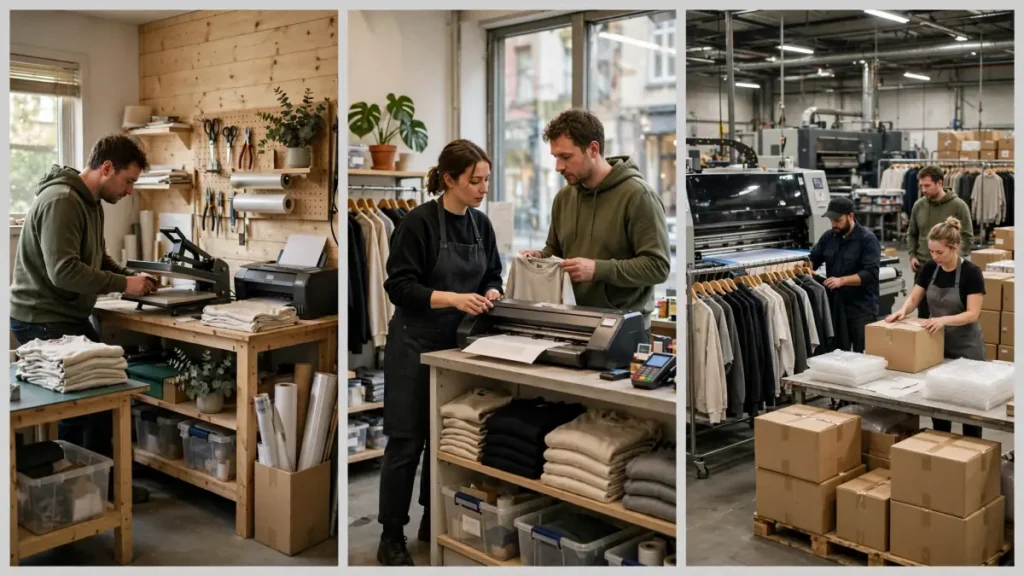
The easiest way to understand insurance budgeting is to compare business profiles rather than rely on one “average print shop.”
Solo Home Sublimation Seller
A one-person operation may start by asking:
- Is business equipment adequately covered at home?
- Do I need general liability?
- Am I covered for products after customers receive them?
- Do customers ever visit my home?
- Do I use my personal vehicle for business activities?
The insurance budget may be relatively simple, but that does not mean the risk is zero.
Small Storefront Print Shop
A small retail shop may need to compare:
- BOP
- general liability
- commercial property
- equipment breakdown
- workers’ compensation
- product liability exposure
- cyber insurance
Customer traffic and higher equipment values change the conversation quickly.
Growing Commercial Printing Operation
A larger operation can add:
- more expensive machinery
- more employees
- larger payroll
- delivery vehicles
- higher inventory
- large contracts
- greater business interruption exposure
- professional errors and omissions exposure
- higher requested liability limits
Sentry identifies employee injury, equipment breakdown, and printing or graphic-art errors among the distinct risks printing businesses can face.
Practical takeaway: Requote or review coverage when your business changes substantially. The policy that fitted a spare-bedroom setup may no longer match a staffed production facility.
BOP vs Buying Policies Separately
A BOP can simplify insurance for eligible small print shops because it packages common liability and property coverage together.
| Option | Potential advantage | What to check |
|---|---|---|
| BOP | Combines common liability and property protection | Not every risk is automatically included |
| Separate policies | Greater ability to customize individual coverage | More policies to compare and manage |
| Endorsements | Add specific protections to an existing policy | Limits and exclusions may differ |
Insureon says a BOP for printing businesses combines general liability and commercial property and can cost less than purchasing those policies separately. The SBA also describes a BOP as a bundled insurance option for small businesses.
A BOP does not mean you now own every type of business insurance.
You may still need to evaluate:
- workers’ compensation
- commercial auto
- cyber coverage
- professional liability
- specialized equipment coverage
- umbrella liability
Ask for a coverage summary before comparing the BOP premium against separate policies.
How to Lower Print Shop Insurance Costs Without Creating Coverage Gaps
The goal is not to buy the cheapest possible policy. It is to remove unnecessary cost while keeping protection aligned with the business.
1. Compare Quotes Using the Same Information
Give each insurer the same:
- revenue
- payroll
- employee count
- equipment values
- coverage limits
- deductible
- business activities
Otherwise, one quote can look cheaper simply because it provides less protection.
The SBA recommends comparing insurance prices, terms, and benefits from multiple sources.
2. Ask About Bundling
If you need liability and property coverage, ask whether a BOP makes sense.
Do not assume bundling is automatically cheaper for your particular business. Compare actual quotes.
3. Keep Equipment Values Accurate
A shop often grows one machine at a time.
You may start with one converted printer and a small heat press, then add:
- a larger press
- DTF equipment
- another printer
- computer systems
- finishing tools
- inventory
An old equipment schedule can leave your insurance disconnected from what is actually sitting in the shop.
4. Choose Deductibles You Can Afford
A higher deductible can lower premiums, but that trade-off only works when your business has enough cash available to absorb the deductible.
Do not select a deductible that would make a smaller covered loss financially painful.
5. Reduce Avoidable Operational Risk
Clean work areas, documented procedures, employee training, equipment maintenance, and clear production responsibilities can reduce the chances of preventable incidents.
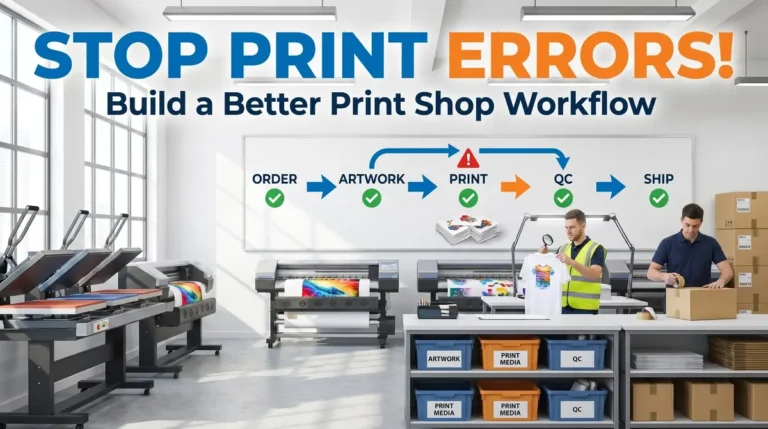
A documented print shop workflow also helps make safety, quality control, and production responsibilities easier to repeat as the shop grows.
6. Review Coverage Instead of Automatically Renewing
Check your insurance when you:
- buy major equipment
- hire employees
- move premises
- start accepting walk-in customers
- add delivery vehicles
- introduce new product lines
- begin wholesale work
- materially increase sales
A cheaper renewal means little if the business has changed but the policy has not.
How to Build an Insurance Budget for Your Print Shop
A simple insurance budget starts with risk, not premiums.
Step 1: List What Could Create a Significant Loss
Break your business into six areas:
- Customers
- Products
- Employees
- Equipment and inventory
- Premises
- Vehicles and data
This makes it easier to match risks with policies.
Step 2: Identify Requirements First
Check whether insurance is required by:
- state law
- lease agreement
- lender
- wholesale contract
- customer contract
- marketplace or event agreement
Workers’ compensation rules for private businesses are primarily state-based, so employers should check the relevant state workers’ compensation authority.
Step 3: Calculate Current Equipment Values
List the items you would struggle to replace after a serious loss.
For example:
| Asset | Value to verify |
|---|---|
| Printers | Current insured value |
| Heat presses | Current insured value |
| Computers | Current insured value |
| Finishing equipment | Current insured value |
| Inventory | Typical peak value |
| Furniture/fixtures | Current insured value |
Do not guess from memory if your shop has accumulated equipment over several years.
Step 4: Request Comparable Quotes
Use identical limits and deductibles whenever possible.
A quote at $60 per month with a $1 million liability limit cannot be fairly compared with a $45 quote providing materially different protection.
Step 5: Convert Everything to an Annual Budget
Annual planning makes the true cost easier to see.
Record:
- annual premium
- deductibles
- endorsements
- policy fees
- renewal date
Then divide the annual total into your monthly operating budget.
If you are still estimating the whole business rather than insurance alone, the cost to open a print shop guide covers equipment, inventory, setup, and other startup expenses separately.
Step 6: Review the Budget as the Shop Grows
Insurance should change when the risk changes.
Adding a $15,000 machine, three employees, a delivery van, and wholesale customers without reviewing your policy defeats the purpose of keeping an insurance budget.
What to Ask Before Choosing the Cheapest Policy
Price should come after coverage.
Before choosing a quote, ask:
- What exactly does the policy cover?
- What is excluded?
- What are the per-occurrence limits?
- What is the aggregate limit?
- What deductible applies?
- How is my equipment valued?
- Is equipment breakdown covered?
- Are products-completed operations included?
- Are all of my printing methods disclosed and covered?
- Does the policy address customer property in my care?
- Is business interruption included?
- Are company vehicles covered?
- Does the policy satisfy lease or customer-contract requirements?
- Are defense costs inside or outside the stated limit?
Take notes while comparing quotes. Insurance documents quickly become difficult to compare when one agent discusses limits, another discusses deductibles, and a third focuses only on monthly price.
A simple print shop production checklist is also useful for documenting how orders move through production and where equipment, employee, and customer-property risks appear in your daily process.
Is Print Shop Business Insurance Worth the Cost?
Insurance becomes more valuable when a single accident, lawsuit, equipment loss, or interruption would be difficult for the business to absorb with its own cash.
The SBA’s practical rule is to consider insuring against losses your business could not comfortably pay for itself. It also recommends assessing your risks and comparing coverage options rather than buying blindly.
Insurance Deserves Higher Priority If You Have:
- customer-facing premises
- expensive printing equipment
- employees
- substantial inventory
- physical products
- wholesale contracts
- leased commercial space
- business-owned vehicles
- sensitive customer information
A Small Home Seller Should Still Check:
- liability exposure
- business equipment
- product-related risks
- limits of home insurance
- business use of vehicles
Being small reduces some exposures, but it does not automatically remove them.
The right question is not:
“What is the cheapest print shop insurance?”
A better question is:
“Which losses could seriously hurt my business, and what would it cost to transfer those risks to insurance?”
That leads to a much more useful quote.
Frequently Asked Questions
How much does insurance cost for a small print shop?
A small print shop may pay about $44 per month for general liability or about $107 per month for a business owner’s policy, based on Insureon customer data. Actual costs vary by location, equipment, employees, revenue, and coverage limits.
What insurance does a print shop usually need?
Common options include general liability, commercial property, a business owner’s policy, workers’ compensation, product liability, cyber insurance, and commercial auto. The right mix depends on how your shop operates.
Is a BOP cheaper than separate insurance policies?
It can be. A business owner’s policy bundles general liability and commercial property, which may cost less than buying both separately.
Does print shop insurance cover printers and heat presses?
Commercial property or a BOP may cover printers and heat presses against covered losses. Mechanical or electrical breakdowns may require equipment breakdown coverage.
Does a home-based T-shirt business need insurance?
Yes, a home-based business can still have liability, product, and equipment risks. Homeowners insurance may not fully cover business property or business-related claims.
Does having employees increase insurance costs?
Yes. More employees can increase workers’ compensation and other business insurance costs because payroll, job duties, and workplace risk affect pricing.
Can I include insurance costs in my printing prices?
Yes. Insurance is a business overhead expense and should be included when calculating your total operating costs and profit margins.
How often should a print shop review its insurance?
Review your coverage at least at renewal and whenever you add employees, equipment, vehicles, products, or a new location.