Sublimation Equipment ROI Calculator: Break-Even & Payback

A sublimation equipment ROI calculator tells you how many profitable sales it may take for a printer, heat press, mug press, oven, cutter, or complete setup to recover its purchase cost. For related planning, see Why White Sublimation on Black Finally Works.
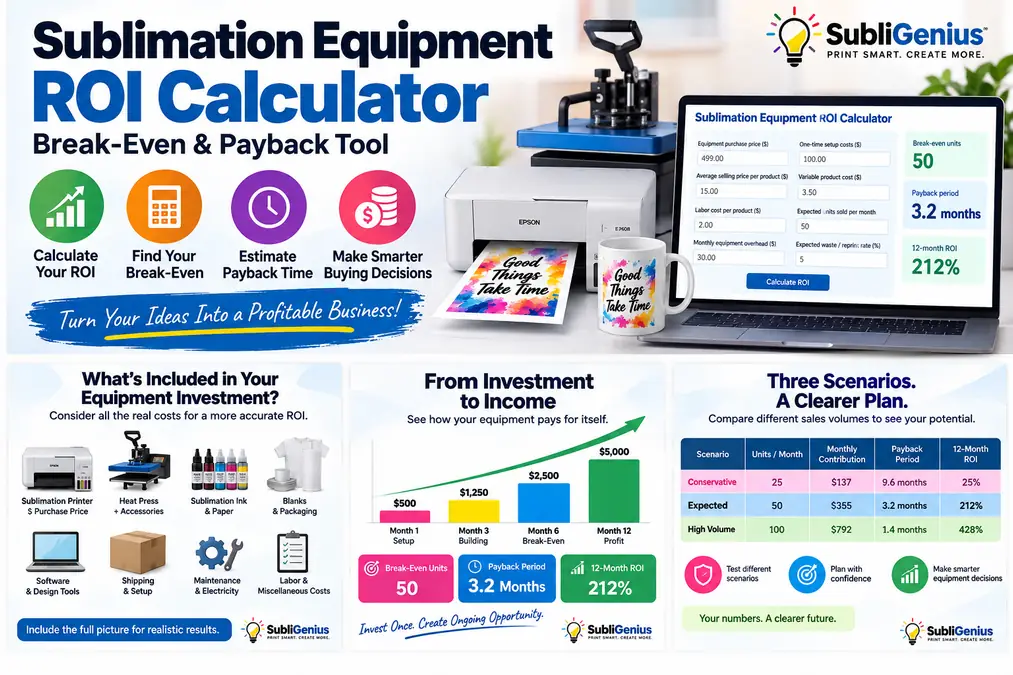
Enter your real equipment investment, product costs, labor, sales volume, waste, and monthly expenses. The calculator estimates your break-even units, monthly contribution, equipment payback period, 12-month return, and different sales-volume scenarios.
Sublimation Equipment ROI Calculator
Enter your own costs and realistic monthly sales. Leave optional fields at zero if they do not apply.
Optional outsourcing comparison
Optional financing inputs
Your Equipment ROI Estimate
Sales Scenario Comparison
| Scenario | Units / Month | Monthly Contribution | Payback |
|---|---|---|---|
| Conservative | 0 | $0.00 | N/A |
| Expected | 0 | $0.00 | N/A |
| High volume | 0 | $0.00 | N/A |
The result is an estimate, not a sales forecast. Use numbers you can realistically support with actual orders, quotes, supplier costs, and production records.
Calculate Your Sublimation Equipment ROI
The most useful equipment calculation is not simply purchase price divided by selling price.
A $20 sale does not put $20 toward recovering the machine. The blank, ink, paper, packaging, labor, waste, payment fees, and other direct costs have to come out first.
The calculator separates those numbers so you can see what each completed sale actually contributes toward the investment.
Main Results
| Result | What it tells you |
|---|---|
| Total equipment investment | Equipment plus one-time setup costs |
| Contribution per product | Money left after direct product and labor costs |
| Investment recovery units | Approximate number of profitable units needed to recover the initial investment |
| Monthly operating break-even | Minimum monthly volume needed to cover recurring equipment overhead |
| Monthly contribution | Amount available each month after direct costs and recurring equipment overhead |
| Payback period | Estimated months required to recover the initial investment |
| 12-month net return | Amount remaining after one year of modeled operations and the initial equipment investment |
| 12-month ROI | Estimated one-year return relative to the initial investment |
A short payback result can look attractive, but it is only useful when the volume assumption is realistic.
If you enter 200 monthly sales when your shop normally handles 25, the calculator will produce mathematically correct but commercially useless results.
What Costs Should You Include?
Include costs that change because you own and operate the equipment. Leaving several small expenses out can make the investment look better than it really is.
| Cost | Where to enter it |
|---|---|
| Printer, heat press, oven, cutter For related planning, see Sublimation Business Back to School Guide. | Equipment purchase price |
| Freight or delivery | Setup cost |
| Required platens or accessories | Setup cost |
| Initial equipment installation | Setup cost |
| Sublimation blank | Variable product cost |
| Ink and transfer paper | Variable product cost |
| Tape and protective paper | Variable product cost |
| Packaging | Variable product cost |
| Payment or marketplace costs tied to each sale | Variable product cost |
| Hands-on production time | Labor per product |
| Expected spoiled blanks and reprints | Waste rate |
| Equipment software | Monthly overhead |
| Maintenance reserve | Monthly overhead |
| Extra electricity attributable to equipment | Monthly overhead |
| Equipment-specific insurance allocation | Monthly overhead |
For a more accurate blank figure, calculate the landed unit cost with the Sublimation Blank Cost Calculator.
Ink is another cost that is easy to guess incorrectly. The Sublimation Ink Coverage Calculator can help you build a better per-print estimate before entering the variable product cost.
Do Not Double-Count Costs
If labor is entered in the calculator's separate labor field, do not include the same labor amount again in variable product cost.
The same rule applies to monthly software, maintenance, electricity, and other recurring expenses.
Each expense should normally appear once.
Use Real Sales Volume, Not Machine Capacity
A machine's theoretical output is not the same as your sales volume.
A press may be physically capable of producing far more items than your shop can sell. ROI comes from paid work, not unused production capacity.
Use these three scenarios:
| Scenario | Volume to enter |
|---|---|
| Conservative | Sales you could reasonably maintain during a slow period |
| Expected | Your most supportable normal monthly volume |
| High volume | Higher sales that are achievable with existing or reasonably expected demand |
The expected case should drive the main payback decision.
The conservative case tests how exposed you are if demand is weaker than planned. The higher-volume case shows the upside if orders grow.
If the purchase only makes sense under the high-volume scenario, the investment depends heavily on growth that has not happened yet.
How the Calculator Determines Break-Even Units
The calculator starts with contribution per completed sale.
Direct cost per unit:
Variable Product Cost + Labor Cost
When a waste percentage is entered, the calculator adjusts that cost upward because some production attempts will consume materials and labor without creating a sellable item.
Waste-adjusted direct cost:
Direct Cost ÷ (1 - Waste Rate)
Contribution per sold unit:
Selling Price - Waste-Adjusted Direct Cost
That contribution is the amount available to recover equipment costs and recurring equipment overhead.
Investment Recovery Units
The calculator estimates initial investment recovery units with:
Total Equipment Investment ÷ Contribution per Unit
This is different from monthly operating break-even.
Monthly Operating Break-Even
Recurring monthly equipment expenses also have to be covered.
The calculator estimates the monthly volume needed to cover those expenses:
Monthly Equipment Overhead ÷ Contribution per Unit
This result answers a different question:
How many products must the equipment produce and sell each month before its recurring equipment-related overhead is covered?
How Equipment Payback Is Calculated
Payback uses your expected monthly sales rather than maximum production capacity.
Monthly contribution:
Contribution per Unit × Expected Monthly Units - Monthly Equipment Overhead
Estimated payback period:
Total Equipment Investment ÷ Monthly Contribution
If monthly contribution is zero or negative, there is no meaningful payback period under those assumptions.
The calculator should display that clearly rather than returning a misleading number.
A negative result does not automatically mean the equipment is a bad purchase. It means the current combination of price, cost, overhead, and expected sales volume does not recover the investment.
Change the assumptions only when you have a business reason to do so.
Profit Margin and Equipment ROI Are Different
Product margin measures the economics of an individual product.
Equipment ROI measures whether the return generated by those products is enough to justify the equipment investment.
For example, a product can have a positive margin while the equipment still takes a long time to pay for itself because monthly order volume is low.
The opposite can happen with a busy shop. A moderate contribution per item can recover equipment quickly if enough profitable orders are consistently sold.
Use the Sublimation Profit Margin Calculator when the main question is:
“Is this product profitable at this selling price?”
Use this equipment ROI calculator when the question becomes:
“Will those profits recover this equipment investment?”
Check Conservative, Expected, and High-Volume Results
One payback number can hide too much risk.
The calculator compares all three volume scenarios using the same costs and selling price.
Conservative Scenario
This tests the investment during slower demand.
Pay attention when conservative monthly contribution falls close to zero. Small cost increases or a few fewer sales could turn that month negative.
Expected Scenario
This should use the strongest volume estimate you can support without assuming ideal conditions.
Existing businesses can use recent completed sales. New businesses may need a more cautious estimate based on confirmed orders, tested demand, or a realistic launch plan.
High-Volume Scenario
This shows what stronger demand could do to equipment payback.
Treat it as an upside case, not the number the purchase automatically delivers.
If you are still estimating the full cost of launching a shop, review the sublimation startup costs guide before finalizing the equipment investment.
Should You Buy Equipment or Keep Outsourcing?
Buying equipment can make sense when the savings from bringing production in-house are large enough to recover the investment within a period that works for your business.
The calculator includes an optional outsourcing comparison.
Enter what you currently pay another supplier per completed item.
The calculator compares that figure with your estimated in-house direct cost.
Estimated savings per unit:
Outsource Cost - In-House Direct Cost
Estimated monthly savings after equipment overhead:
Savings per Unit × Monthly Volume - Monthly Equipment Overhead
If monthly savings are positive, the calculator can estimate how long it may take for those savings to recover the equipment investment.
Buying Is Not Automatically Cheaper
Owning equipment can introduce costs that outsourcing hides:
- Maintenance
- Production labor
- Reprints
- Downtime
- Software
- Utilities
- Inventory
- Space
- Training
Outsourcing has its own limitations, such as supplier pricing, turnaround times, minimums, and less production control.
The calculator provides the financial side of the comparison. Production reliability and workflow still matter.
How Financing Changes the Cash Flow
Financing changes when cash leaves the business, but it does not make the equipment itself cheaper.
The advanced section lets you enter:
- Down payment
- Annual percentage rate
- Loan term
The tool estimates the monthly payment and monthly cash remaining after the payment.
Use that result for cash-flow planning.
Keep the basic equipment ROI result separate. This makes it easier to compare two machines based on their operating economics without making one appear more profitable merely because more of its purchase price was financed.
Interest also increases the total amount paid over the financing term.
For a purchase decision, check both:
Can the equipment generate an acceptable operating return?
and
Can the business comfortably handle the required monthly cash payments?
Why a Fast ROI Estimate Can Be Misleading
An equipment calculator becomes unreliable when the assumptions are unrealistic.
Sales Volume Is Too Optimistic
The most common problem is entering what the machine can produce instead of what customers will buy.
Use paid sales or defensible demand estimates.
Labor Is Entered as Zero
Owner time still has economic value.
A product that leaves $10 after materials but requires a large amount of hands-on work does not contribute the full $10 toward equipment recovery.
Waste Is Ignored
Misprints, damaged blanks, alignment mistakes, and customer-approved reprints increase effective production cost.
Enter a waste assumption that reflects your own production records when possible.
Monthly Costs Are Missing
Software subscriptions, maintenance, extra electricity, equipment-specific insurance, and other recurring expenses reduce the amount available for equipment payback.
Selling Price Is Not Realistic
Do not enter the price you hope to charge if your market is currently paying something different.
If pricing is still uncertain, work through the sublimation product pricing formula before trusting the ROI result.
Compare Two Sublimation Equipment Options
Equipment A and Equipment B should be compared using the same sales assumptions whenever possible.
| Compare | Equipment A | Equipment B |
|---|---|---|
| Total investment | Enter actual cost | Enter actual cost |
| Contribution per unit | Same product assumptions | Same product assumptions |
| Expected monthly units | Realistic volume | Realistic volume |
| Monthly overhead | Equipment-specific | Equipment-specific |
| Break-even units | Calculator result | Calculator result |
| Payback period | Calculator result | Calculator result |
| 12-month net return | Calculator result | Calculator result |
A more expensive machine can sometimes justify its cost if it meaningfully changes labor, waste, capacity, or outsourcing expenses.
A cheaper machine can be the stronger choice when demand is still limited and the additional capacity of a larger setup would sit unused.
The calculator should support the decision, not force a specific equipment choice.
Sublimation Equipment ROI Calculator FAQs
What is equipment ROI in a sublimation business?
Equipment ROI compares the financial return generated by equipment with the amount invested in purchasing and setting it up. For this calculator, the focus is on contribution from actual sales after direct costs and equipment-related overhead.
How do I calculate how many sublimation products I need to sell to break even?
Divide the total equipment investment by the contribution available from each completed sale. Contribution is selling price minus the direct cost required to produce that sellable item.
Recurring monthly equipment overhead should be considered separately when estimating the payback period.
Is break-even the same as profit margin?
No. Break-even tells you when revenue or contribution has covered a defined cost. Profit margin measures profit relative to sales.
The sublimation profit margin explanation covers product margin in more detail.
Should I include my labor in equipment ROI?
Yes, if you want the calculation to reflect the economic cost of production.
Leaving owner labor at zero can make contribution per unit and equipment payback look stronger than the actual workflow supports.
Should printer and heat press costs be combined?
Combine them when both pieces of equipment are required for the investment you are evaluating.
If you already own the heat press and are deciding whether to buy a new printer, use only the new costs caused by that decision.
What is a good ROI for sublimation equipment?
There is no universal percentage that makes an equipment purchase good or bad.
A useful result depends on your available cash, financing cost, demand reliability, equipment risk, alternative uses for the money, and how long you are comfortable waiting to recover the investment.
What if the calculator says the equipment never pays back?
Check the underlying assumptions rather than forcing a positive answer.
A non-paying result can come from low volume, high direct costs, excessive monthly overhead, low selling prices, or a combination of those factors.
The result is telling you that the current model does not generate enough monthly contribution to recover the investment.
Can I calculate ROI before starting a sublimation business?
Yes, but treat the result as a planning scenario rather than proof of future profit.
New businesses usually have less reliable sales-volume data. Run a conservative case as well as the expected case and avoid using maximum equipment capacity as your forecast.
Check the Numbers Before You Buy
A sublimation equipment ROI calculator is most useful before money is committed.
Use actual equipment quotes, realistic unit costs, a value for your labor, a reasonable waste allowance, and sales volume you can support. Then compare the conservative, expected, and higher-volume cases.
If the numbers still work when the assumptions are cautious, you have much stronger information for the purchase decision.
If they only work when every month is busy and nothing goes wrong, the equipment investment carries more risk than the headline payback number suggests.
For other cost, pricing, production, and planning tools, use the Sublimation Calculator Hub.