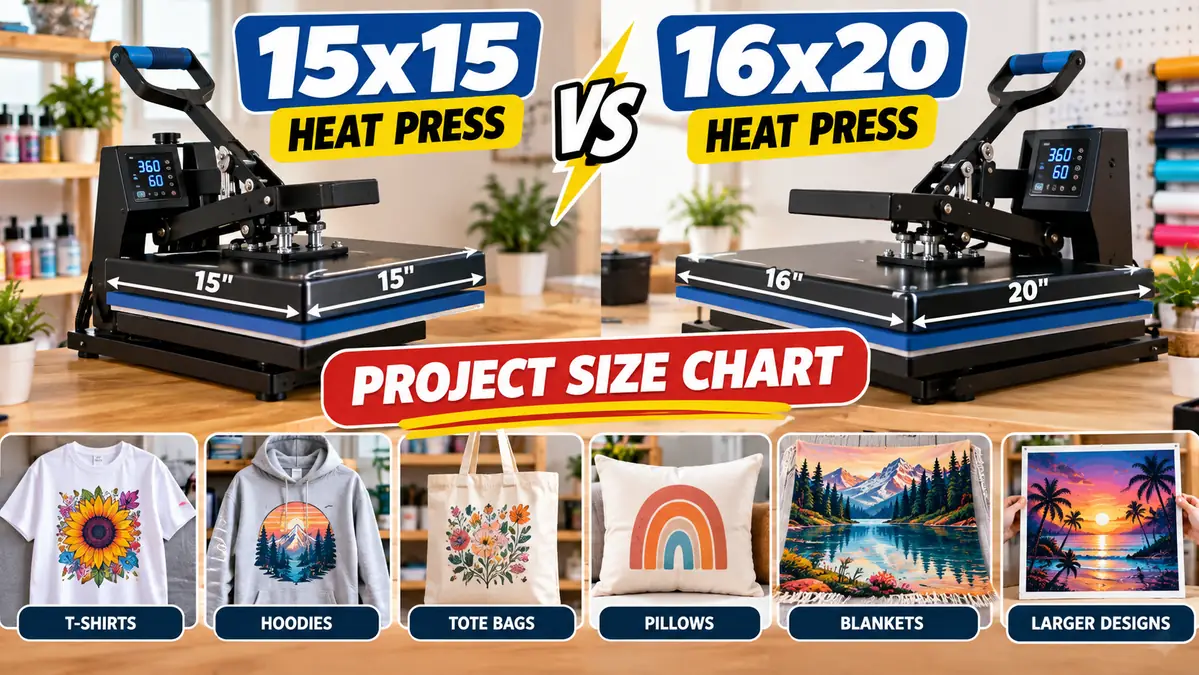
15×15 vs 16×20 Heat Press: Project Size Chart

A 15×15 heat press is large enough for many standard shirt designs, small sublimation blanks, tote bags, and everyday transfer work.
A 16×20 press gives you substantially more room for oversized graphics, larger hoodie designs, rectangular panels, and jobs you want to press in one cycle.
The difference is bigger than the model names suggest. A 15×15 platen has 225 square inches of surface area. A 16×20 platen has 320 square inches, about 42% more platen area.
The best choice depends on the size of your transfers, not just the size printed on the garment label.
15×15 vs 16×20 Heat Press at a Glance
| Factor | 15×15 Heat Press | 16×20 Heat Press |
|---|---|---|
| Nominal platen area | 225 sq in | 320 sq in |
| Standard shirt graphics | Usually enough | More placement room |
| Oversized graphics | More restrictive | Better suited |
| Hoodie fronts | Works for many designs | More room around seams and pockets |
| Large back graphics | Depends on transfer size | More flexible |
| Large sublimation panels | Limited by 15″ platen | Better coverage |
| Small logos | Excellent | Excellent |
| Home workspace | Easier to fit | Requires more room |
| Machine weight | Usually lower | Usually higher |
| Power requirement | Depends on model | Depends on model |
| Purchase cost | Usually lower | Usually higher |
| Best use | Standard projects | Larger and growing project mix |
These dimensions describe the platen, not the dimensions of the entire machine.
The heat press buying guide covers clamshell, swing-away, auto-open, pressure systems, warranties, and other features. This comparison stays focused on size.
Heat Press Project Size Chart
Measure the transfer before choosing a press.
A shirt labeled XL or 2XL does not automatically require a 16×20 machine. A 10×12 graphic on a 2XL shirt still fits comfortably on a 15×15 platen.
Transfer Size vs Platen Size
| Transfer size | 15×15 | 16×20 | Practical note |
|---|---|---|---|
| 4×4 | Easy fit | Easy fit | Common logo-sized work |
| 8×10 | Easy fit | Easy fit | Plenty of positioning room |
| 10×12 | Easy fit | Easy fit | Common apparel range |
| 12×14 | Usually comfortable | Comfortable | Check garment seams |
| 13×14 | Fits nominal platen | Comfortable | Less placement margin on 15×15 |
| 14×15 | Very tight fit | Comfortable | Little error margin on 15×15 |
| 15×16 | Too long for one 15×15 press | Fits nominal 16×20 | Check actual heated dimensions |
| 15×18 | Too large | Fits nominal 16×20 | Useful for larger vertical graphics |
| 15×19 | Too large | Tight fit | Leave room for positioning if possible |
| Wider than 16″ | Too large | May also be too large | Larger equipment may be required |
| Taller than 20″ | Too large | Too large for one full press | Consider larger-format equipment |
A nominal 15×15 platen does not mean every 15×15 transfer will be easy to position. Leaving some space around the transfer makes loading and alignment easier.
The same applies to a nominal 16×20 platen. Some manufacturers list actual heating-element dimensions slightly below the rounded model name. For example, one current Heat Press Nation 16×20 model lists a heating-element size of 15.77×19.72 inches.
Practical rule: Avoid designing to the absolute edge of the platen unless you have confirmed the real heated area of your specific machine.
Which Projects Fit a 15×15 or 16×20 Heat Press?
The project name gives only part of the answer. Transfer dimensions and raised areas on the blank determine how much platen space is actually usable.
| Project | 15×15 | 16×20 | Main issue to check |
|---|---|---|---|
| Left-chest logo | Excellent | Excellent | Placement |
| Youth shirt | Usually enough | More than enough | Transfer dimensions |
| Standard adult shirt front | Usually enough | More room | Actual artwork size |
| Large shirt back | Depends | Better suited | Height of transfer |
| Oversized streetwear graphic | Often restrictive | More useful | Transfer width and height |
| Hoodie front | Often workable | More flexible | Pocket, seams, zipper |
| Hoodie back | Depends | More room | Hood and seam placement |
| Tote bag | Usually enough | More room | Handles and seams |
| Pillow cover | Depends | Better for larger designs | Printable area |
| Small photo panel | Usually enough | Enough | Blank dimensions |
| Large sublimation panel | Limited | Better suited | Full platen coverage |
| DTF gang transfer | Depends on layout | More layout room | Transfer dimensions |
| Sleeve or pant-leg transfer | Orientation matters | More room | Garment loading |
Stahls currently positions its 15×15 MAXX press for T-shirts, sweatshirts, tote bags, and smaller shops, while it positions the 16×20 version for full-front and oversized prints, hoodies, jackets, fleece, jerseys, and team decoration.
Those are useful categories, but the final decision should still come from your actual transfer dimensions.
The Difference Is Bigger Than One Inch Sounds
“15×15 vs 16×20” sounds like you are gaining only one inch.
Most of the useful difference comes from the extra five inches of platen depth.
A 15×15 press gives you:
15 × 15 = 225 square inches
A 16×20 gives you:
16 × 20 = 320 square inches
That is 95 additional square inches, or roughly 42% more nominal platen area.
The additional depth is useful for:
- long shirt-back designs
- vertical graphics
- hoodie artwork
- rectangular signs
- sublimation panels
- longer tote designs
- larger DTF transfers
The extra inch of width helps too, but the five additional inches in the other direction create most of the practical difference.
Is a 15×15 Heat Press Big Enough for T-Shirts?
Yes. A 15×15 press can handle many normal T-shirt transfers in one press.
The deciding measurement is the graphic.
Standard front designs
A transfer that measures 10×12 or 12×14 fits inside a nominal 15×15 platen with usable room for positioning.
This is why 15×15 has remained a common size for apparel work.
Large back designs
The limitation becomes more noticeable once designs approach the full 15-inch platen dimension.
A 14×15 transfer may technically fit, but there is little room for:
- alignment
- transfer-paper margins
- garment movement
- protective paper
A 16×20 platen makes that same transfer easier to place.
Oversized shirt graphics
Once the transfer exceeds about 15 inches in either direction, a 15×15 cannot cover the entire graphic in one press.
That is where the 16×20 begins to solve a real problem.
What about XL, 2XL, and 3XL shirts?
Do not choose platen size from shirt size alone.
A large shirt can carry a small design. A medium shirt can carry a large graphic.
Measure:
- artwork width
- artwork height
- printable garment area
- distance from collar and seams
Those numbers determine whether the transfer fits.
Is a 15×15 Heat Press Enough for Hoodies?
A 15×15 can press many hoodie designs, but hoodies introduce obstacles that T-shirts do not.
The main problem is not always platen size.
Watch for:
- front pockets
- pocket seams
- zippers
- drawstring hardware
- thick collars
- side seams
- the hood itself
Raised areas can stop the platen from applying equal pressure across the transfer.
A 16×20 gives you more room to reposition the garment and avoid some obstacles, especially with larger artwork. It does not make seams disappear.
For example, a small front design above the pocket may fit easily on a 15×15. A long full-front hoodie graphic can become much easier to position on a 16×20.
Use a pressing pillow or appropriate platen setup when raised seams interfere with pressure, and check our heat press setup guide for pressure and platen setup.
Bottom line: Choose 16×20 for hoodies when your recurring graphics are large, not simply because the garment has a hood.
Can You Press a 16×20 Design on a 15×15 Heat Press?
A transfer larger than the platen can sometimes be pressed in sections, but sectional pressing is not equivalent to covering the transfer in one cycle.
The method can work for some transfer materials and designs.
It also introduces extra variables:
- alignment
- transfer movement
- pressure changes
- overlap between press areas
- repeated heat exposure
- additional production time
A design that requires two press cycles also doubles part of your handling workflow.
Occasional oversized job
Sectional pressing may be acceptable when an oversized project appears once in a while and the transfer material allows it.
Buying a larger machine for one unusual order may not make sense.
Recurring oversized work
If you section-press the same type of job every week, platen size has become a production limitation.
That is a stronger argument for 16×20.
Sublimation Makes Full Platen Coverage More Important
Large sublimation transfers are easier to control when the complete image fits beneath the heated platen in one cycle.
Sublimation depends on consistent:
- temperature
- time
- pressure
- transfer position
Repositioning a partly transferred image adds another opportunity for movement or uneven treatment.
For larger polyester panels or flat sublimation blanks, choose a press that can comfortably cover the transfer area whenever practical.
Example
A 12×14 sublimation panel fits inside a 15×15 platen.
A 15×18 panel does not.
The 16×20 size becomes much more useful for the second project because it can cover the transfer without dividing it into separate press areas.
For material-specific starting points, use the Heat Press Temperature for Sublimation chart.
The Heat Press Settings Calculator can help compare time, temperature, and pressure recommendations by material.
15×15 vs 16×20 for DTF and HTV
Both platen sizes work well for DTF and HTV when the complete transfer fits inside the heated area.
Small logos and standard graphics
A 16×20 does not make a small 4×4 or 10×12 transfer better simply because the platen is larger.
A quality 15×15 provides plenty of coverage.
Oversized DTF transfers
This is where the 16×20 becomes more useful.
A 15×18 DTF transfer exceeds a 15×15 platen but fits inside a nominal 16×20 platen.
That can turn a sectional application into a single press.
HTV
Large layered HTV work can benefit from extra space, but platen size is only one consideration.
Alignment, carrier-sheet dimensions, material instructions, pressure, and garment seams still matter.
Bigger Does Not Automatically Mean Better Heat
Platen size tells you how much area a press can cover. It does not tell you how evenly the machine heats that area.
A good 15×15 press can be a better purchase than a poorly built 16×20.
Compare:
- temperature consistency
- pressure consistency
- controller accuracy
- frame strength
- platen construction
- warranty
- replacement parts
- manufacturer support
This matters more as platen area grows because the heater must maintain useful temperature across a larger surface.
Our heat press buying guide covers these broader quality factors.
How Much Workspace Does a 16×20 Heat Press Need?
Do not measure your table using the platen dimensions alone.
The machine is larger than 16×20.
You need room for:
machine footprint + opening movement + garment loading + operator access
Clamshell presses
A clamshell opens upward.
Check:
- cabinet clearance
- wall shelves
- operator reach
- space behind the press
Swing-away presses
A swing-away upper platen moves sideways.
A machine that fits on your tabletop while closed may still hit a wall, shelf, printer, or storage rack when opened.
Slide-out platens
A drawer-style lower platen needs clear space in front of the machine.
Current model example
Stahls currently lists its MAXX 250:
- 15×15: 28x16x17 inches, 65 lb
- 16×20: 29x17x17 inches, 87 lb
Both are clamshell models.
That is only one product line. Other designs can have very different footprints.
For example, Heat Press Nation lists one 15×15 Black Series clamshell at 24x15x31 inches in its open position and 51 lb product weight.
Its 16×20 Signature Pro swing-away is listed at 28x16x27 inches open and about 116 lb.
Those models are not direct equivalents. They show why you should check the actual press, not estimate machine size from platen dimensions.
Check Power Requirements Before Buying
A 16×20 press does not automatically need a special electrical circuit, and a 15×15 does not automatically use less power.
Electrical specifications vary by model.
Same power example
Stahls lists both the current 15×15 and 16×20 MAXX 250 models at:
- 120 V
- 15 A
- 1800 W
The 16×20 has a larger platen, but these two versions share the same listed electrical specification.
Different power example
Heat Press Nation lists:
HPN Black Series 15×15
- 120 V
- 13 A
- 1400 W
HPN Signature Pro 16×20 Swing-Away
- 120 V
- 14 A
- 1600 W
These examples are model-specific.
Before ordering any press, verify:
- voltage
- amperage
- wattage
- plug type
- manufacturer’s circuit recommendation
Do not assume two presses with the same platen size have the same electrical needs.
Does a 16×20 Heat Press Take Longer to Heat Up?
It can, but platen size alone does not determine warm-up time.
Warm-up depends on:
- heater wattage
- heating-element design
- platen thickness
- starting room temperature
- target temperature
- controller design
A well-designed 16×20 press with adequate heating power may warm more effectively than a lower-powered machine with a smaller platen.
Use the manufacturer’s stated warm-up performance when available instead of assuming that every 16×20 is slower.
When a 15×15 Heat Press Makes More Sense
Choose 15×15 when the smaller platen already covers the work you sell.
It is a practical fit when:
- most transfers stay below 15 inches
- standard T-shirts are your main product
- small sublimation blanks dominate your workflow
- oversized work is uncommon
- workspace is limited
- equipment needs to be moved occasionally
- the budget difference buys a higher-quality machine
- production volume is still manageable
A quality 15×15 is not something every business has to outgrow.
If 95% of your orders use 10×12 transfers, another five inches of platen depth may spend most of its time unused.
When a 16×20 Heat Press Makes More Sense
The larger platen becomes valuable when the extra space solves a recurring problem.
Consider 16×20 when:
- large front or back designs sell regularly
- 15×16, 15×18, or similar transfers appear often
- hoodie work is a major part of the business
- large sublimation panels are part of your product line
- sectional pressing is slowing production
- operators need more placement margin
- you expect regular oversized DTF work
- your 15×15 is already limiting profitable orders
Do not buy 16×20 only because someone says you will “need it eventually.”
Buy it when the project mix uses the additional platen area.
Better 15×15 or Cheaper 16×20?
A better-built 15×15 is often the stronger choice when all of your normal transfers fit it.
Platen area cannot compensate for poor:
- heat distribution
- pressure control
- construction
- temperature calibration
- support
- replacement-part availability
A cheaper 16×20 becomes attractive only if you need the size and the machine meets the quality requirements for your work.
Start with your largest recurring transfer.
If it is 12×14, compare press quality first.
If it is 15×18, a 15×15 cannot solve the basic coverage problem no matter how well built it is.
Should You Upgrade From 15×15 to 16×20?
Upgrade when the current platen is costing you measurable time or sales.
Do not judge from frustration after one unusual order.
Track these numbers for a month:
| Upgrade question | Your result |
|---|---|
| Jobs larger than 15×15 | |
| Profitable jobs declined because of size | |
| Projects requiring sectional pressing | |
| Extra minutes per sectional job | |
| Average profit on oversized jobs | |
| Larger projects outsourced | |
| Current machine resale value | |
| 16×20 purchase cost | |
| Additional workspace required |
Keep the 15×15 when
- oversized jobs are rare
- sectional pressing is uncommon
- every main product fits
- the machine is reliable
- size is not affecting production
Consider 16×20 when
- oversized orders repeat every week
- you routinely turn away large work
- sectional pressing adds measurable labor
- your product line is moving toward larger transfers
If throughput is the real problem rather than size, read the best heat press for high-volume apparel printing before assuming a larger single-station platen is the answer.
For equipment payback, the Sublimation Equipment ROI Calculator can help compare purchase cost with added profit.
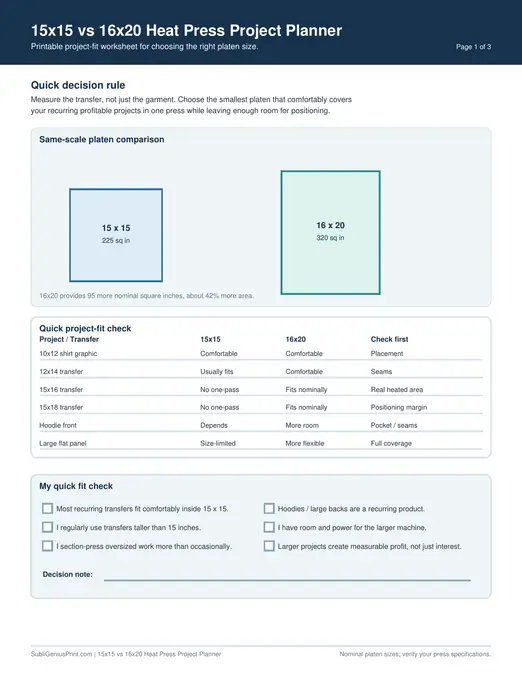
15×15 vs 16×20 Heat Press Project Planner
Before ordering a press, make a list of the work you actually expect to produce.
Use this simple worksheet:
| Project | Transfer Width | Transfer Height | Seams / Obstacles | 15×15 One Pass? | 16×20 One Pass? | Monthly Volume |
|---|---|---|---|---|---|---|
| Standard shirt | ||||||
| Large shirt back | ||||||
| Hoodie | ||||||
| Tote | ||||||
| Sublimation panel | ||||||
| DTF transfer | ||||||
| Other |
Measure finished transfer files, not guesses based on the product name.
If every high-volume job fits comfortably inside 15×15, that tells you something useful.
If several profitable recurring products require 16×18 or similar coverage, that tells you something too.
15×15 vs 16×20 Heat Press FAQs
Is a 15×15 heat press big enough for shirts?
Yes, for many standard shirt graphics. The shirt size does not determine the required platen size. Measure the transfer itself. Designs around 10×12 or 12×14 fit comfortably within a nominal 15×15 platen.
Can I press XL and 2XL shirts with a 15×15 press?
Yes. A larger garment does not automatically require a larger platen. A 12×14 design on a 2XL shirt still fits a 15×15 press. A 15×18 design does not, regardless of whether the shirt is medium or 2XL.
Is a 16×20 heat press too big for a beginner?
Not if your planned projects need the space and your workspace can handle the machine. A beginner making mostly small shirts and mugs may gain little from the extra platen area. Buy for your projects rather than experience level.
Can I press a 16×20 transfer with a 15×15 heat press?
Not in one complete press. Some transfer types can be applied in sections, but sectional pressing adds alignment, handling, and reheating concerns. If 16×20-class transfers are recurring work, a larger platen is the cleaner production solution.
Is a 15×15 heat press enough for hoodies?
It can be. Smaller hoodie graphics fit a 15×15 press. Large fronts and backs become easier on a 16×20. Pockets, zippers, seams, drawstrings, and hood placement also affect usable pressing area.
What heat press size is good for sublimation?
Choose a platen that can cover the full transfer area of your recurring flat projects. A 15×15 works for many shirts and small blanks. Larger panels and oversized apparel transfers can justify 16×20.
Does a larger heat press use more electricity?
Not always. Electrical requirements depend on the specific machine. Some current 15×15 and 16×20 models use the same listed wattage, while other product lines show different power requirements. Always check the manufacturer specification before buying.
Does a 16×20 heat press take longer to heat?
Not necessarily. Heater wattage, platen construction, controller design, and ambient temperature all affect warm-up time. Compare actual model specifications instead of assuming larger automatically means slower.
Can a 16×20 heat press small designs?
Yes. A large platen can press small transfers. The extra platen size does not improve a small design by itself, but it gives you more room for positioning and future larger projects.
Should I buy a better 15×15 or a cheaper 16×20?
Choose the better 15×15 when all your important projects fit within it and the larger machine requires sacrificing heat or pressure quality. Choose 16×20 when your recurring transfer dimensions actually exceed the smaller platen and the machine still meets your quality requirements.
Choose the Platen Around Your Largest Recurring Project
The difference between 15×15 and 16×20 should come down to the work you produce repeatedly.
A 15×15 press is enough for many standard apparel designs and smaller sublimation projects. It uses less workspace and can let you put more of the equipment budget into build quality.
The 16×20 earns its extra space when larger graphics, hoodies, panels, or oversized transfers are a regular part of production.
Before buying, measure your ten most common transfers.
If they all fit comfortably inside 15×15, buy based on press quality.
If several profitable jobs regularly exceed that platen, the extra 95 square inches of a 16×20 can solve a real production limitation.