Heat Press Buying Guide: Types, Sizes and Features

If you’re shopping for your first heat press, you’ve probably run into the same wall everyone does: a dozen types, a dozen sizes, and every retailer telling you their model is the one you need. Before you invest in equipment, read our guide to beginner sublimation printer mistakes.
Before you compare specific products, you need to narrow down two things: what type of press fits how you’ll actually use it, and what size platen fits what you’ll actually press.
This guide covers both, plus the features that affect repeatability, loading, serviceability, and long-term support.
Quick recommendations: Choose a press around your largest recurring transfer, the blank’s pressing area, and available workspace. Clamshell presses can be compact, but 15×15 is not a universal size requirement.
For occasional mugs, compare a combo machine with manufacturer-approved attachments against a separate mug heater. Drawer loading is not the same as combo capability. Frequent drinkware work may justify dedicated heating equipment.
Already outgrowing a single press and thinking about production volume? Skip ahead to our high-volume heat press guide, this page is built for first-time buyers, not scaling shops.
Heat Press Type Selector: Choose Based on Your Work
The right press depends on the products you make, your largest transfer size, available workspace, and how often you press. Use the selector below to narrow the type and platen size before comparing brands.
Heat Press Type Selector
This is a buying framework, not a substitute for the transfer or blank manufacturer’s time, temperature, pressure, electrical, and equipment requirements.
If your expected workload is already high, use our high-volume heat press guide. For equipment payback planning, compare the purchase with the sublimation equipment ROI calculator.
Heat press types explained
Every heat press does the same basic job: apply consistent heat and pressure for a set time. What differs is how the press opens, how it distributes that pressure, and how safely you can load a substrate.
Clamshell presses
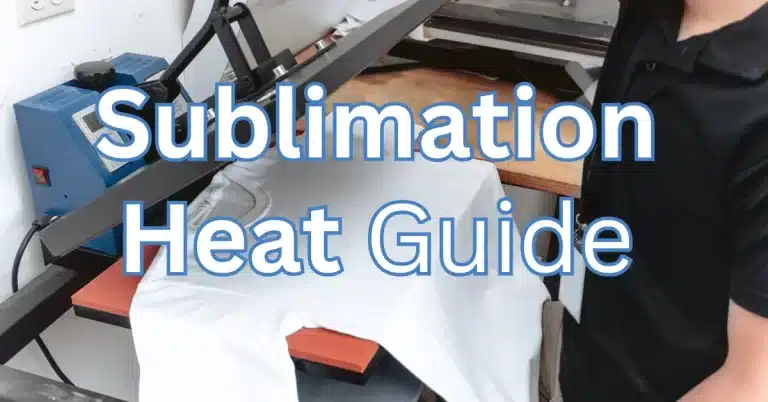
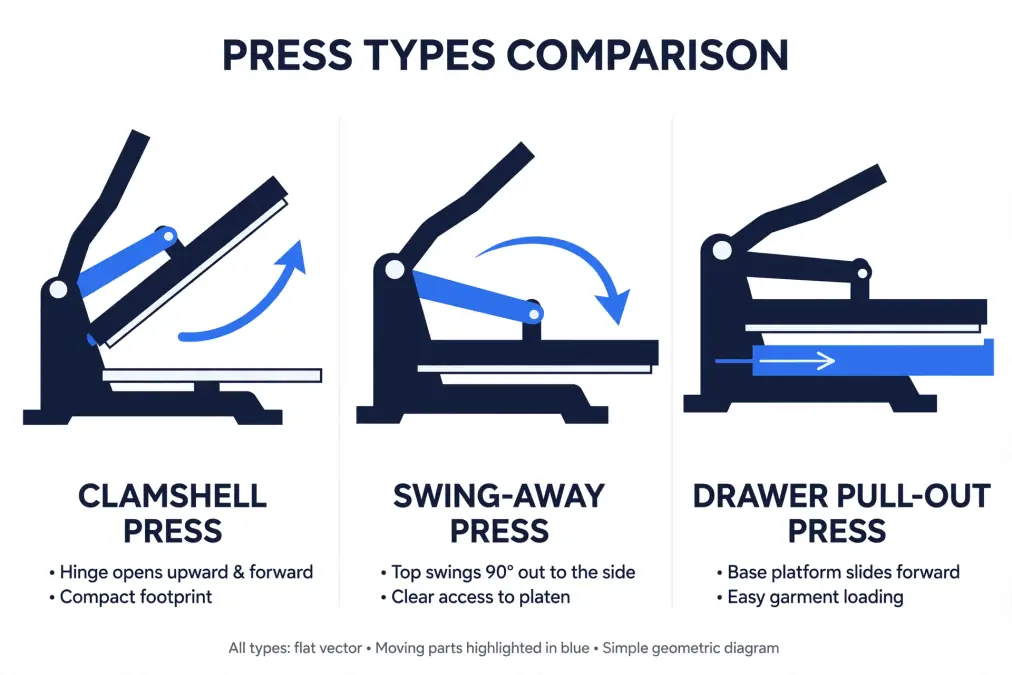
A clamshell press opens and closes like its namesake, hinged at the back, top platen swinging up and down in a single motion. It’s the most compact, most affordable, and most common starting point for sublimation beginners.
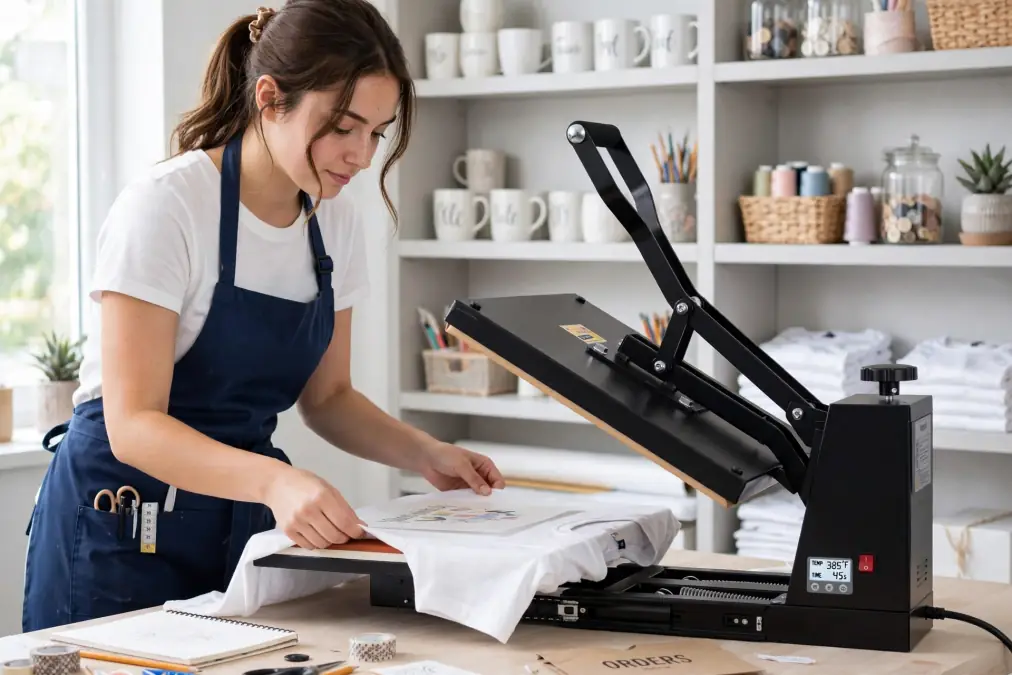
The tradeoff is loading position. Because the heated platen swings down close to where your hands are placing the transfer, there’s more risk of accidental contact with the hot surface than on a swing-away design. For thin, flat substrates like shirts, keychains, and photo panels, that tradeoff is usually worth the smaller footprint and lower price.
Swing-away presses
On a swing-away press, the heated top platen swings entirely off to the side before you load your substrate, then comes straight down in a single vertical motion for the actual press.
That vertical, even-pressure motion is the main advantage: it distributes pressure more consistently across the full surface, which matters more as your substrate gets thicker or your design covers more of the shirt.
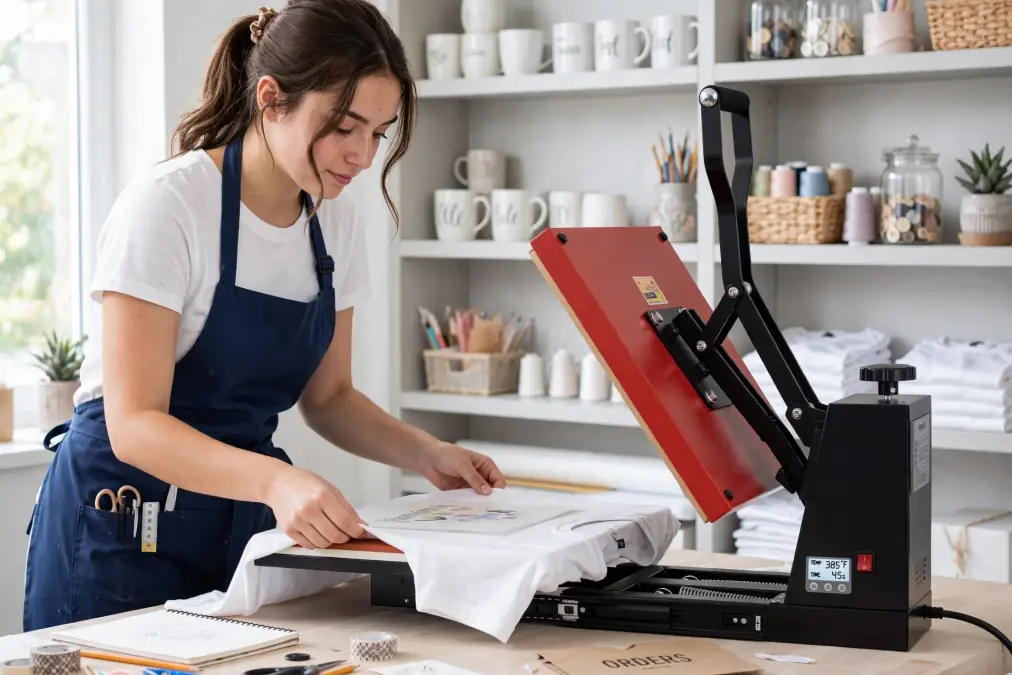
Swing-away presses need more clearance since the platen swings out to the side, and they typically cost more than an equivalent clamshell. For anyone pressing thicker items, layered materials, or large-coverage designs, that extra space and cost usually pays off in more consistent results.
Drawer-style and combo presses
A drawer-style press has a lower platen that slides out like a drawer for loading, rather than requiring you to work underneath a hinged upper platen. This style is common on multi-attachment combo units, where you can swap between a flat platen, a mug attachment, a plate attachment, and a cap attachment on the same base machine.
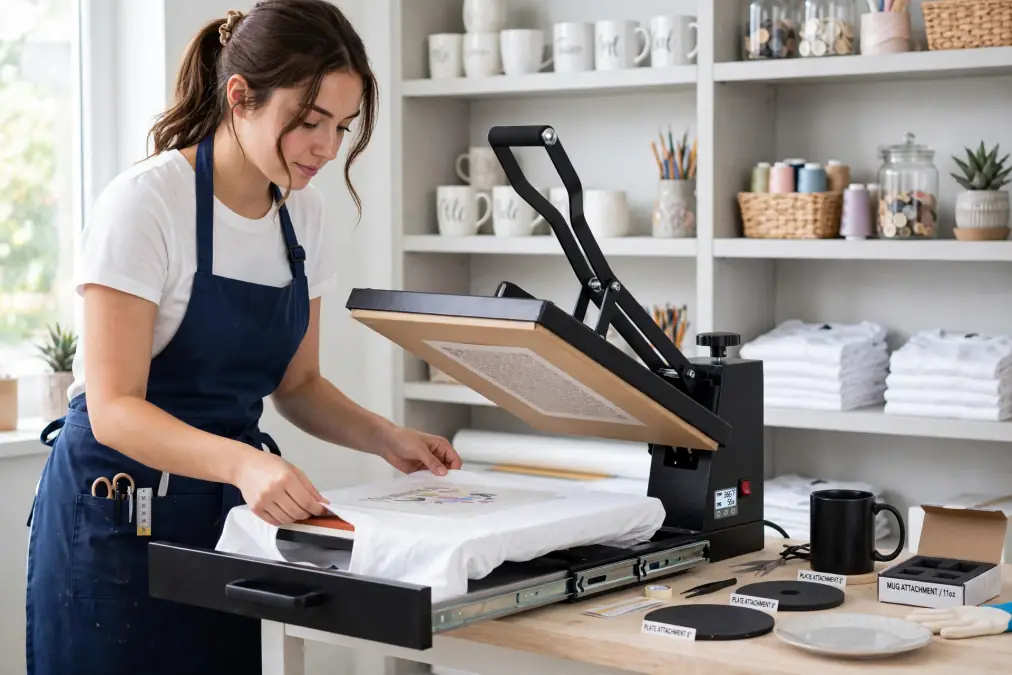
If you’re planning to sell more than one product type, a combo press can be more cost-effective than buying a dedicated flat press and a separate mug press. The tradeoff is that swapping attachments takes time, so a high-volume single-product shop is usually better served by a dedicated press per product line instead.
Auto-open presses
Auto-open isn’t a separate press category, it’s a feature that can appear on clamshell, swing-away, or combo presses. When the timer ends, the press releases and opens on its own instead of requiring you to catch the exact moment and lift it manually.
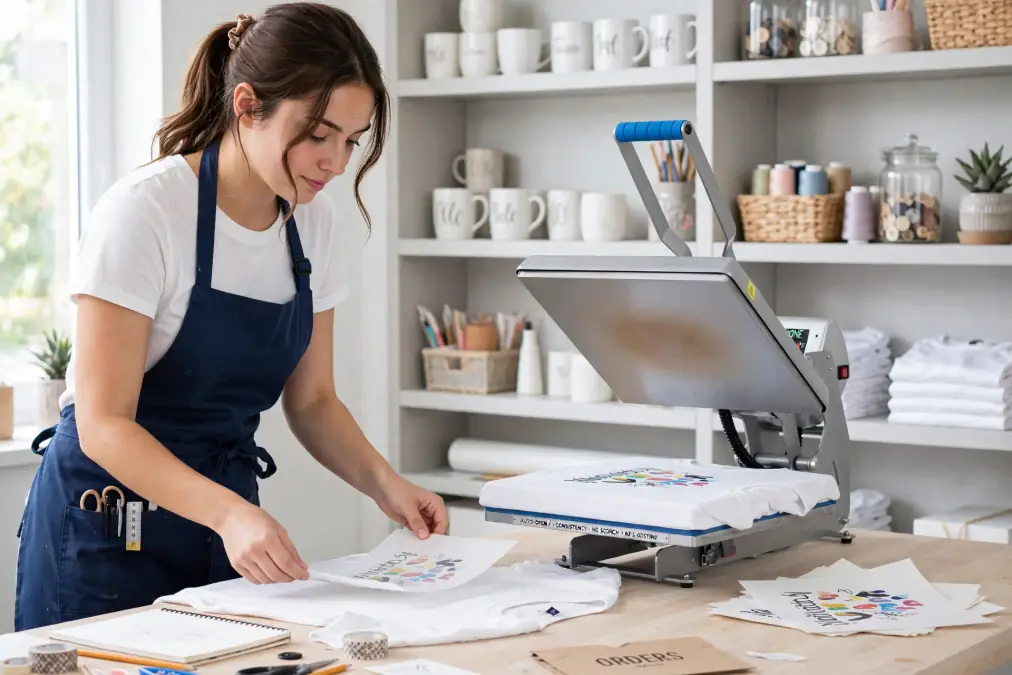
Auto-open removes one source of timing variation because the press releases when the timer ends. It is useful for repeated jobs or when you are preparing the next item, but it does not replace the correct time, temperature, pressure, and peel instructions for the transfer or blank.
| Press type | How it opens | Best for | Tradeoff |
|---|---|---|---|
| Clamshell | Hinged at the back, top platen swings up and down | Thin, flat substrates: shirts, keychains, photo panels. Most common beginner choice. | Heated platen swings close to loading hands, more contact risk |
| Swing-away | Top platen swings fully to the side, then presses straight down | Thicker items, layered materials, large-coverage designs | Needs more clearance, typically costs more |
| Drawer-style / combo | Lower platen slides out like a drawer for loading | Multi-product sellers, mugs, plates, caps, and flat items on one base machine | Swapping attachments takes time, slower for single-product high volume |
| Auto-open | A feature, not a separate type; opens on its own when the timer ends | Anyone who wants consistent contact time without manually timing the lift | Can appear on clamshell, swing-away, or combo presses, usually a price add-on |
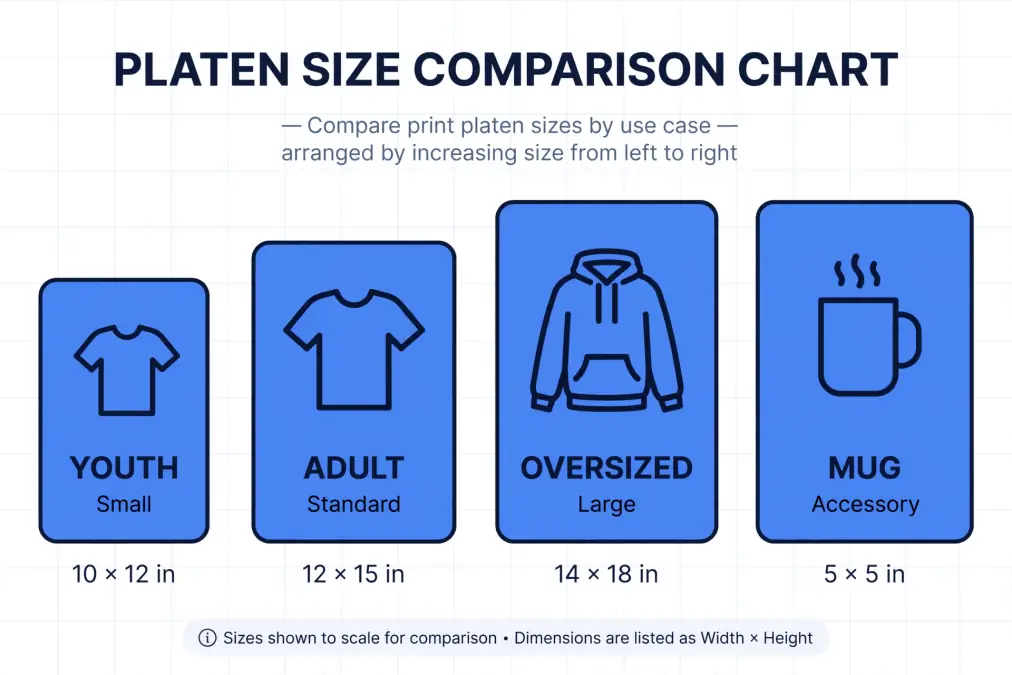
What size do you actually need?
| Platen size category | Typical use case |
|---|---|
| Small format (roughly 9″x12″ to 10″x12″) | Youth sizes, sleeves, small panels, ornaments |
| Standard format (roughly 11″x15″ to 15″x15″) | Adult t-shirt fronts, the most common size for general apparel work |
| Large format (16″x20″ and up) | Oversized designs, full-front coverage, hoodies and larger garments |
| Combo / interchangeable | Mugs, plates, caps in addition to flat items, via swappable attachments |
A 15″x15″ platen is one practical option for many apparel jobs, not a fixed requirement. Measure your largest repeat transfer and confirm the usable area plus garment loading clearance.
A small platen may suit sleeves or compact designs. If your actual recurring work includes wide shirt fronts or hoodies, check that those transfers fit without splitting or awkward repositioning.
If you’re choosing between 15×15 and 16×20, match the platen to your real jobs and workspace. A 15×15 press is practical for standard shirt work and tighter spaces. A 16×20 press gives more placement room for oversized graphics, hoodies, and larger transfers, but only pays off if you will use the extra area.
Buying considerations
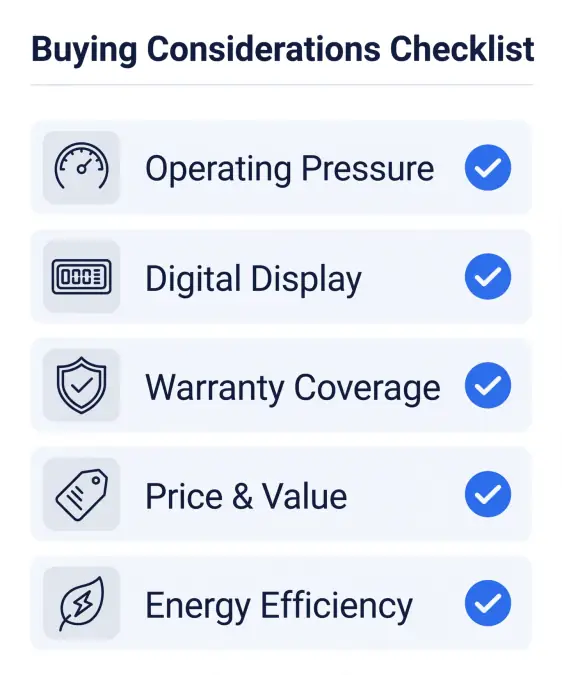
Pressure and even heat distribution
Heat consistency and pressure uniformity are difficult to judge from a spec sheet alone. Uneven contact can show up as patchy color or lighter areas where the transfer did not receive consistent heat and pressure.
The required pressure depends on the transfer, blank, and manufacturer instructions. What matters across jobs is even contact over the transfer area. Choose a press with adjustable pressure, follow the product-specific pressing guidance, and check whether the manufacturer provides calibration or pressure-reference information. Interchangeable platens can also change effective pressure, so pressure may need to be adjusted when the lower platen size changes.
Digital vs. analog controls
Digital time and temperature controls make settings easier to record, but a digital display does not verify even platen heat. Compare pressure adjustment, calibration guidance, support and documented operating behavior before buying.
It also makes it far easier to follow published time and temperature charts precisely, including our own heat press temperature guide for sublimation.
Warranty considerations
Warranty terms vary by manufacturer and sometimes by component. Read the written coverage for the heating platen, controller, frame, moving parts, and labor rather than relying only on the headline warranty length.
Before buying, check written warranty coverage for the heater, controls, frame, pressure mechanism, parts, labor and shipping. Confirm service options and replacement-part availability in your area.
Don’t assume warranty length based on price point alone; check the specific listing.
Budget picks vs. what to actually spend
The cheapest heat press on the market is rarely the cheapest one over time. A unit with inconsistent pressure or heat distribution produces failed transfers, and failed transfers cost you blanks, ink, paper, and time on every bad press, not just the sale price of the machine.
That doesn’t mean you need the most expensive option to start, it means evaluating pressure consistency and warranty coverage as part of the real cost, not just the sticker price.
Current pricing varies significantly by size and feature set, check listings directly at the time you’re ready to buy rather than relying on a fixed number here, since heat press pricing shifts with sales and inventory more than most sublimation equipment.
Interchangeable Platens Can Improve Difficult Jobs
Smaller or specialty lower platens help isolate the part of the garment that needs heat.
That is useful around:
- pockets
- youth garments
- sleeves
- bags
- zippers
- seams
Stahls notes that seams, buttons and zippers can interfere with pressure and recommends changing platens when needed to keep those obstructions away from the transfer area.
If apparel variety is important to your business, check whether replacement or specialty platens are available before buying.
Mug Press, Tumbler Press, Combo Press or Oven?
Do not choose the equipment until you know how often you will make drinkware.
| Workflow | Equipment to consider |
|---|---|
| A few mugs occasionally | Combo attachment may be enough |
| Regular mug orders | Dedicated mug press |
| Regular tumblers | Dedicated tumbler press |
| Multiple tumblers per batch | Tumbler press or sublimation oven |
| Mixed irregular drinkware | Compare oven workflow |
| Mostly flat products | Keep drinkware equipment separate |
Combo Press
A combo machine can save space for occasional use.
Its weakness is workflow.
Changing attachments repeatedly becomes less attractive when drinkware orders increase.
Dedicated Mug or Tumbler Press
Dedicated equipment is easier to leave configured for one product type.
Check the manufacturer’s supported:
- diameter
- circumference
- height
- shape
before assuming every tumbler or mug fits.
Sublimation Oven
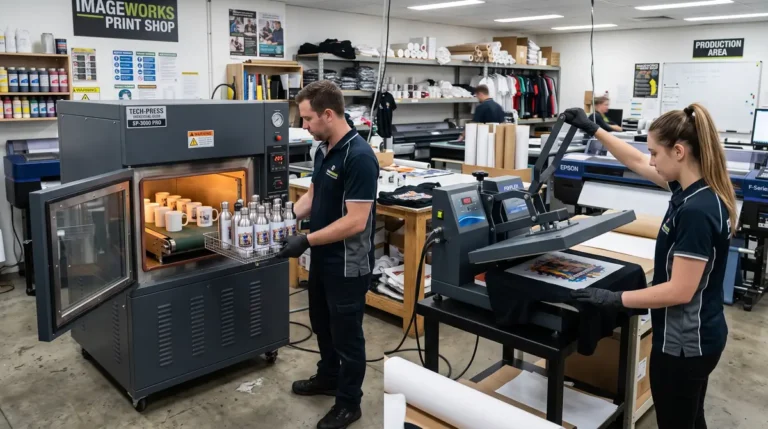
An oven can handle multiple or irregularly shaped items in ways a flat press cannot.
For a deeper equipment decision, see the industrial sublimation oven vs heat press comparison.
Check These Specifications Before Buying
A spec sheet is useful only when you know which numbers affect your work.
Use this checklist.
Platen and Loading
- platen dimensions
- removable or interchangeable lower platens
- threadability
- slide-out loading
- maximum substrate thickness
- working clearance
Heat and Pressure
- adjustable pressure
- stated temperature range
- temperature control method
- heating-platen construction
- available calibration information
Stahls’ buying guidance emphasizes heat consistency, pressure, platen construction, loadability, service and manufacturer support rather than focusing on a single headline specification.
Workflow
- manual, auto-open or automatic operation
- timer
- presets
- loading access
- repeat-cycle convenience
Physical Requirements
Check:
- closed dimensions
- open dimensions
- swing clearance
- drawer clearance
- machine weight
- wattage
- electrical requirements
A swing-away press can fit on a bench while closed and still collide with a wall when opened.
Measure the operating footprint.
Support
Before purchasing, check:
- written warranty
- warranty exclusions
- technical support
- replacement parts
- replacement platens
- documentation
- seller support
Do not assume a longer feature list means better long-term support.
Cheap vs Small-Business vs Production Presses
Fixed price brackets age quickly.
A more useful comparison is capability.
| Level | Typical use | Priorities |
|---|---|---|
| Entry / craft | Occasional projects | Basic pressure, usable platen, compact footprint |
| Small business | Regular paid work | Repeatability, support, threadability, workflow |
| Production | High daily volume | Serviceability, platen options, automation, durability |
Entry-Level
Suitable when you are still learning or producing occasionally.
Focus on:
- pressure adjustment
- usable temperature control
- safe operation
- support
Small-Business
Once orders become regular, workflow matters more.
Look for:
- reliable controls
- easier loading
- auto-open or useful automation
- threadability
- good support
- replaceable parts
Production
A high-volume press needs to survive repeated cycles without becoming the bottleneck.
For that buying stage, use the high-volume apparel heat press guide.
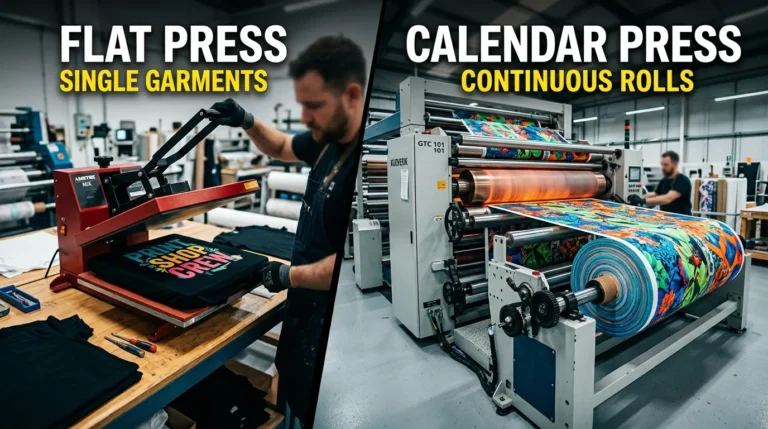
If your work is moving toward roll goods or bulk fabric, compare a calendar heat press vs flat heat press instead of trying to stretch a starter press beyond its role.
Total Cost of Ownership: Compare the Complete Setup
A heat press purchase involves more than a machine price. Compare each shortlisted model against your actual products, electrical capacity, attachment needs, support coverage, and likely throughput. These factors remain useful even when advertised prices change.
| Buying factor | What to check |
|---|---|
| Machine and compatible attachments | Included platen, interchangeable tables, mug attachments and any required stands |
| Installation and power | Machine weight, counter space, opening clearance, voltage and rated current |
| Service and replacements | Heating elements, pads, electronics, replacement parts and warranty labor/shipping |
| Output and workflow | Garment loading, attachment swaps and practical batch pace |
| Risk of rejected prints | Heat distribution, pressure consistency and ability to verify settings |
| Total delivered cost | Equipment, accessories, shipping, setup and planned maintenance |
Estimate total equipment outlay = press + necessary attachments + delivery/setup + planned maintenance or replacements. Then compare that cost with realistic orders. The sublimation equipment ROI calculator helps explore assumptions without promising a specific return.
For one documented example of model-specific specifications, the Geo Knight DK16A product page lists pressing dimensions, electrical requirements and component warranty terms. Verify these for the exact press you intend to buy.
Common mistakes when buying your first heat press
- Buying too small a platen. Choose around your largest recurring transfer size and workspace, not only the lowest purchase price.
- Choosing based on price alone. A lower price with no pressure adjustability or a thin warranty often costs more once you count failed presses and early replacement.
- Not planning for multi-product needs upfront. Consider a combo only when the required mug or plate attachments are manufacturer-approved for your actual blanks. A separate heater may be more practical for frequent drinkware jobs.
- Skipping digital controls to save money. The consistency they provide matters more once you’re selling finished products, not just making them for yourself.
- Not checking warranty coverage before buying. Confirm what’s covered and for how long before you commit, not after something fails.
Upgrade path
An entry-level press is the right starting point for most beginners, but it’s not meant to be a permanent production tool if your business grows. If you’re pressing dozens of items a day rather than a handful, or you’re running multiple presses to keep up with orders, it’s time to look at commercial-grade equipment built for that volume.
Our high-volume heat press guide covers what changes at that scale.
If you’re specifically weighing a calendar press for bulk fabric or roll-fed work against a traditional flat press, that’s a deeper decision than this guide covers, see our calendar press vs flat press comparison for that specific choice.
And if you’re wondering whether a sublimation oven might fit your workflow better than a press for certain items, our sublimation oven vs heat press breakdown covers the cost and output tradeoffs.
Frequently asked questions
What’s the difference between a clamshell and swing-away press?
A clamshell opens and closes like a hinge, with the heated platen swinging down close to the loading area. A swing-away press moves the heated platen fully off to the side before loading, then presses straight down for more even pressure. Clamshells are more compact and affordable; swing-away presses are safer to load and generally better for thicker items.
What size heat press do I need for adult t-shirts?
A 15″x15″ platen is the standard reference size for adult shirt fronts. Smaller platens work for youth sizes and sleeve prints, but limit you on full-front adult designs.
Do I need a separate mug press, or can a combo unit do both?
A combo or drawer-style press with interchangeable attachments can handle both flat items and mugs on one base machine. If you’re selling high volumes of both product types, dedicated presses for each are faster since you’re not swapping attachments between runs.
How much pressure does a heat press actually need?
Pressure needs vary by substrate and manufacturer, and exact PSI figures aren’t always published by every brand. What matters more in practice is even distribution across the entire platen surface, not just hitting a specific number. Check for adjustable pressure control and look for user feedback on consistency rather than relying on a spec sheet number alone.
Is a cheap heat press worth it for beginners?
It depends on what “cheap” gets you. A budget press with adjustable pressure and a reasonable warranty can be a fine starting point. A budget press with fixed pressure and minimal warranty coverage often costs more over time in failed transfers and early replacement than a mid-range option would have upfront.
What’s the difference between a heat press and a sublimation oven?
A heat press applies direct pressure and heat to a flat or nearly-flat surface. A sublimation oven heats the entire item in an enclosed space without direct pressure, which makes it better suited to irregularly shaped items a flat press can’t contact evenly. See our sublimation oven guide for when you’d actually need one.
Final recommendation
For flat apparel, choose the platen size around your recurring transfers and compare clamshell, swing-away or slide-out access within your workspace. If drinkware is a regular product, check actual blank dimensions and compare an approved combo system with dedicated equipment.
Check platen consistency, safe loading, pressure adjustment, warranty terms and the cost of required accessories. The lowest purchase price does not necessarily make a press the best fit for the products you actually sell.
Once your press arrives, the next step is dialing in your settings. Our heat press settings calculator gives you a starting point for time, temperature, and pressure based on your specific substrate.