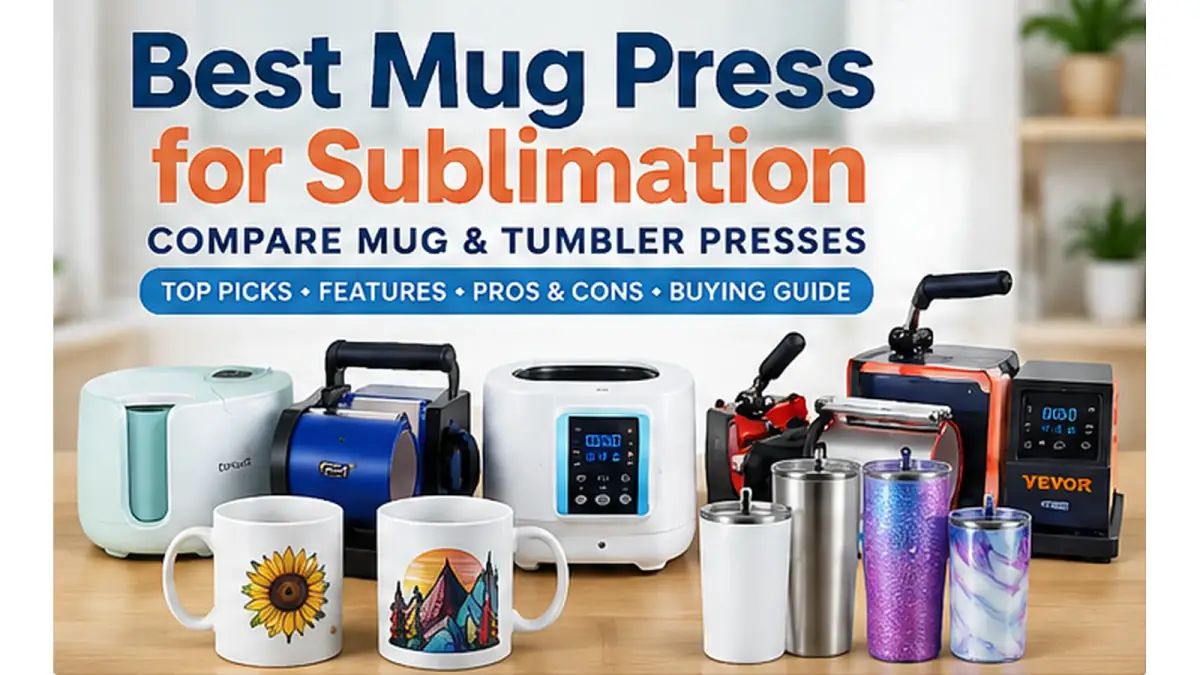
Best Mug Press for Sublimation 2026: Compare Mug & Tumbler Presses

The best mug press for sublimation depends less on the brand name and more on the drinkware you actually plan to press.
A machine built around 11 oz and 15 oz ceramic mugs can be a good fit for a mug-focused shop, but it may become frustrating as soon as you add 20 oz skinny tumblers. A long tumbler press gives you more flexibility, while a manual press with replaceable elements can make more sense for regular production.
The first buying decision is simple: standard mugs only, mugs plus tumblers, or higher-volume drinkware production.
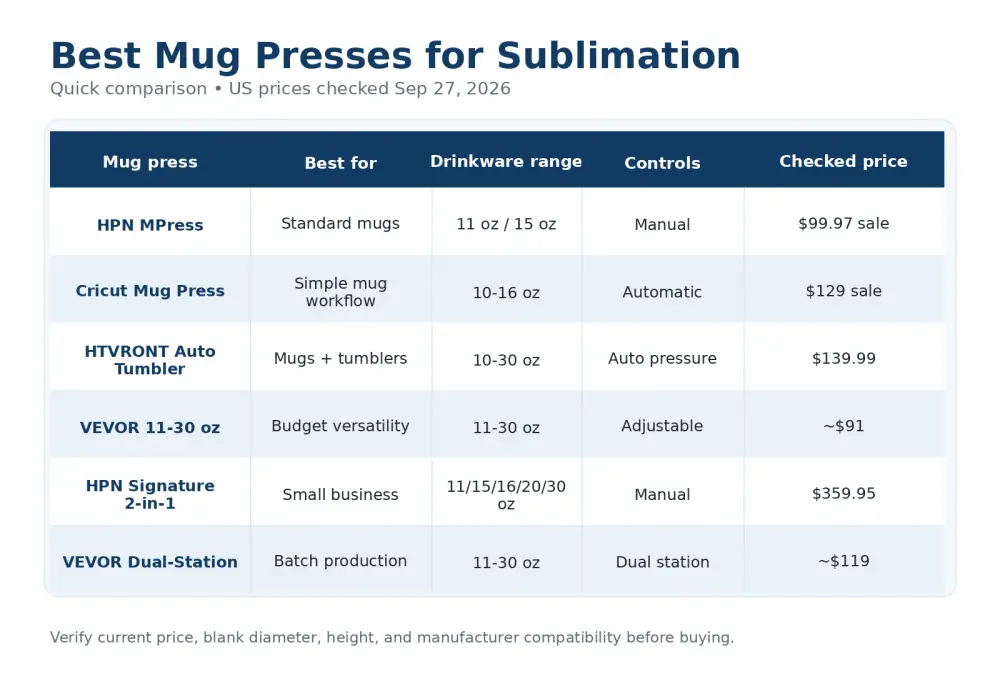
Best Mug Presses for Sublimation at a Glance
These picks are based on verified manufacturer specifications, controls, drinkware compatibility, replacement-part considerations, and the type of workflow each press fits.
US prices checked September 27, 2026. Sale prices can change.
| Mug press | Best for | Verified drinkware range | Pressure/control style | Price checked |
|---|---|---|---|---|
| HPN MPress Digital Mug Press | Standard 11 oz and 15 oz mugs | 11 oz and 15 oz mugs, up to 3.4-inch diameter | Manual press, adjustable time/temp | $99.97 sale |
| Cricut Mug Press | Simple standard-mug workflow | 10 to 16 oz, 3.2 to 3.4-inch diameter | Automatic heat/pressure process | $129 sale |
| HTVRONT Auto Tumbler Heat Press | Mugs plus skinny tumblers | 10 to 30 oz, about 2.95 to 3.18-inch diameter | Automatic pressure, adjustable time/temp | $139.99 |
| VEVOR 11-30 oz Tumbler Heat Press | Budget multi-size drinkware | 11 to 30 oz, 2.91 to 3.43-inch diameter | Adjustable time/temp | About $91 |
| HPN Signature 2-in-1 | Small business and long-term flexibility | 11/15 oz mugs plus 16/20/30 oz skinny tumblers | Manual, 4-point pressure adjustment | $359.95 |
| VEVOR Dual-Station Tumbler Press | Batch drinkware production | 11 to 30 oz | Two independently controlled stations | About $119 |
Manufacturer pricing and availability change frequently, so compare the current price with the drinkware range and replacement-part situation before buying.
HPN MPress Digital Mug Press: Best Fit for Standard Mugs on a Budget
The HPN MPress makes the most sense when your product line centers on traditional 11 oz and 15 oz sublimation mugs.
Heat Press Nation lists compatibility with 11 oz and 15 oz sublimation mugs, a maximum substrate diameter of 3.4 inches, digital time and temperature controls, and a temperature range up to 400°F. The press was listed at $99.97 when checked.
Best for:
Standard ceramic mug production without paying for tumbler capability you may never use.
Avoid if:
You already plan to add 20 oz or 30 oz skinny tumblers.
A particularly useful detail is the replaceable heating element. Heat Press Nation sells a model-specific MPress replacement element that handles 11 oz and 15 oz mugs. It was listed at $64.95 but sold out when checked.
That matters because the heating element is the part doing the hardest thermal work. A cheap mug press becomes less attractive if a worn element means replacing the entire machine.
Bottom line: Choose the MPress when standard ceramic mugs are the main product and you prefer manual time and temperature control over a fully automatic workflow.
Cricut Mug Press: Best Fit for Simple Mug-Only Production
The Cricut Mug Press removes most setup decisions. There is no normal manual time, temperature, or pressure adjustment during pressing.
Cricut specifies compatible drinkware at 10 to 16 oz, with a diameter of 3.2 to 3.4 inches and a maximum height of 4.72 inches. The pressing surface needs to be smooth and straight.
The machine was listed at $129 on Cricut’s US store when checked, against a $149.99 MSRP.
Best for:
A beginner or low-volume seller who wants a straightforward workflow for compatible ceramic mugs.
Avoid if:
You want broad tumbler compatibility or direct control over pressure, temperature, and cycle time.
Cricut also recommends keeping the design at least 0.5 inch from the handle. Designs pushed farther into that area can develop fading or discoloration because of the changing mug geometry.
That is an important example of why a mug’s ounce rating alone does not tell you whether it fits a press well.
Bottom line: The Cricut Mug Press favors simplicity. That same simplicity becomes a limitation when your blanks vary in diameter, height, shape, or required settings.
HTVRONT Auto Tumbler Heat Press: Best Fit for Mugs Plus Skinny Tumblers
The HTVRONT Auto Tumbler Heat Press covers a wider drinkware range without requiring manual clamping pressure.
HTVRONT lists compatibility with 10 to 30 oz drinkware around 2.95 to 3.18 inches in diameter. The machine automatically applies pressure according to the tumbler diameter while still allowing the operator to set time and temperature. Its listed temperature range is 210°F to 390°F.
The standard kit was $139.99 when checked.
Best for:
A maker who expects to move between ceramic mugs, skinny tumblers, glass drinkware, and similar straight-sided blanks.
Avoid if:
Your blanks regularly fall outside the specified diameter range or you want hands-on pressure adjustment.
This type of automatic press removes one variable from the operator’s workflow. That can help when several people use the same machine, but it also means you have less ability to compensate manually for an unusual blank.
Bottom line: This is a stronger direction than a mug-only press when your future product catalog includes standard mugs and common skinny tumblers.
HPN Signature 2-in-1: Best Fit for a Growing Sublimation Business
The HPN Signature 2-in-1 costs considerably more than hobby-focused presses, but it takes a different approach to long-term drinkware production.
The package includes:
- 11/15 oz mug attachment
- 16/20/30 oz skinny tumbler attachment
- 4-point pressure adjustment
- adjustable time and temperature
- replaceable interchangeable elements
- steel frame construction
Heat Press Nation listed the machine at $359.95 when checked. The standard manufacturer warranty is one year, while technical support is offered beyond that period.
Best for:
A small business that expects to keep the press in service and values replaceable attachments, pressure adjustment, and access to parts.
Avoid if:
You only make a few standard mugs each month.
Heat Press Nation explicitly classifies the mug heating element as a consumable item that is not covered by the standard warranty. That sounds like a drawback, but the company also sells compatible replacement elements.
For production equipment, knowing the wear part can be replaced is often more useful than pretending the part will never wear.
Bottom line: The higher purchase price starts to make more sense when parts access, pressure control, and multiple drinkware sizes matter to the business.
VEVOR 11-30 oz Tumbler Heat Press: Best Budget Option for Multiple Cup Sizes
The VEVOR 11-30 oz model offers a broad size range at a comparatively low entry price.
VEVOR lists compatibility with 11 to 30 oz cups, a diameter range of 2.91 to 3.43 inches, and a maximum height of 10.63 inches. The machine provides adjustable time and temperature settings.
The model was about $90.90 when checked, although VEVOR pricing changes frequently between colors, promotions, and listings.
Best for:
Budget-conscious buyers who want to press both mugs and common straight tumblers.
Avoid if:
Long-term replacement-element availability is one of your highest priorities.
VEVOR’s current policy lists a standard 12-month manufacturer’s warranty, with repair support for covered manufacturing or mechanical failures.
The low purchase price is appealing, but price should not replace a blank-fit check. Measure your actual drinkware diameter before assuming every 20 oz or 30 oz tumbler will fit.
Bottom line: This model provides a lot of drinkware range for the purchase price, but verify the exact blank dimensions and current parts policy before building a business workflow around it.
VEVOR Dual-Station Tumbler Press: Best Fit for Batch Drinkware Production
A dual-station press changes the buying decision when order volume starts to matter.
VEVOR’s dual-station model supports drinkware up to 30 oz and gives each station independent time and temperature control. The current listing describes two heating stations that can work simultaneously.
It was listed at about $118.90 when checked.
Best for:
A small shop regularly processing multiple mugs or tumblers in the same production session.
Avoid if:
Most of your work is one-off personalization.
Two stations do not automatically double real production output. Artwork preparation, wrapping, taping, cooling, inspection, and packaging still consume time.
Use a sublimation production time calculator when comparing a faster press setup with your actual order workflow.
Bottom line: Buy extra stations because your production volume justifies them, not simply because the machine can press more than one item at a time.
Mug Press or Tumbler Press? Decide This Before Comparing Brands
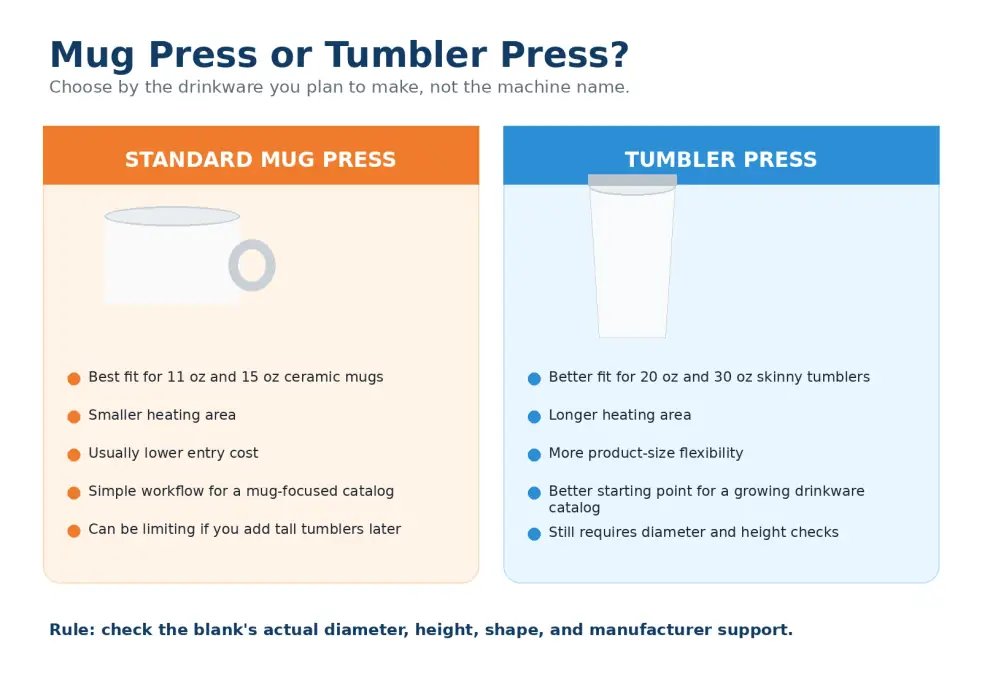
A standard mug press and a tumbler press solve related but different problems.
| Your product plan | Better starting point |
|---|---|
| Mostly 11 oz ceramic mugs | Standard mug press |
| 11 oz and 15 oz mugs | Standard mug press |
| Mugs plus 20 oz skinny tumblers | Long tumbler press |
| 20 oz and 30 oz tumblers | Tumbler press |
| Many drinkware shapes | Interchangeable-attachment system |
| Larger batches | Dual-station or production-oriented press |
Choose a Standard Mug Press for 11 oz and 15 oz Mugs
A standard mug press is easier to justify when ceramic mugs make up most of your work.
You get a smaller heating area designed around short cylindrical blanks, and you avoid paying for extra capacity that sits unused.
If you are still learning the full production process, use the step-by-step mug sublimation guide for artwork preparation, wrapping, pressing, and cooling.
Choose a Tumbler Press When 20 oz or 30 oz Drinkware Is Part of the Plan
Skinny tumblers are substantially taller than a standard coffee mug.
The heating element has to cover enough of that length, and the press needs to accept the actual diameter. A machine described only as a “mug press” may not do either.
If tumbler production will be an important part of your catalog, it is usually better to buy for that requirement now instead of replacing a mug-only press later.
Choose Interchangeable Attachments When Your Catalog Changes Often
A press with replaceable elements makes sense when you expect to add several drinkware formats.
The trade-off is cost. Attachments increase the initial investment and create more parts to store, maintain, and replace.
For sellers comparing a press with a convection oven, the decision is broader than cup size. Read the dedicated mug press vs convection oven comparison rather than treating the two methods as interchangeable.
What Actually Matters When Choosing a Sublimation Mug Press
Maximum temperature is easy to advertise. Heat coverage, pressure, blank fit, and serviceability usually matter more in day-to-day use.
Heating Coverage Matters More Than the Highest Temperature Number
A press can reach the required temperature and still produce weak results if the heating element does not transfer heat evenly across the design area.
Common symptoms include:
- faded areas near the bottom
- weak color close to the handle
- one side transferring better than the other
- the same pale area appearing on repeated mugs
- full-wrap designs looking stronger in the center than at the edges
The mug itself can contribute to the problem. Ceramic is often thicker near the base, and areas close to the handle are harder for many presses to contact evenly.
A wider temperature range on the control panel will not fix poor physical contact.
Pressure Control Affects Contact Between the Transfer and Blank
Sublimation needs close, even contact between the printed transfer and the coated blank.
Manual presses let you adjust clamping pressure directly. Automatic presses simplify this by applying pressure for you.
Neither system is automatically better.
Automatic pressure suits a consistent product line. Manual adjustment is useful when blanks vary slightly in diameter or you need more control over contact.
Measure Diameter and Height, Not Just Ounces
A 15 oz label describes capacity. It does not fully describe the mug’s external dimensions.
Check:
- outside diameter
- printable height
- total mug height
- straight-wall area
- taper near the top or bottom
- handle clearance
Cricut, for example, specifies a narrow 3.2 to 3.4-inch diameter range even though compatible mugs can range from 10 to 16 oz.
VEVOR’s reviewed tumbler model accepts 2.91 to 3.43-inch diameters despite being marketed for 11 to 30 oz drinkware.
The physical measurement tells you more than the capacity printed on the box.
Straight, Tapered, and Handled Drinkware Are Not Interchangeable
Most wrap-style mug and tumbler presses work best on straight cylindrical sections.
Curves and tapers can reduce contact between the heating pad and the blank. Handles create another area where the element cannot fully wrap around the surface.
Before buying a press for latte mugs, tapered tumblers, handled travel mugs, or unusually shaped blanks, verify that the manufacturer offers a compatible attachment or explicitly supports the shape.
Do not assume a blank fits because its ounce capacity falls within the advertised range.
Thermal Recovery Matters During Repeated Production
Putting a cold mug into a hot press pulls heat from the heating element.
A press used once every half hour has plenty of time to stabilize. A press used repeatedly during a 30-mug order has a harder job.
For batch work, pay attention to:
- recovery between cycles
- stable readings during repeated presses
- how the manufacturer handles temperature regulation
- whether your workflow gives the press time to recover
Production speed is not just the timer setting. Wrapping, loading, reheating, cooling, and handling all contribute to output.
Replacement Heating Elements Can Matter More Than Extra Digital Features
Heating elements are wear components on some mug presses.
Heat Press Nation explicitly calls its mug heating elements consumable items and sells replacement elements for several press families.
Before buying, ask:
- Is a replacement heating element available?
- What does it cost?
- Is it currently stocked?
- Can the user replace it?
- Is the element covered by the warranty?
- Does replacement require buying an entire attachment?
A $100 press that becomes disposable after a heater problem can cost more over time than a more serviceable machine.
Mug Press Compatibility Chart by Drinkware Type
Use this as a buying reference, not as a substitute for checking the blank’s exact measurements.
| Drinkware | Standard mug press | Long tumbler press | Multi-attachment press | Convection oven |
|---|---|---|---|---|
| 11 oz ceramic mug | Usually suitable | Often suitable | Suitable with correct element | Suitable with correct wrap |
| 15 oz ceramic mug | Often suitable | Often suitable | Suitable with correct element | Suitable with correct wrap |
| 16 oz glass can | Model dependent | Often better suited | Attachment dependent | Often suitable |
| 20 oz skinny tumbler | Usually not | Common use case | Suitable with tumbler element | Suitable |
| 30 oz skinny tumbler | Usually not | Model dependent | Suitable with correct element | Suitable |
| 40 oz handled tumbler | Usually not | Often too large | Requires specific large attachment | Method dependent |
| Stainless travel mug | Shape dependent | Shape dependent | Attachment dependent | Often possible |
| Tapered latte mug | Usually problematic | Usually problematic | Specific element preferred | Often easier |
| Shot glass | No | No | Requires specialty attachment | Possible with proper wrap |
Practical rule: Match the press to the blank’s diameter, height, and shape, then confirm the manufacturer supports that combination.
Automatic vs Manual Mug Press: Which Fits Your Workflow?
Neither design is automatically better. The right choice depends on how consistent your blanks and production process are.
Automatic Presses Reduce Setup Decisions
Machines such as the Cricut Mug Press or HTVRONT Auto Tumbler Press reduce the amount of clamping work required from the operator.
That helps when:
- multiple people use the same machine
- you want a simple training process
- you work with a narrow range of known blanks
- repeatability matters more than manual adjustment
Cricut takes automation further by controlling the transfer cycle without normal manual time or temperature adjustment.
HTVRONT automatically applies pressure while still allowing the user to adjust time and temperature.
Manual Presses Give You More Physical Control
A manual clamp is useful when the blank needs slightly different pressure.
That flexibility can help with:
- slight diameter variation
- different mug suppliers
- switching between attachments
- troubleshooting incomplete contact
The trade-off is operator judgment. Too little pressure can leave weak transfer areas, while excessive pressure can create other problems or shorten component life.
Small Businesses Should Think About Repeatability and Downtime
The cheapest press is not always the least expensive machine to own.
For regular paid orders, compare:
- cycle consistency
- replacement elements
- spare-part availability
- warranty terms
- technical support
- time lost if the machine fails
Use the sublimation equipment ROI calculator to compare equipment cost with your real profit per order and expected sales volume.
Best Mug Press Setup by Use Case
A use-case decision is more useful than declaring one machine the universal winner.
For a Beginner Making Standard Ceramic Mugs
Look first at:
- HPN MPress
- Cricut Mug Press
Choose Cricut when you value a simplified automated workflow.
Choose the MPress when you want manual time and temperature settings and access to a replaceable heating element.
For Mugs Plus 20 oz and 30 oz Skinny Tumblers
A longer press is the better starting point.
The HTVRONT Auto Tumbler Press and VEVOR 11-30 oz press both cover a broader drinkware range than a standard mug-only machine.
Check diameter carefully before ordering blanks in bulk.
For an Etsy or Small Sublimation Business
Look beyond purchase price.
A stronger business-focused checklist includes:
- parts availability
- pressure control
- multiple attachment options
- technical support
- repeatable production
- warranty
- expansion into new drinkware sizes
The HPN Signature 2-in-1 fits this type of workflow better than a basic mug-only press because the standard package already covers mugs and common skinny tumblers.
For Batch Mug or Tumbler Production
A dual-station machine can reduce waiting at the pressing stage.
That only pays off when pressing is actually your bottleneck.
If printing, trimming, wrapping, cooling, or packaging takes longer than pressing, adding another heating station may not improve total job output as much as expected.
If Long-Term Serviceability Matters
Check replacement parts before purchase.
Heat Press Nation has the clearest replacement-element ecosystem among the models compared here. HPN lists model-specific mug and tumbler heating elements in its replacement-parts catalog.
A manufacturer warranty is still useful, but a press may remain in service much longer than the warranty period.
Hidden Costs to Check Before Buying a Mug Press
The machine price is only the first equipment cost.
Budget for:
- replacement heating elements
- optional mug or tumbler attachments
- heat-resistant tape
- protective paper
- heat-resistant gloves
- test blanks
- failed blanks during setup
- shipping
- sales tax
- extended protection plans
- downtime if parts are unavailable
For example, the MPress replacement element was listed at $64.95 when checked.
HPN’s Signature 2-in-1 includes both its standard mug attachment and skinny-tumbler attachment, so the higher purchase price already covers two drinkware categories.
Cricut’s US warranty information currently lists a one-year limited warranty for eligible machines and heat presses purchased from authorized sellers.
HTVRONT’s US policy lists machine coverage for 365 days after receipt.
VEVOR currently lists a standard 12-month manufacturer’s warranty.
Compare the cost of getting back into production, not just the cost of getting the machine onto your workbench.
Common Mug Press Buying Mistakes
Buying a Mug-Only Press Before Deciding If You Want to Sell Tumblers
This is one of the easiest equipment purchases to outgrow.
If 20 oz or 30 oz tumblers are likely to enter your catalog, compare long tumbler presses before buying a standard mug-only machine.
Shopping by Ounce Capacity Instead of Diameter
“Fits 30 oz” does not mean every 30 oz blank fits.
Measure the blank and compare it with the manufacturer’s diameter and height range.
Assuming Every Straight-Looking Mug Is Truly Straight
Some drinkware tapers slightly near the rim or base.
That small change can reduce pressure and heat contact near the edge of a full-wrap design.
Ignoring Pressure Adjustment
Pressure is not just a setup detail.
Poor contact can show up as pale areas, soft edges, or incomplete transfer near difficult parts of the blank.
Ignoring Replacement Heating Elements
A digital display can last while the heating element develops a problem.
Check the replacement element before buying the press, not after you need one.
Comparing Maximum Temperature Instead of Heating Coverage
A higher maximum temperature does not prove a press heats more evenly.
Most buying decisions should focus on usable settings, coverage, contact, recovery, and fit.
Buying Only for the Products You Sell Today
Think one product step ahead.
If you currently make 11 oz mugs but already plan to add skinny tumblers, buying a tumbler-capable press now may cost less than replacing a mug-only machine later.
Assuming Better Equipment Fixes Every Bad Transfer
A good press cannot correct:
- an incompatible blank coating
- loose transfer paper
- poor artwork
- incorrect print settings
- moisture
- wrong time and temperature
- movement during pressing
Use a sublimation temperature chart as a starting reference, then follow the blank manufacturer’s settings when available.
Mug Press Problems That Can Look Like a Bad Machine
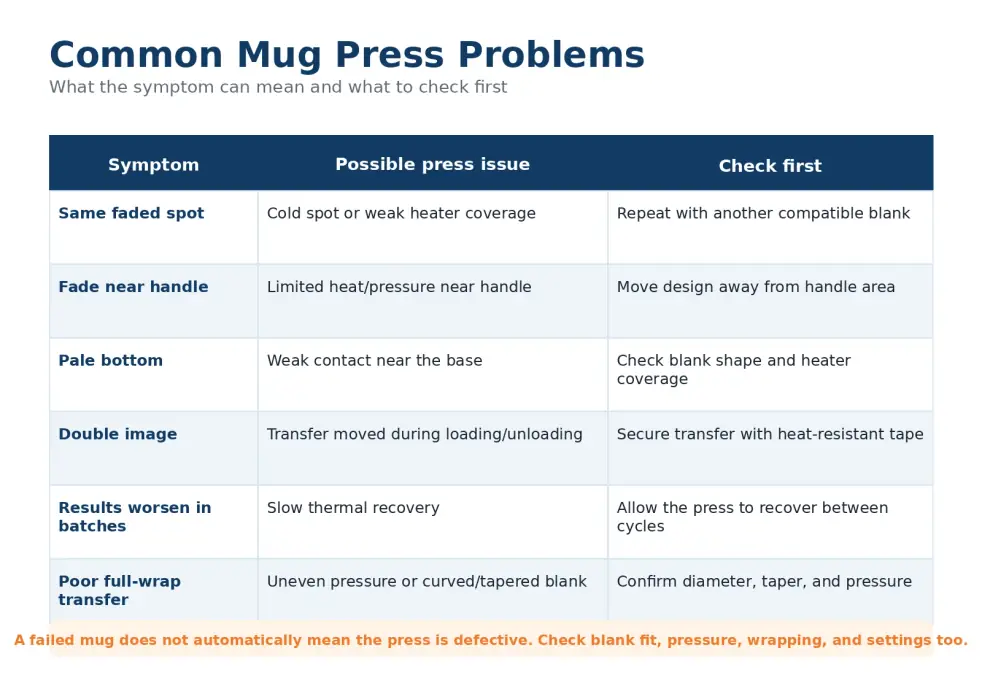
Not every failed mug means the press is defective.
| Symptom | Possible press-related cause | Possible workflow cause |
|---|---|---|
| Same faded spot on every mug | Cold spot or heater issue | Blank shape repeatedly losing contact |
| Fade near handle | Limited element coverage | Design placed too close to handle |
| Whole mug looks pale | Incorrect temperature or calibration | Wrong time, ink, paper, coating, or print settings |
| Double image or shadow | Transfer moved during loading/unloading | Tape not securing design |
| Bottom of design stays pale | Weak coverage near base | Thick mug base or incorrect cycle |
| Later mugs become inconsistent | Slow thermal recovery | Production pace too fast |
| One mug works, another fails | Pressure/fit variation | Blank dimensions or coating differ |
Start troubleshooting with repeatability.
If the same physical area fails on several compatible mugs, inspect the press, heating element, and contact pattern.
If the failure moves around between mugs, check wrapping, pressure, blank consistency, transfer movement, and settings before replacing the machine.
Mug Press Buying Checklist
Use this checklist before ordering.
Drinkware Fit
- I know the exact diameter of my main mugs.
- I know the maximum height I need to press.
- I know if my blanks are straight or tapered.
- I checked handle clearance.
- I confirmed tumbler support if I plan to sell tumblers.
Press Controls
- I know whether I want automatic or manual pressure.
- I checked whether time is adjustable.
- I checked whether temperature is adjustable.
- I understand how pressure changes for different blanks.
Ownership Costs
- I checked replacement heating-element availability.
- I checked replacement-element price.
- I reviewed the warranty.
- I checked who provides technical support.
- I included extra attachments in my budget.
Production
- I estimated how many mugs I will press per week.
- I considered recovery time between cycles.
- I know if a single station is enough.
- I checked if pressing is actually my production bottleneck.
Future Products
- I considered 20 oz tumblers.
- I considered 30 oz tumblers.
- I checked whether larger or specialty attachments are available.
- I am buying for the product range I expect to sell, not only today’s first project.
Frequently Asked Questions
Is the Cricut Mug Press Worth It for Sublimation?
The Cricut Mug Press is a practical choice when you want a simple process for compatible straight-sided mugs and do not need manual time, temperature, or pressure adjustments. Its main limitation is the narrow physical compatibility range: 10 to 16 oz, 3.2 to 3.4 inches in diameter, and up to 4.72 inches high.
A broader tumbler press is a better fit if you plan to sell several drinkware sizes.
Can a Mug Press Be Used for Tumblers?
Only when the press or its attachment supports the tumbler’s actual dimensions.
Some long mug presses are designed for 20 oz and 30 oz skinny tumblers. Standard short mug presses often are not.
Check diameter, height, and shape rather than relying on the product name.
What Is the Difference Between a Mug Press and a Tumbler Press?
A standard mug press has a shorter heating element sized around coffee mugs. A tumbler press uses a longer heating area that can accommodate taller drinkware.
Some machines bridge both categories, but you still need to confirm the exact supported diameter and height.
Can One Mug Press Handle Both 11 oz and 15 oz Mugs?
Many can.
The HPN MPress supports both 11 oz and 15 oz mugs, while Cricut supports compatible straight-wall mugs from 10 to 16 oz within its specified diameter and height range.
Capacity alone is not enough. Check the measurements.
Is an Automatic Mug Press Better Than a Manual Press?
Automatic presses are easier when you use a consistent range of compatible blanks.
Manual presses give you more control over pressure and settings. That can help when blanks vary.
Choose based on your workflow rather than assuming automation always produces better transfers.
Do Mug Press Heating Elements Wear Out?
Some manufacturers explicitly treat heating elements as consumable parts.
Heat Press Nation states that its mug heating elements are consumables and sells replacements for several models.
There is no reliable universal lifespan because use frequency, temperature cycles, construction, and maintenance vary.
Should I Buy a Mug Press or a Convection Oven?
Choose a mug press when you want a compact dedicated workflow for compatible drinkware and prefer direct contact pressure.
An oven can handle shapes that are difficult for a fixed heating element, but it requires wraps or shrink systems and a different production process.
See the full mug press vs convection oven comparison before choosing between the two methods.
Which Mug Press Should You Buy?
Start with the drinkware, not the machine.
For mostly 11 oz and 15 oz ceramic mugs, a standard press such as the HPN MPress or Cricut Mug Press keeps the setup simple.
For mugs plus 20 oz and 30 oz skinny tumblers, a longer tumbler-capable press gives you more room to expand.
For a small sublimation business, replacement parts, pressure control, attachments, warranty support, and production consistency deserve as much attention as the purchase price.
Measure your main blanks before ordering. Check diameter, height, straight-wall area, heater coverage, replacement-element availability, and warranty terms. Those details will tell you far more than a product page that only says “11 to 30 oz.”