Workers’ Comp for Print Shop Employees: A Beginner’s Guide

Workers’ compensation for print shop employees helps handle eligible work-related injuries and occupational illnesses. It can cover medical treatment, wage replacement, rehabilitation, and other benefits, depending on the state and the claim.
The part that often causes confusion is the legal requirement. There is no single employee-count rule that applies to every U.S. print shop.
Workers employed by private companies generally fall under state workers’ compensation systems, so a shop owner needs to check the rules where employees actually work.
For a small printing business, that check should happen before hiring the first employee, not after an injury occurs.
Note: This information is for general business planning. Workers’ compensation requirements, exemptions, benefits, and claim rules vary by state.
What Is Workers’ Compensation for a Print Shop?
Workers’ compensation is a system that provides benefits for eligible employees who suffer work-related injuries or occupational illnesses. For private-sector workers, the exact coverage and claim rules are normally controlled at the state level.
For a print shop, that could involve an employee injured while operating production equipment, handling materials, packing orders, or completing another job-related task.
Workers’ comp should not be confused with the other insurance a print business may carry.
| Coverage | Main Purpose |
|---|---|
| Workers’ compensation | Employee work-related injuries and occupational illnesses |
| General liability | Third-party bodily injury or property-damage claims |
| Commercial property | Covered loss or damage to business property |
| Equipment coverage | Covered damage or breakdown involving insured equipment |
For example, an employee injury and a customer injury can happen in the same building but involve different types of insurance. Our explanation of general liability insurance for print shops explains that distinction in more detail.
Bottom line: workers’ comp focuses primarily on the employee and the work-related injury or illness, not every loss that happens inside the business.
Do Print Shops Need Workers’ Comp Insurance?
A print shop may be legally required to carry workers’ compensation once it has employees, but the exact point at which coverage becomes mandatory depends on state law and the business circumstances.
The U.S. Department of Labor directs employees of private companies to their state workers’ compensation board because state systems control most private-sector workers’ comp requirements.
Check these factors before assuming your shop is exempt:
- State where employees work
- Number of employees
- Full-time and part-time workers
- Business structure
- Owner or officer status
- Available owner exemptions
- Type of work employees perform
- Worker classification
What If the Print Shop Has Only One or Two Employees?
Do not assume a very small workforce means workers’ comp is optional.
Employee thresholds differ between states. Some rules also treat owners, corporate officers, LLC members, part-time workers, or particular industries differently.
A safer hiring workflow is:
- Identify the state where the employee will work.
- Find that state’s official workers’ compensation agency.
- Check the employer coverage threshold.
- Review rules for owners and officers.
- Confirm coverage before the employee begins work when required.
This becomes especially important when a home-based sublimation operation grows into a shop with production help, packing staff, or another person running equipment.
Are Independent Contractors Covered?
Calling someone an independent contractor does not automatically settle their workers’ compensation status.
Worker classification depends on applicable state rules and the actual working relationship. A business should not use a contractor label as a shortcut around workers’ comp requirements.
If someone regularly performs production work for your shop, confirm their classification rather than assuming a 1099 arrangement removes every workers’ compensation obligation.
Download the Print Shop Workers’ Comp Readiness Checklist
How Workers’ Comp Works for a Small Print Shop
For a small printing business, workers’ comp generally connects the employer’s coverage with the process used when an employee suffers an eligible work-related injury or occupational illness.
A basic workflow looks like this:
- The employer obtains required coverage.
Coverage may come from an insurer, state system, or another permitted arrangement depending on the state. - An employee experiences a work-related injury or illness.
The incident needs to fall within the state’s workers’ compensation rules. - The injury is reported.
The employee and employer follow the applicable workplace and state reporting process. - A claim is handled through the workers’ comp system.
The insurer, state fund, self-insured employer, or other responsible party reviews the claim under applicable rules. - Eligible benefits are provided.
Benefits can include medical care and wage-related benefits, with exact eligibility determined by the applicable workers’ compensation system.
Hypothetical example: A production employee injures a hand while performing an assigned printing or finishing task. The shop documents the incident and follows its workers’ comp reporting procedure rather than trying to pay the expense informally and ignore the claim process.
The details change by state, but having a reporting procedure in place before an incident makes the response much easier to manage.
What Does Workers’ Comp Usually Cover?
Workers’ compensation systems are designed around work-related injury and occupational disease. Common benefit categories include medical treatment, wage replacement, and vocational rehabilitation, although the exact benefits differ by state.
| Benefit Area | What It Can Address |
|---|---|
| Medical treatment | Eligible treatment related to the workplace injury or illness |
| Wage replacement | Part of qualifying lost wages when an employee cannot work |
| Rehabilitation | Eligible services that help an injured worker return to work |
| Disability benefits | Benefits available under applicable state rules |
| Other statutory benefits | Additional benefits provided by the particular workers’ comp system |
Washington’s Department of Labor & Industries, for example, identifies approved medical services and partial wage replacement among the benefits available under its system.
Coverage is not decided only by where an injury happened. The facts of the incident and the state’s rules determine whether a claim qualifies.
For a print shop owner, the practical lesson is to report a potential work-related injury through the proper process rather than deciding personally that it is or is not covered.
What Workers’ Comp Does Not Automatically Cover
Workers’ compensation is not a general policy for every accident, expense, or loss connected with a printing business.
Some situations belong under entirely different forms of insurance.
| Situation | Workers’ Comp? | Coverage to Review |
|---|---|---|
| Employee suffers an eligible work-related injury | Potentially | Workers’ compensation |
| Customer slips inside the shop | Not normally a workers’ comp claim | General liability |
| Fire damages a printer or heat press | Not an employee injury claim | Commercial property |
| Machine suddenly breaks internally | Not an employee injury claim | Equipment breakdown coverage |
| Production stops after covered property damage | Not a workers’ comp benefit | Business income coverage |
| Employee suffers an injury unrelated to work | Not automatically covered | Depends on circumstances and other coverage |
State law determines whether a particular employee injury qualifies, so avoid creating a homemade list of “covered” and “not covered” employee injuries.
The clearer distinction is this: workers’ comp addresses qualifying employee work injuries and occupational illnesses. It does not replace insurance for customers, equipment, property, or general business losses.
That is why a print shop can need several policies at the same time.
Print Shop Workplace Risks That Deserve Attention
Printing work combines production equipment, material handling, repetitive tasks, workstations, and sometimes chemicals or cleaning products. OSHA maintains printing-industry resources addressing concerns such as ergonomics, hazard communication, machine guarding, and lockout/tagout.
Machinery and Production Equipment
Cutters, presses, finishing equipment, conveyors, and other powered machines require clear operating procedures and appropriate guarding.
An employee who has been shown how to complete a print job still needs to understand safe equipment use, shutdown procedures, and which tasks require additional training.
Repetitive Work and Ergonomics
Print production is not limited to obvious machine hazards.
OSHA’s screen-printing guidance identifies prolonged awkward postures and repetitive computer motions as potential ergonomic concerns. Its printing resources also address material handling, reaching, lifting, and other repetitive activities.
Workstation layout matters for designers, prepress employees, production staff, and packing workers.
Inks, Cleaning Products, and Other Materials
Employees need clear instructions for handling the products used in the shop.
Labels, safety information, storage practices, ventilation requirements, personal protective equipment, and cleanup procedures should match the products and processes actually being used.
Lifting, Packing, and Housekeeping
Boxes of blanks, paper stock, finished orders, material rolls, packing supplies, cords, and crowded work areas can create routine production hazards.
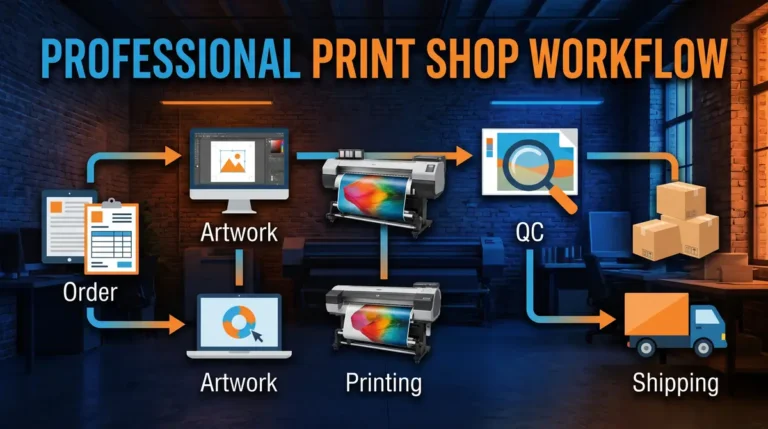
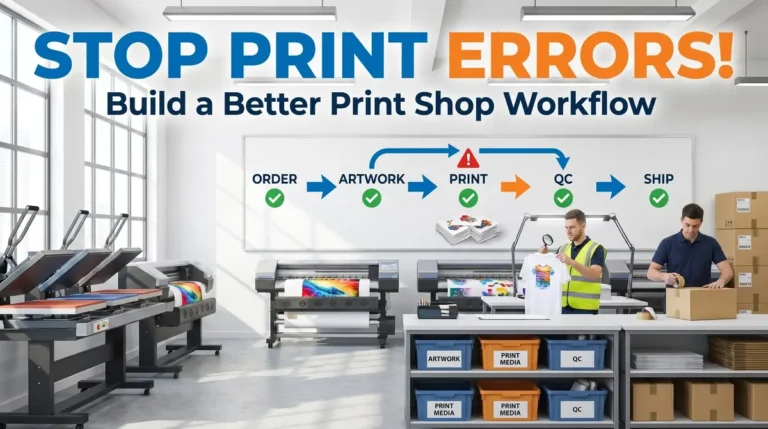
Many of these problems become easier to control when safety checks are part of the normal print shop workflow instead of something employees think about only after an incident.
What Do You Need to Get Workers’ Compensation Coverage?
There are not three universal legal requirements that every U.S. business must meet to obtain workers’ compensation. Requirements vary by state and coverage provider.
For quote preparation, however, most of the information a small print shop needs can be organized into three practical groups.
1. Business Information
Prepare basic details about the company:
- Legal business name
- Business structure
- Business location
- Nature of the printing operation
- States where employees work
- Years in operation, when requested
Describe what the business actually does. A design studio with one administrative employee is not the same operating exposure as a production shop with employees running presses and finishing equipment.
2. Employee and Payroll Information
Be ready to provide accurate workforce information, which can include:
- Number of employees
- Payroll
- Full-time or part-time status
- Employee roles
- Owners or officers working in the business
Do not reduce an employee’s job description to “print worker” if the insurer or state system requests more detail.
3. Job Duties and Classification Information
Workers’ comp pricing and administration can depend on the work employees perform.
Prepare clear descriptions such as:
- Graphic design and prepress
- Printing equipment operation
- Heat pressing
- Cutting and finishing
- Packing and fulfillment
- Office administration
- Delivery or field work, when applicable
An insurer or state system may request more information, including prior coverage or claims information.
Does Business Structure Affect Workers’ Comp?
It can.
States may treat sole proprietors, partners, corporate officers, and LLC members differently. Some owners can qualify for exemptions while others may count toward a coverage requirement.
Business structure decisions also affect issues outside workers’ compensation. The LLC vs sole proprietorship comparison for print shops explains the broader differences between those structures.
Do not assume forming an LLC automatically removes an owner’s workers’ compensation obligations.
How Much Does Workers’ Comp Cost for a Print Shop?
There is no reliable single price that applies to every print shop.
Workers’ compensation cost can change with the state, payroll, type of work performed, employee classifications, claims experience, and the rating rules applied to the business.
Washington L&I, for example, explains that an employer’s actual rate can vary based on industry and claim history.
Why Two Print Shops Can Pay Different Amounts
Consider two hypothetical businesses.
Shop A
- Owner-operated
- One employee mainly handling design and administration
- Limited production duties
Shop B
- Several production employees
- Press and finishing work
- Frequent material handling
- Larger payroll
The two companies may not receive the same workers’ comp pricing because their payroll and employee duties are different.
For quote accuracy, focus on describing each employee’s actual job rather than trying to choose the cheapest-sounding classification yourself.
Bottom line: get a quote based on your real payroll and duties. A generic national average cannot tell you what your shop will actually pay.
State Workers’ Comp Rules Can Be Very Different
State requirements deserve more attention than generic advice such as “every business needs workers’ comp after X employees.”
The Department of Labor directs private-company workers to state workers’ compensation boards because these programs are primarily administered at the state level.
Two states show how different those systems can be.
Florida Example
Florida currently requires workers’ compensation coverage for non-construction employers with four or more employees, including applicable business owners who are corporate officers or LLC members. Florida states that the threshold applies to full-time or part-time employees. Different rules apply to construction and agriculture.
A typical print shop would generally need to determine which industry classification applies to its operation rather than assuming a rule from another type of business.
Who Can Be Exempt in Florida?
Florida allows qualifying corporate officers and LLC members to apply for an exemption that excludes the individual from workers’ compensation coverage. The exemption is issued to the qualifying person, not to the business as a whole. An exempt officer or member cannot collect workers’ compensation benefits under that exemption.
Check here for more Florida workers’ compensation exemption requirements
For Florida’s non-construction industry, current eligibility rules include:
- A corporate officer must be listed as an officer of an active registered corporation.
- An LLC member seeking exemption must attest to at least 10% ownership.
- No more than 10 LLC members may elect exemption under the non-construction rules.
- Other eligibility requirements also apply.
That exemption does not allow an owner to declare ordinary employees exempt.
Washington Example
Washington takes a different approach.
The state does not allow employers to purchase ordinary private workers’ compensation coverage. Businesses that need coverage generally obtain it through Washington Labor & Industries unless they qualify as certified self-insured employers.
This is a good example of why a print shop owner should not buy a policy based only on advice written for another state. Washington workers’ compensation requirements
How to Check the Rule in Your State
Use this sequence:
- Find your state’s official workers’ compensation agency.
- Check the employer coverage requirements.
- Confirm how full-time and part-time employees are counted.
- Review sole proprietor, partner, officer, and LLC-member rules.
- Check any available exemption requirements.
- Confirm worker-classification rules.
- Verify coverage before hiring or cancelling an existing policy.
Save the official agency page with your business insurance records so you can recheck it as the shop grows.
What Should a Print Shop Do After an Employee Is Injured?
A written response process helps prevent confusion when an injury interrupts a busy production day.
Use this general sequence:
- Address urgent medical needs.
Emergency care comes before paperwork. - Have the injury reported internally.
Record what happened using your shop’s incident procedure. - Follow the workers’ comp reporting process.
Contact the insurer, state fund, claims administrator, or other responsible party according to your state’s rules and policy instructions. - Preserve relevant information.
Keep incident details, employee information, witness information, and relevant workplace records organized. - Review the workplace condition.
A claim and a safety correction are separate tasks. Fix an equipment, housekeeping, training, or workflow problem when one contributed to the incident. - Maintain claim records.
Keep workers’ compensation records separate and organized according to applicable requirements.
Avoid inventing your own reporting deadlines. State requirements can differ, so use the procedure supplied by your state agency and workers’ compensation provider.
How to Reduce Workers’ Comp Problems Before an Injury
Insurance responds after certain events. Safe shop operations reduce the chance that those events happen in the first place.
A practical prevention checklist includes:
- Train employees before allowing independent equipment use.
- Keep guards and other safety devices in place.
- Create procedures for servicing and shutting down powered equipment.
- Label and store workplace chemicals correctly.
- Give employees access to required safety information.
- Improve awkward or repetitive workstations.
- Keep floors, aisles, and production areas clear.
- Use sensible material-handling procedures.
- Record employee job duties accurately.
- Update classifications when duties materially change.
- Create a written incident-reporting process.
- Review coverage when hiring additional staff.
OSHA’s printing-industry resources specifically address ergonomics, machine guarding, hazard communication, and lockout/tagout as workplace safety concerns.
A documented print shop production checklist can also help turn routine safety and process checks into repeatable daily habits.
Print Shop Workers’ Comp Readiness Checklist
Before hiring an employee or requesting a workers’ compensation quote, work through this list.
Business and Coverage
- Confirm the state where each employee works.
- Check the official state coverage requirement.
- Confirm the employee-count threshold, if one applies.
- Review owner, officer, partner, and LLC-member rules.
- Check whether any exemption requires an application or certificate.
- Confirm current workers’ compensation coverage before work begins when required.
Employee Information
- List every employee.
- Record payroll accurately.
- Separate employee job duties clearly.
- Review full-time and part-time workers.
- Verify contractor classifications rather than relying on labels.
Production Safety
- Review machine guards.
- Review employee equipment training.
- Check chemical labeling and storage.
- Inspect workstations for repetitive or awkward tasks.
- Keep material-handling routes clear.
- Create an incident-reporting procedure.
Insurance Review
- Keep your carrier or state-fund contact information accessible.
- Review coverage when payroll grows.
- Update employee duties when jobs change.
- Recheck state requirements when expanding into another state.
- Review renewal information for accuracy.
This checklist is especially useful before the first hire and again when a small owner-operated shop begins adding production employees.
Frequently Asked Questions
Does a print shop with one employee need workers’ comp?
It depends on the state. There is no nationwide one-employee threshold for private print shops. Check the official workers’ compensation rules in the state where the employee works before assuming the business is exempt.
Do part-time print shop employees count?
They can. The rule depends on the state. Florida, for example, currently counts full-time and part-time employees when determining its four-employee requirement for non-construction businesses.
Are family members working in a print shop automatically exempt?
Do not assume so. Family-member treatment can depend on state law, business structure, the person’s work status, and other circumstances. Confirm the rule with the applicable state workers’ compensation agency.
Can an LLC owner exempt themselves from workers’ compensation?
Some states provide owner exemptions, but the rules vary. Florida allows qualifying LLC members to apply for an exemption. An approved Florida exemption applies to the member, not to the entire company.
Are independent contractors covered by workers’ comp?
Their treatment depends on applicable classification and workers’ compensation rules. Calling a worker an independent contractor does not by itself establish how the person will be treated under state law.
Does workers’ comp cover a burn from a heat press?
A work-related heat-press burn can potentially qualify if the employee and incident meet the state’s workers’ compensation requirements. The claim should be reported through the proper process rather than accepted or rejected informally by the employer.
Can workers’ comp cover repetitive-motion injuries?
Workers’ compensation systems can cover qualifying occupational injuries or diseases, but eligibility depends on the applicable state rules and facts of the claim. OSHA also identifies repetitive motion and awkward postures as ergonomic concerns in printing work.
Can general liability insurance replace workers’ comp?
No. They serve different purposes. Workers’ compensation addresses qualifying employee work-related injuries and illnesses, while general liability typically deals with third-party claims such as customer bodily injury or property damage.
Who is exempt from workers’ compensation in Florida?
Florida allows qualifying corporate officers and LLC members to apply for exemption under specific rules. The exemption applies to the qualifying individual rather than making the entire business exempt, and the exempt person cannot receive workers’ compensation benefits under that exemption.
Check Your State Requirements Before the Next Hire
Workers’ compensation for print shop employees is easiest to manage before a shop begins adding staff. Identify where employees will work, verify the state’s coverage requirement, document each person’s real job duties, prepare accurate payroll information, and review available owner exemptions.
Do not rely on a national employee-count rule or assume that a small shop, LLC, family business, or contractor arrangement is automatically exempt. State workers’ compensation rules control most private-sector situations.
Once the coverage side is clear, put the same discipline into training, equipment safety, incident reporting, and your everyday production workflow.