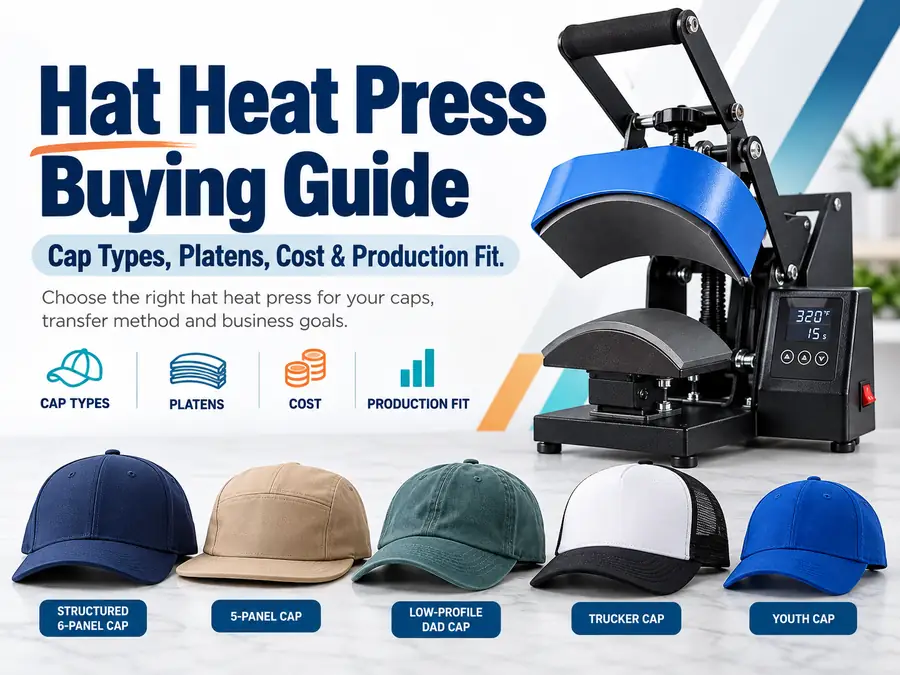
Hat Heat Press Buying Guide: Platens, Cap Fit & Cost

A good hat heat press should match the caps you actually sell. Platen curve, crown depth, seam placement, and how the cap is held under tension matter more than a machine’s maximum temperature.
Occasional hat orders may be fine with a compatible cap attachment. Regular paid work is easier to control on a dedicated press, especially when you switch between low-profile caps, structured six-panel hats, youth sizes, truckers, and heat-applied patches.
| Your work | Better starting point | Why |
|---|---|---|
| A few hats occasionally | Compatible cap attachment | Lowest equipment cost if your existing press supports a proper curved attachment |
| Regular 5-panel or unstructured caps | Dedicated cap press | Faster setup and more repeatable curved contact |
| Mixed structured, low-profile, and youth caps | Press with interchangeable lower forms | Different crown shapes need different support |
| Dimensional patches or heat-sensitive hats | Consider upper and lower heat | Lets more heat reach the adhesive from underneath while reducing heat on the face |
| Daily production | Commercial dedicated press | Workflow, service, replacement parts, and repeatability become more important |
If you are still deciding between flat, swing-away, combo, and specialty presses, start with our heat press buying guide. The rest of this page focuses only on caps and headwear.
Go to a Section
- Hat press vs regular heat press
- Cap types and compatibility
- Upper heat vs dual heat
- Current hat press price comparison
- Match the press to your transfer method
- Creases, scorch marks, and edge lifting
- Which hat press type should you buy?
- Frequently asked questions
Hat Press vs Regular Heat Press: When Do You Need One?
A dedicated cap press becomes useful when the curved crown makes a flat platen difficult to load evenly. A cap press supports the front panel from underneath while a curved heater applies pressure across the transfer area.
A flat press can still handle some beanies, flat hat panels before assembly, or very small areas that can be supported correctly. For finished baseball caps, truckers, fitted caps, and most structured crowns, the curved pressing surface is the main reason to move to cap-specific equipment.
Bottom line: buy a hat press when cap geometry is becoming a production problem, not simply because hats appear in your catalog.
Start With the Hat, Not the Heat Press
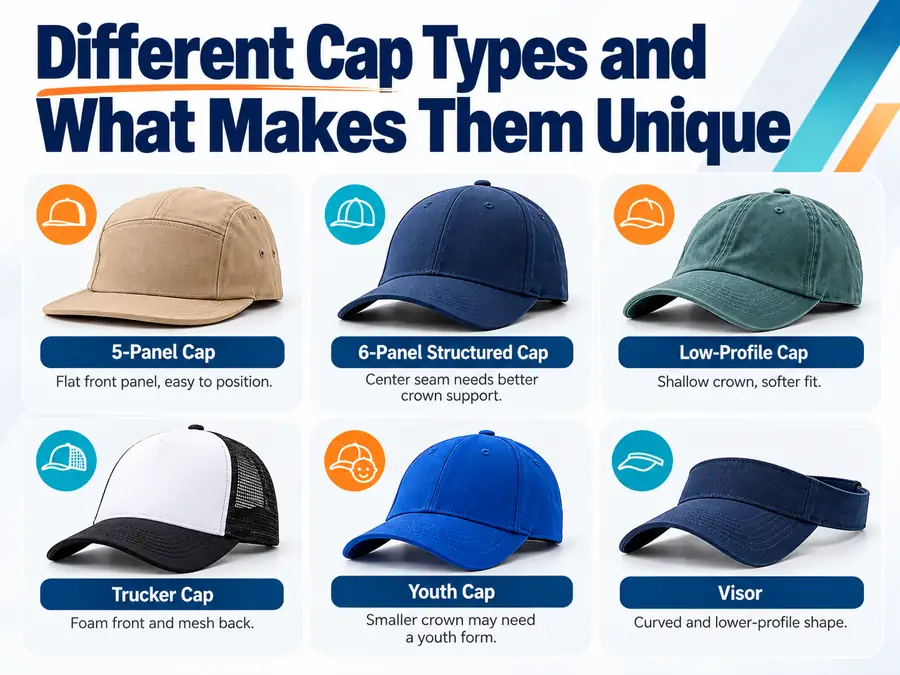
The same cap press can behave very differently with a shallow dad hat and a tall structured trucker. Before comparing machines, list the blanks you plan to sell and group them by crown profile, construction, and transfer location.
5-Panel Caps
A 5-panel cap gives you an uninterrupted front panel with no center seam running through the main transfer area. That can make front-panel heat application easier, but the crown can still be shallow, tall, foam-backed, or heavily structured. Match the lower form to the actual blank rather than assuming every 5-panel cap fits the same way.
6-Panel Structured Caps
The center seam creates a high point under the design. If the lower form does not support the crown well, pressure can concentrate on that seam while the surrounding transfer gets less contact. This is one reason six-panel caps can show a dark seam line, crease, or weak adhesion near the edges.
Low-Profile and Unstructured Caps
Low crowns need a shallower form than many full-crown ball caps. Forcing a shallow hat over a deep form can wrinkle the panel or make the transfer area difficult to flatten. Look for a press with a form designed for low-profile caps if these blanks are a regular product.
Trucker and Foam-Front Hats
Foam fronts can deform under excessive heat or pressure, while polyester components can be sensitive to scorching or dye migration depending on the transfer. Pressure control and a form that supports the crown without crushing it matter more than simply choosing the highest temperature range.
Youth Caps and Small Crowns
A form sized for a large adult crown may leave a youth cap poorly supported. If youth teams, schools, or children’s headwear are part of your business, check whether a smaller lower form is included or available before ordering the press.
Cap Press Compatibility Matrix
Use this matrix as a buying filter. It is not a universal settings chart because cap construction varies by blank manufacturer.
| Cap type | Main fit challenge | Lower-form need | Useful press feature | Equipment fit |
|---|---|---|---|---|
| 5-panel structured | Crown height and front-panel shape | Medium or deep curved support | Cap hold-down, adjustable pressure | Dedicated cap press |
| 6-panel structured | Center seam creates a pressure high point | Firm support behind the seam | Good form fit, pressure control, optional lower heat | Dedicated cap press |
| Low-profile / dad cap | Shallow crown can wrinkle on deep forms | Shallow curved form | Interchangeable platen or low-profile form | Multi-form press |
| Youth cap | Adult form may be too large | Small or youth form | Interchangeable forms | Multi-form press |
| Foam trucker | Foam can compress or mark | Support without over-stretching | Fine pressure control, accurate temperature | Dedicated press |
| Dimensional patch work | Adhesive needs heat without flattening the face | Stable crown support | Upper and lower heat can help | Dual-heat press |
Bottom line: if one lower form has to handle every blank in your shop, test your most difficult cap before assuming the fit is universal.
Curvature Matters More Than Platen Width Alone
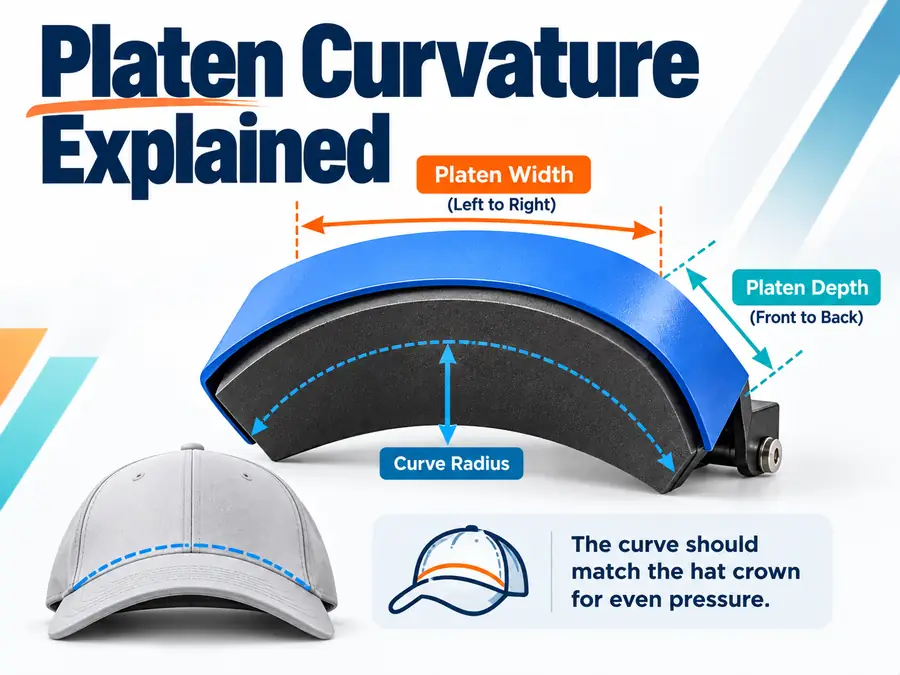
Platen width tells you how much design area a press can cover. It does not tell you whether the lower form matches the crown. Curve depth, crown height, and how tightly the cap stretches across the form decide whether pressure reaches the whole transfer.
Geo Knight illustrates the point with its DK7 cap press. The machine includes Standard, Euro, and Youth lower forms rather than treating one curve as ideal for every cap. Geo Knight also sells 3 x 5, 3.25 x 5.5, and 3-3/8 x 7-inch forms as separate options for compatible presses.
Measure the transfer area too. A large patch may physically fit across the hat while extending beyond the area the press can support evenly.
Interchangeable Platens vs One Molded Form
Interchangeable forms are useful when you do not control the blank. One molded form is simpler when you standardize on a small number of cap styles that fit it well.
| Platen approach | Best for | Main advantage | Main tradeoff |
|---|---|---|---|
| Interchangeable lower forms | Shops using many cap profiles and sizes | Better chance of matching youth, low-profile, and full-crown hats | Extra forms cost money and take changeover time |
| Single molded lower form | Standardized cap inventory | Fewer parts and quicker workflow | Fit depends heavily on how well your blanks match the form |
Hotronix takes a different approach with the 360 IQ. Its molded lower platen is designed to accommodate a broad range of hat shapes, and Stahls added a Quick Snap platen cover in 2026 for improved fit across structured and unstructured caps. Neither approach is automatically better. Your blank mix decides which one is easier to live with.
Upper Heat vs Dual Heat: Is a Heated Lower Platen Worth It?
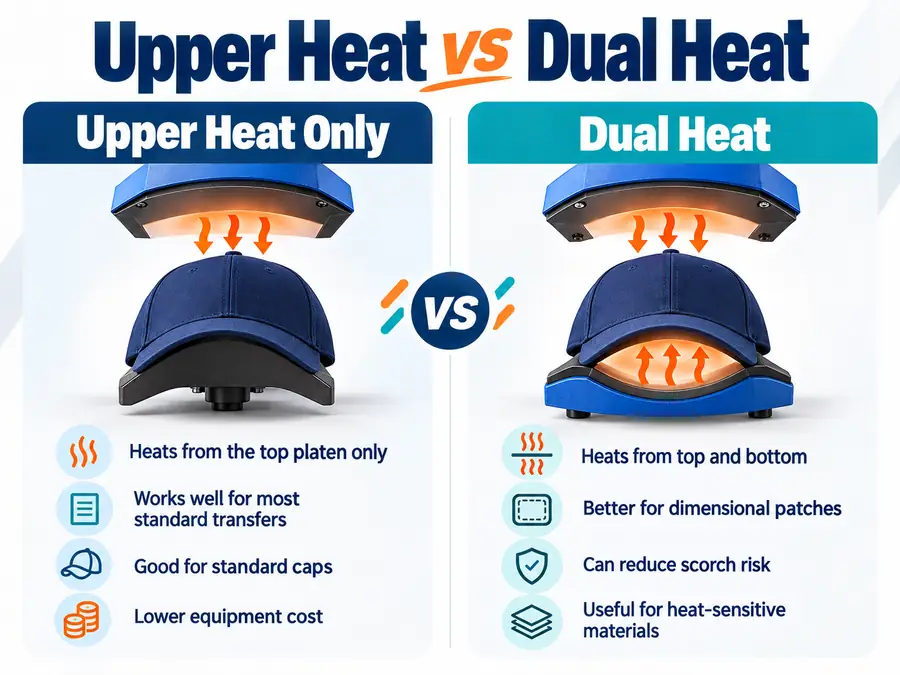
Dual heat is most useful when you need to activate adhesive while limiting the heat applied directly to the face of a patch or heat-sensitive hat. It is not required for every HTV, DTF, sublimation, or patch job.
The Hotronix 360 IQ uses heated upper and lower platens with independent controls. Stahls positions that setup for dimensional emblems, patches, appliqué, and hat materials where reducing top heat can help control scorching or crushing.
Geo Knight also offers a separate bottom-heat attachment for the DK7 and DK7T. That matters because you can start with a top-heated cap press and add lower heat later if your product mix justifies it.
Bottom line: pay for lower heat when your transfer system or heat-sensitive blanks benefit from it. Do not treat it as a required feature for every cap business.
Manual, Auto-Open, or Production Hat Press?
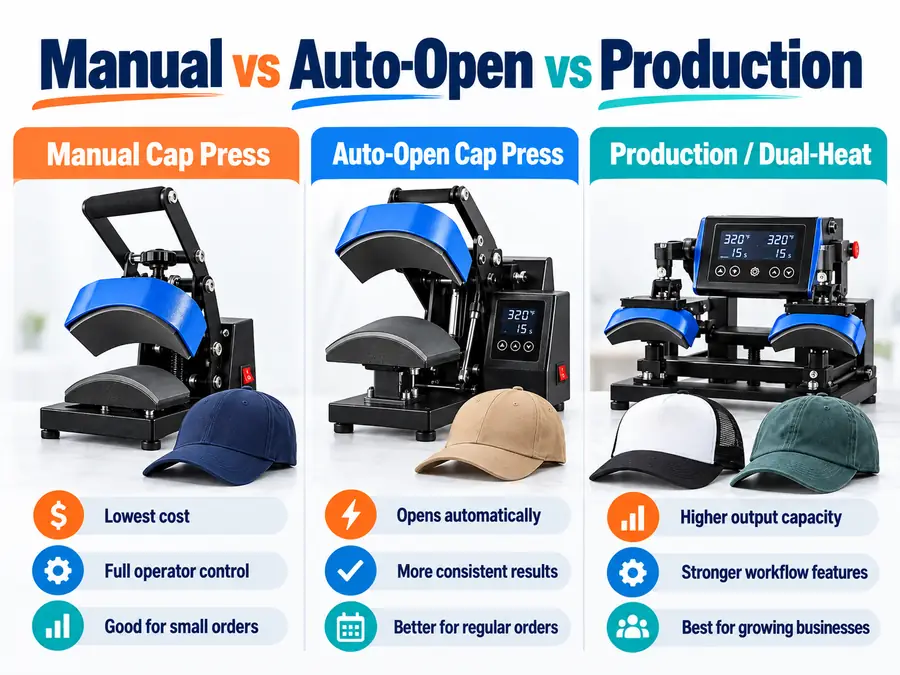
Automation affects workflow more than cap compatibility. A manual press can produce repeatable work when the operator controls time, pressure, and loading well. Auto-open reduces the need to watch the timer, while production systems add features aimed at faster cycling or specialized applications.
| Press class | Operator involvement | Best use | What to check |
|---|---|---|---|
| Manual dedicated cap press | Operator closes and opens each cycle | Small business and regular custom orders | Pressure adjustment, hold-down, form options, support |
| Auto-open cap press | Operator loads and closes, press releases at cycle end | Repeat work where timing consistency matters | Release mechanism, pressure consistency, serviceability |
| Dual-heat / specialty production press | More setup options, often application-specific | Patches, heat-sensitive blanks, premium headwear workflows | Independent heat control, replacement parts, training |
| Twin-station cap press | Operator alternates between two stations | Higher output with repeated designs | Bench space, loading speed, actual bottleneck |
For shops already pressing large apparel orders every day, the equipment decision is broader than caps. Our high-volume heat press guide covers the production side of that upgrade.
Current Hat Press Price Classes and What You Get
Current US pricing ranges from hundreds of dollars for a basic dedicated cap press to about $2,000 for specialized dual-heat equipment. Prices below were checked October 10, 2026 and can change with promotions, options, and availability.
| Model | Price checked | Platen / form approach | Operation | Notable fit |
|---|---|---|---|---|
| Hotronix MAXX 250 Cap Press | $699 promotional 2026 price | 3.5 x 6 in standard platen; optional interchangeable cap platens | Manual | Entry professional cap workflow with upgradeable platen sizes |
| Geo Knight DK7 | $795 | Standard, Euro, and Youth forms included | Manual with gas-spring lift | Shops that want multiple crown forms included |
| Insta 420 | $1,195 | 4.5 x 6.75 in upper; 3.25 x 6.75 in lower curved platen | Manual | Compact press with hold-down and five controller presets |
| Hotronix 360 IQ | $2,050 | Molded lower platen with upper and lower heat | Specialty dual-heat | Dimensional patches, emblems, and heat-sensitive hat workflows |
The table is a feature comparison, not a hands-on ranking. We have not tested these four machines side by side under identical conditions, so the better choice depends on cap mix, transfer method, required forms, and service needs.
Cap Attachment vs Dedicated Hat Press
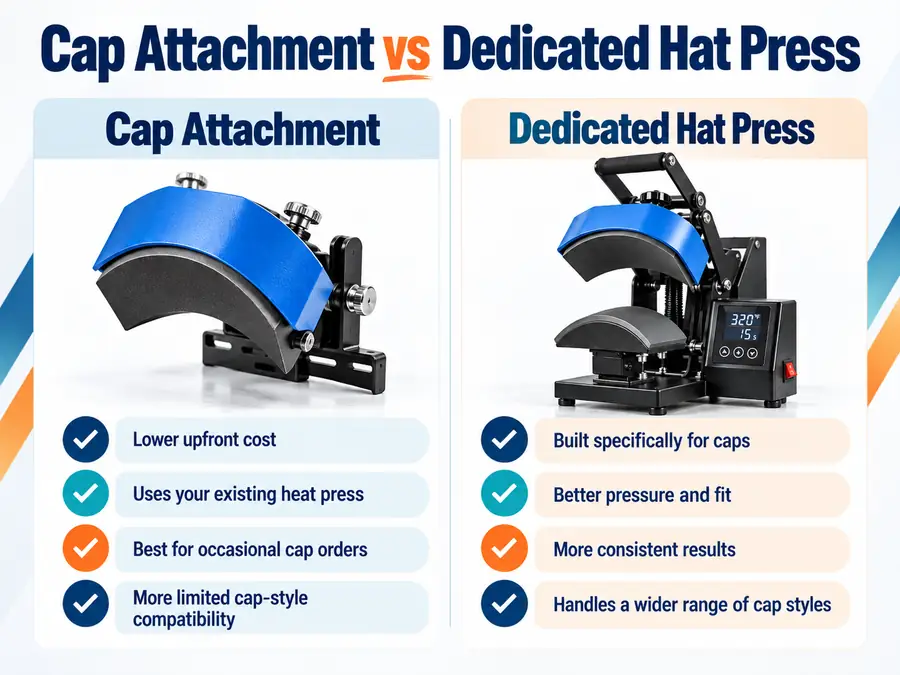
A cap attachment makes sense when you already own a compatible press and hats are occasional. A dedicated press becomes easier to justify when attachment changes, setup time, or inconsistent loading slows paid orders.
| Factor | Cap attachment | Dedicated cap press |
|---|---|---|
| Upfront cost | Usually lower if you already own the compatible base press | Higher because it is a separate machine |
| Workspace | Saves bench space | Needs dedicated space |
| Changeover | Attachment swapping can interrupt flat-product work | Ready for caps without reconfiguring the main press |
| Form options | Depends on the attachment system | Varies by machine; some include several forms |
| Production flow | Best for occasional caps | Better for repeated paid cap work |
For one real example, Geo Knight lists its DC-CAP attachment at $375 and includes Standard, Euro, and Youth forms. It only makes sense for compatible Geo Knight Digital Combo equipment, so treat attachment pricing as system-specific rather than universal.
Match the Press to Your Transfer Method
The press has to support the transfer manufacturer’s application instructions. Do not choose temperature or pressure from a generic hat chart when the HTV, DTF transfer, sublimation blank, or patch supplier gives product-specific settings.
HTV
Prioritize even curved contact, a stable cap hold-down, and pressure adjustment. Small HTV logos can be forgiving, but seams and unsupported edges still create weak contact.
DTF Transfers
DTF still needs even heat and pressure across the complete transfer. A center seam or poorly matched lower form can leave one area over-pressed while another area receives less contact. Follow the transfer supplier’s instructions for temperature, time, pressure, peel, and any post-press.
Sublimation on Compatible Polyester Caps
Sublimation requires a compatible polyester surface and enough heat for the transfer system. The hat itself still has to tolerate the process without unwanted deformation or scorching. Check the blank supplier’s guidance before treating every polyester cap as identical.
Heat-Applied Patches and Emblems
Patch thickness changes the pressure and heat path. Lower heat can be useful when the adhesive needs energy from underneath but the patch face or hat material should see less top heat. Use the patch manufacturer’s approved application method rather than a universal patch setting.
What Causes Hat Press Creases, Scorch Marks, and Edge Lifting?
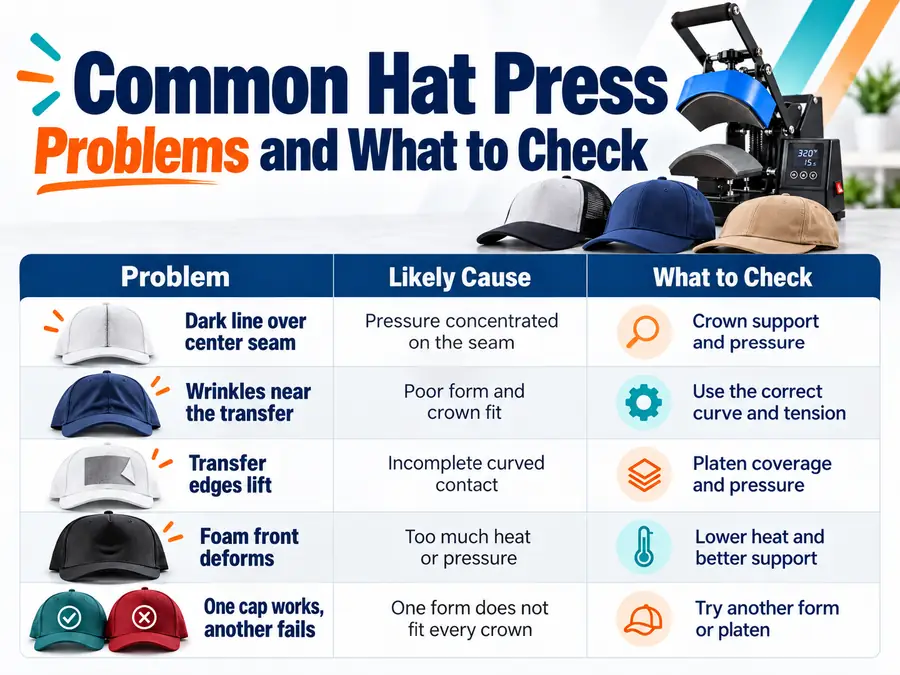
Most hat-press failures are easier to diagnose when you separate fit problems from settings problems. Before replacing the machine, inspect how the cap sits on the lower form.
| Symptom | Possible equipment-fit issue | What to inspect |
|---|---|---|
| Dark line over center seam | Pressure concentrated on the seam | Crown support, lower-form fit, pressure level, transfer location |
| Wrinkle or crease near transfer | Hat is stretched poorly over the form | Form curvature, crown depth, hold-down tension |
| Transfer edges lift | Incomplete contact around the curve | Platen coverage, form match, pressure, transfer size |
| Foam front collapses or marks | Too much heat, pressure, or poor support | Blank limits, pressure, temperature, protective pad instructions |
| One cap style works and another fails | One lower form does not match both crowns | Alternative form or platen options |
Use the transfer supplier’s settings first, then solve mechanical contact problems. Raising pressure to compensate for the wrong crown shape can make seam marks and creasing worse.
Specifications to Check Before You Buy
A cap press spec sheet is useful only if you connect each number to a real blank or workflow. Check these items before ordering:
- upper platen dimensions and usable transfer area
- lower-form dimensions and crown profile
- included forms or platens
- cost and availability of optional forms
- cap hold-down or stretching mechanism
- pressure adjustment method
- upper-only vs independently controlled upper and lower heat
- timer, presets, and auto-open features
- 120V or 240V requirements, wattage, and approved circuit needs
- actual operating footprint, not just shipping dimensions
- replacement heaters, controllers, pads, and mechanical parts
- written warranty and US technical support
When possible, send the seller the exact cap style and transfer type you plan to run. A demonstration using your blank is more useful than a generic statement that the press works with “all hats.”
Will a Dedicated Hat Press Pay for Itself?
Use contribution profit, not selling price, when estimating payback. Subtract the cap, transfer, packaging, payment fees, expected waste, and other variable costs before treating each sale as equipment recovery.
Simple planning formula: equipment investment ÷ contribution profit per hat = approximate hats needed to recover the equipment cost.
That estimate still excludes financing, taxes, labor changes, downtime, and other fixed costs. For a more complete equipment decision, enter your own numbers in the sublimation equipment ROI calculator.
Which Hat Press Type Should You Buy?
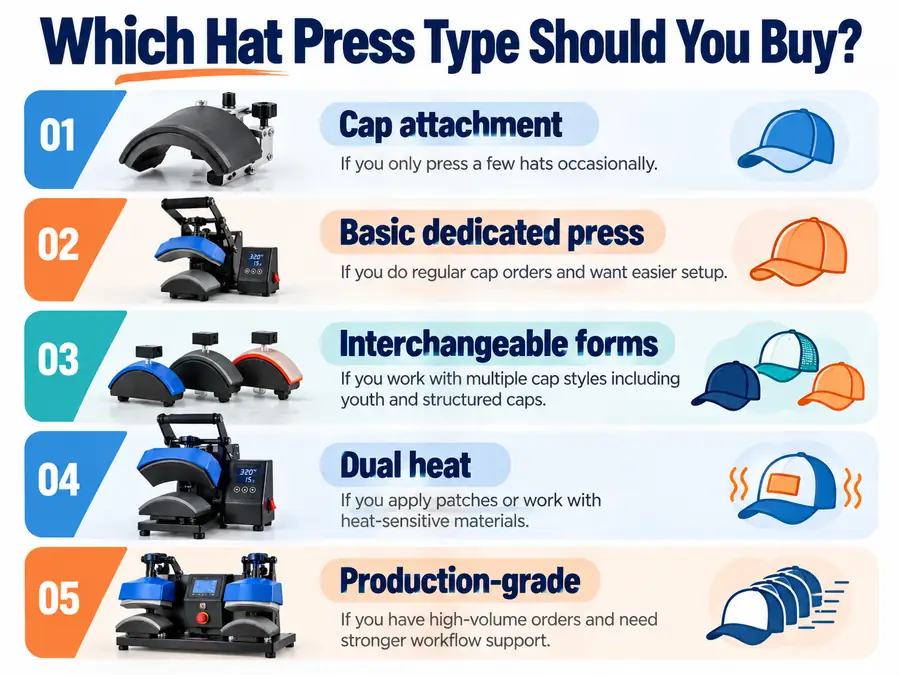
Choose the lowest-cost setup that fits your real cap mix without creating a recurring production problem.
- Choose a cap attachment when hats are occasional and your existing press supports a proper curved attachment with forms that match your blanks.
- Choose a basic dedicated cap press when hats are a regular paid product and you want the machine left ready for headwear.
- Choose an interchangeable-form system when you sell youth, low-profile, full-crown, structured, and other varied cap styles.
- Choose dual heat when your approved patch or emblem workflow benefits from heating from underneath or you need more control over top heat on sensitive caps.
- Choose production equipment when loading time, repeat cycles, service support, and downtime cost more than the difference in purchase price.
If you are buying mainly for one cap blank, test that exact blank before paying for flexibility you will not use. If customers bring their own headwear or your catalog changes often, platen options become much more valuable.
Questions to Ask Before Ordering a Hat Press
- Which exact cap profiles fit the included lower form?
- What alternate forms or platens are available, and what do they cost?
- Can the seller demonstrate my actual blank and transfer?
- How is the cap held under tension during pressing?
- Is pressure adjustable, and how is it set?
- Can upper and lower temperatures be controlled independently?
- Which replacement parts are stocked in the United States?
- What is covered by the heater, controller, frame, parts, and labor warranty?
- What electrical circuit and working clearance does the machine require?
- What is the current delivered price with the platens or accessories I actually need?
Frequently Asked Questions
Can you use a regular heat press for hats?
A regular flat press can work for some flat or easily supported areas, but finished baseball caps and structured crowns are difficult to press evenly on a flat platen. A dedicated cap press uses curved support to match the hat’s shape.
What size platen is best for hats?
There is no single best size for every cap. Width affects design area, while curve and crown fit affect pressure. Choose the form around the cap styles you sell most often and make sure the complete transfer fits inside the supported pressing area.
Do you need different platens for different caps?
Not always. Some presses use one molded form across many hat styles, while others use interchangeable low-profile, youth, standard, or oversized forms. Multiple forms are most useful when your blanks vary widely.
Why does my hat crease in the heat press?
Creasing can come from a poor match between the crown and lower form, excessive pressure, or a hat that is not stretched smoothly before pressing. Check fit and support before increasing pressure or changing temperature.
Is a heated lower platen worth it?
It can be worth the cost for dimensional patches, emblems, and heat-sensitive headwear when the approved application benefits from heat from underneath. For ordinary top-heated transfer work, lower heat may not add enough value to justify the price.
Can the same hat press apply DTF, HTV, sublimation, and patches?
Many commercial cap presses support several transfer methods, but compatibility depends on the hat blank, transfer, platen fit, and required application settings. Always follow the blank and transfer manufacturers’ instructions.
Buy Around the Caps You Plan to Sell
The best hat heat press is the one that supports your real crown shapes and transfer methods without forcing you to fight the blank on every order. For a shop using several hat profiles, interchangeable forms can be more valuable than a longer feature list. For patch-heavy work, lower heat may justify a more specialized machine.
Before ordering, collect two or three of your most difficult cap blanks, confirm the transfer supplier’s application requirements, and compare them against the press’s lower-form options. Once the machine is chosen, use the heat press settings calculator only as a starting reference when manufacturer-specific settings are not already provided.