Sublimation Mug Blanks Buying Guide: 11 oz vs 15 oz, Coating & Cost

A good sublimation mug blank is not just a cheap white ceramic mug. It needs the right coating, consistent dimensions, a shape that fits your heating equipment, protective packaging, and a cost that still makes sense after damaged or unusable pieces are removed.
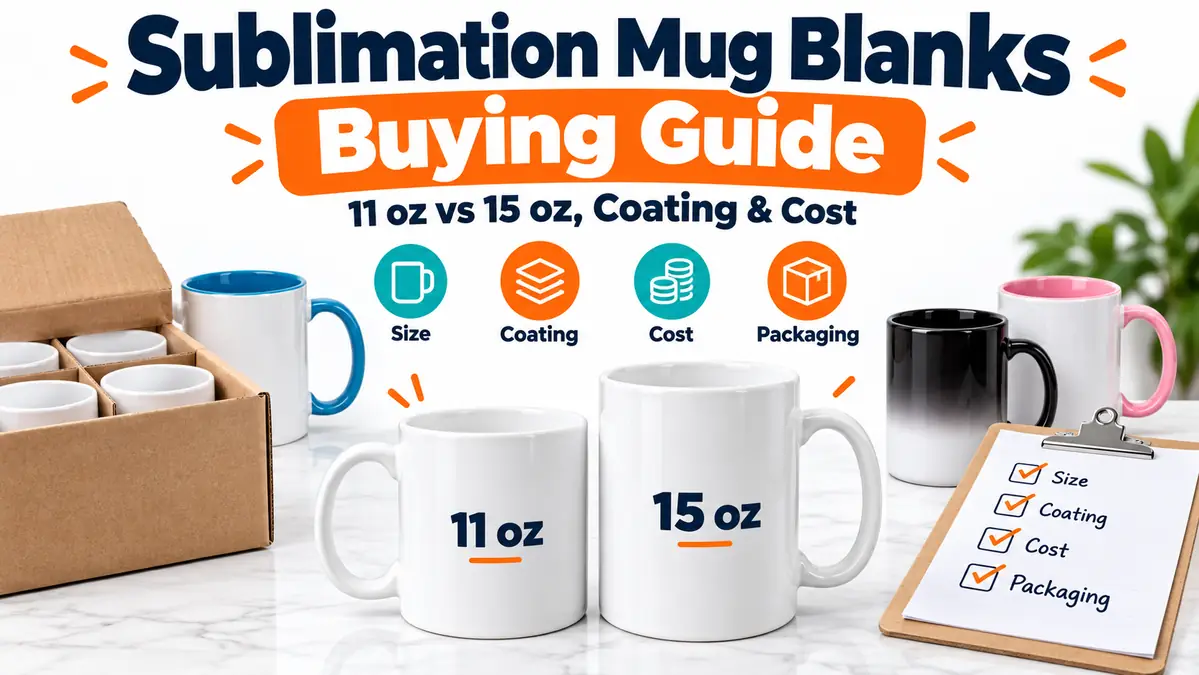
For most new mug sellers, a standard white 11 oz blank is the simplest starting point. A 15 oz mug makes sense when customers want a larger option or you need a second price tier. Before buying either one by the case, check the actual dimensions and coating specifications for that exact SKU.
| Buyer situation | Good starting choice |
|---|---|
| First mug product | Standard white 11 oz |
| Larger customer option | White 15 oz |
| Testing a new supplier | Small sample or pack |
| Proven recurring orders | Case-packed core mug |
| Premium product line | Better-documented coating and quality control |
| Novelty catalog | Add specialty mugs after core sizes are proven |
Go to a Section
- 11 oz vs 15 oz mug blanks
- Mug blank buying matrix
- Coating quality
- Press and oven compatibility
- True usable cost
- How to test blanks
- Which mug blank to buy
- Buying checklist
11 oz vs 15 oz Sublimation Mug Blanks
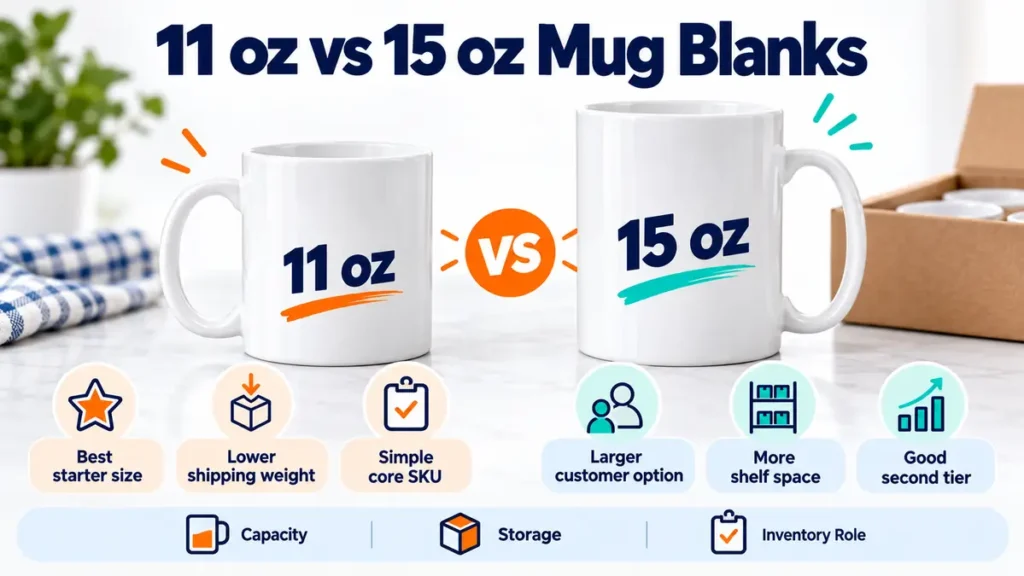
The 11 oz mug is usually the safer first SKU. The 15 oz version gives customers a larger drink size, but it also takes more storage space and may require a different artwork template or press setup.
| Factor | 11 oz mug | 15 oz mug |
|---|---|---|
| Capacity | Smaller | Larger |
| Best starting use | General gifts, personalization, testing | Larger gift mug, second product tier |
| Physical footprint | Usually smaller | Usually taller or larger |
| Design area | SKU-specific | SKU-specific |
| Press fit | Verify diameter and height | Verify diameter and height |
| Storage | Lower space per unit | More shelf and carton space |
| Shipping | Usually lighter | Usually heavier |
| Inventory role | Core SKU | Upsell or second size |
When an 11 oz mug makes sense
An 11 oz white mug works well when you want to keep your first product line simple. It can cover personalized gifts, logos, event orders, and many general custom-mug designs without forcing you to carry several ceramic SKUs.
Using one mug body also simplifies templates, packaging, production records, and reorders while you learn which designs and customer groups actually sell.
When a 15 oz mug makes sense
A 15 oz blank gives the customer more drink capacity and creates a clear second product option. Add it when buyers ask for a larger mug, you want another price tier, and your equipment supports the exact body dimensions.
Do not assume that moving from 11 oz to 15 oz only means increasing the artwork size. The body profile can change too.
Capacity does not define the mug dimensions
Two blanks can both be labeled 11 oz while using different outside diameters, heights, handle positions, and printable areas. The same issue applies to 15 oz blanks.
A current example shows why exact specifications matter. JPPlus lists one 11 oz economy white sublimation mug at 3-3/4 inches high with a 3-1/4 inch top and base diameter, while its 15 oz version is 4-5/8 inches high with a 3-3/8 inch top diameter and a narrower 2-3/8 inch base. Both are sold as sublimation mugs, but they do not share the same body dimensions. Check the current JPPlus mug specifications before relying on these measurements for purchasing.
Bottom line: Build templates and press decisions from the specification for the exact SKU you purchase, not from a generic 11 oz or 15 oz template.
What Makes a Good Sublimation Mug Blank?
A good ceramic blank should be sold specifically for sublimation and arrive consistent enough that you can repeat the same production setup across multiple mugs.
- Documented sublimation compatibility
- A smooth, even printable surface
- Consistent body shape
- Even rim and stable base
- Repeatable handle placement
- Clean ceramic finish
- Clear supplier application instructions
- Predictable availability for reorders
Inspect the mug before pressing it
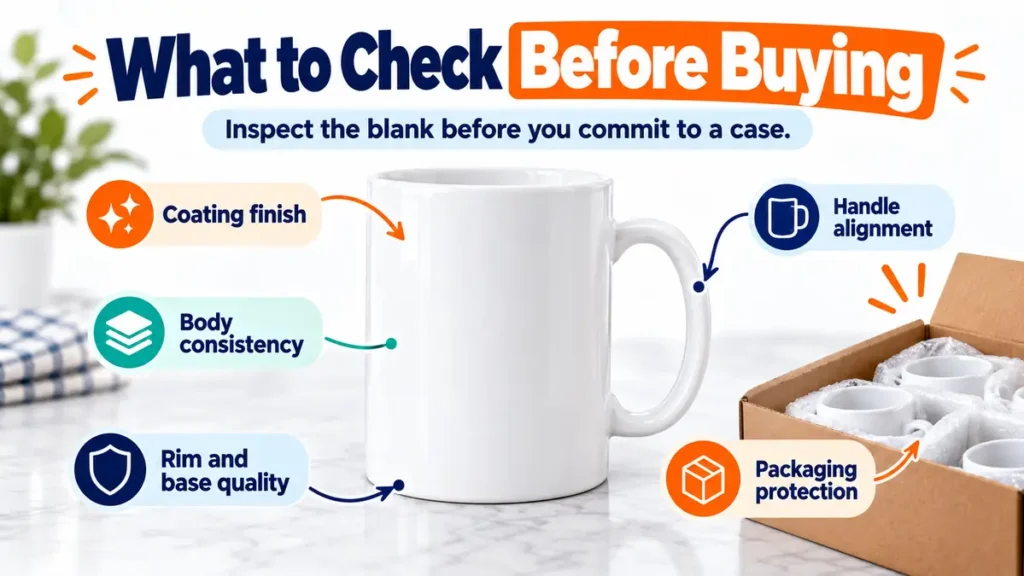
Check new blanks under good lighting before using ink, paper, and production time on them. Look for chipped rims, cracked handles, uneven bases, visible coating marks, surface pinholes, scratches, glaze defects, warped bodies, and inconsistent handle alignment.
Set defective blanks aside before production. It is easier to document a supplier problem before the mug has been decorated.
Sublimation Mug Blank Buying Matrix
Use this matrix to narrow the mug categories that belong in your inventory. The exact dimensions, coating, case quantity, and supported heating method still need to be verified on the product page for the SKU you plan to buy.
| Mug type | Strength | Main buying concern | Best use |
|---|---|---|---|
| Standard white 11 oz | Simple, flexible core product | Verify dimensions and coating consistency | Beginners, general gifts, bulk personalization |
| Premium white 11 oz | Better documentation or finishing may be available | Higher purchase cost must produce real value | Repeat commercial production |
| Standard white 15 oz | Larger customer option | Press fit, storage, freight | Upsells and larger drink size |
| Premium white 15 oz | Larger format with premium positioning | Usable cost and repeat availability | Higher-value product line |
| Colored inner or handle | Adds visual differentiation | More colors create more SKUs | Niche designs and color themes |
| Black mug with imaging area | Distinctive appearance | Limited printable area | Designs built around a defined print panel |
| Color-changing mug | Novelty effect | Coating, care instructions and repeatability | Gift and novelty lines |
| Specialty shape | Differentiated product | Templates, equipment fit and replacement stock | Established sellers with validated demand |
Before ordering, verify the outside diameter, mug height, printable area, body profile, coating documentation, supported heating method, pack or case quantity, packaging method, damage policy, and landed cost.
Sublimation Mug Coatings: What Can You Actually Compare?
The mug needs a coating designed to receive sublimation dye. A normal ceramic mug should not be treated as sublimation-ready just because it is white and fits inside a press.
- Explicitly labeled for dye sublimation
- Supplier application instructions
- Compatible heating methods
- Surface finish
- Care instructions
- Dishwasher or microwave claims when documented
- Coating or product-line identification
- Replacement policy for coating defects
Proprietary coating names
Some suppliers sell mugs under their own coating names or product families. Treat those names as useful when they come with meaningful information such as care guidance, application instructions, or manufacturer documentation.
A branded coating name by itself does not tell you that the mug will fit your equipment or produce an acceptable usable-unit cost.
What about “AAA” sublimation mugs?
Marketplace listings sometimes use terms such as “AAA grade.” Do not assume those labels represent a universal industry grading system. Treat them as seller terminology unless the supplier explains exactly what the grade measures.
Bottom line: Compare documented coating compatibility, dimensions, packaging, return policy, and sample quality instead of relying on an undefined quality label.
Will the Mug Fit Your Mug Press or Oven Workflow?
Press compatibility should be checked before you buy a full case. Verify the outside diameter, overall height, straight pressing area, taper, handle clearance, and heating-element range.
Cricut gives a useful example of why capacity alone is not enough. Its Mug Press guidance for non-Cricut blanks specifies 10 to 16 oz capacity, a smooth straight pressing area, a 3.2 to 3.4 inch diameter, and a maximum height of 4.72 inches. See Cricut’s current Mug Press compatibility guidance if that is the equipment you use.
Capacity does not equal compatibility
A listing that says “11 oz sublimation mug” does not automatically mean the mug fits every 11 oz heating element. Find your press manufacturer’s supported range, compare it with the blank’s exact dimensions, check handle clearance, and test a small quantity before committing to a large order.
If you are still choosing your production method, compare a mug press vs convection oven before building your blank inventory around one workflow.
For a mug press
- Check outside diameter and height.
- Confirm the straight-wall contact area.
- Check handle clearance.
- Compare the mug with the heating-element specifications.
For a convection oven
- Confirm the blank supplier supports oven use.
- Check mug shape and printable area.
- Verify wrap or shrink-sleeve requirements.
- Follow the supplier’s application instructions for that blank.
Case Quantity and Packaging Change the Real Cost
Bulk mug pricing only makes sense when enough of the case reaches you in sellable condition. Mugs may be sold as single pieces, small test packs, partial cases, full cases, or larger wholesale quantities.
Case counts are not universal. As of October 10, 2026, JPPlus lists 36 per case for its economy white 11 oz and 15 oz ceramic sublimation mugs, and Photo USA states that its standard ceramic 11 oz and 15 oz mugs ship 36 per case while some specialty bodies use different counts. Check the exact SKU before comparing case prices.
Packaging affects your usable inventory
Look at how the mugs are protected. Individual boxes, cardboard dividers, protective sleeves, reinforced outer cartons, and handle protection can all affect breakage, storage, and fulfillment.
For sellers who ship finished mugs to customers, individually boxed blanks may have extra practical value if the packaging can be reused safely for fulfillment.
Calculate the True Usable Cost per Mug
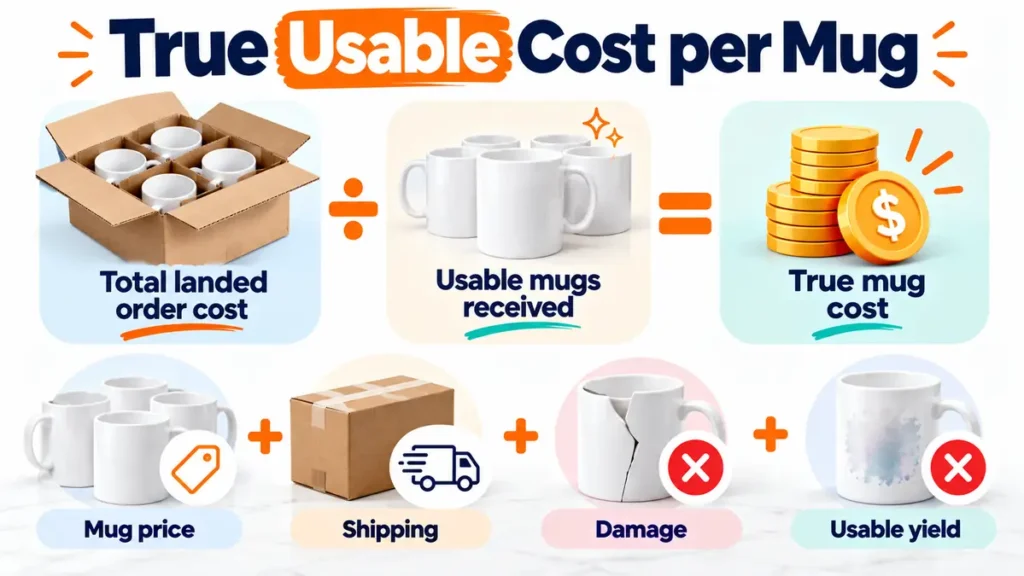
Do not compare two mug suppliers using the advertised unit price alone. Use the cost of the mugs that are actually usable.
True usable mug cost = total landed order cost ÷ usable mugs received
Your landed order cost can include the mug price, inbound shipping, freight charges, and nonrecoverable order fees. Remove pieces that cannot be sold because of cracks, chips, broken handles, severe surface defects, or unusable coating defects.
A simple hypothetical example
Suppose a case contains 36 mugs and three arrive unusable. Your cost per sellable mug should be based on 33 mugs, not 36. The exact dollar result depends on your current product price, shipping, fees, credits, and replacement policy.
Use the sublimation blank cost calculator when you want to compare suppliers using landed and usable cost instead of catalog price.
Bottom line: A mug that costs slightly more before shipping can still be the cheaper business choice if it arrives more consistently and produces more sellable units.
Track Breakage Instead of Guessing a Universal Rate
There is no useful universal breakage percentage that applies to every supplier, carrier, package, warehouse, or mug style. Track your own orders instead.
- Quantity ordered
- Quantity received
- Broken mugs
- Chipped mugs
- Coating defects
- Other unusable pieces
- Replacements or credits
- Final usable quantity
Usable yield = usable mugs ÷ mugs ordered × 100
After several orders, your own records become more useful than a generic online breakage estimate. If one supplier looks cheaper but repeatedly delivers fewer usable mugs, the purchasing data will show the difference.
How to Test Mug Blanks Before Ordering a Full Case
A small test can uncover fit, coating, packaging, and consistency problems that product photos cannot show.
- Buy the smallest practical test quantity. Avoid committing to a large case before checking the actual blank.
- Inspect every test mug. Check rims, handles, bases, coating, and body shape.
- Measure several pieces. Consistency across the batch matters as much as the first mug.
- Check the mug against your press. Confirm fit before printing.
- Use one controlled test design. Include solid colors, fine detail, gradients, and text if those elements represent your normal work.
- Follow the blank supplier’s instructions. Do not judge a new mug using settings intended for another product.
- Compare finished mugs. Look for repeatable color and printable-area behavior.
- Record defects and damage. Track them before calculating your cost.
- Review the packaging. A good blank is not useful if the case regularly arrives damaged.
- Calculate usable-unit cost. Decide whether the supplier still looks competitive after losses.
For the actual printing workflow, use the separate how to sublimate mugs tutorial rather than mixing pressing instructions into your purchasing decision.
White vs Colored vs Black vs Color-Changing Mug Blanks
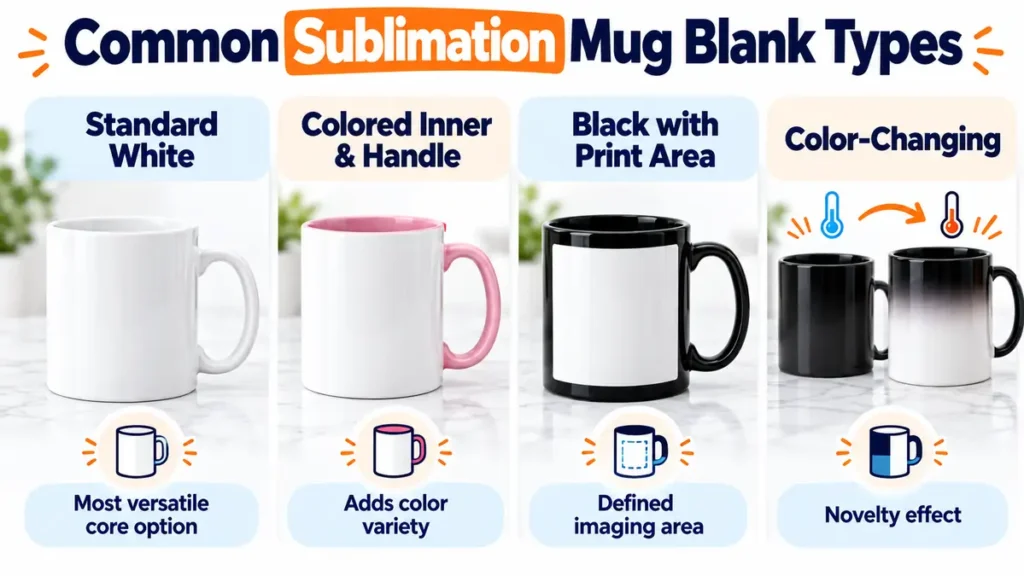
Start with the mug styles that solve a clear customer need. Every extra color and finish increases the number of SKUs you need to store and reorder.
Standard white mugs
White ceramic gives artwork a neutral background and works with a wide range of designs. It is usually the simplest core inventory because one mug can serve many niches without forcing you to carry separate blank colors for every design.
Colored inner and handle mugs
A colored interior or handle can make a design feel more intentional for school colors, sports themes, holidays, brand colors, and profession-specific designs. The trade-off is inventory complexity. Five accent colors mean five separate blank SKUs.
Black mugs with printable areas
Some dark mugs are made with a defined white or sublimation-ready imaging area. Check where the image can be placed, the exact template dimensions, whether the black area accepts sublimation, and how the printable panel aligns with the handle.
Color-changing mugs
Color-changing mugs can add novelty value, but they deserve extra testing before a large order. Verify the coating instructions, heating method, care claims, imaging area, finished appearance when cold and hot, and consistency across several test mugs.
For many small shops, specialty mugs work better as an expansion product than as the first blank they stock.
Buying Single Mugs, Packs, or Full Cases
Purchase quantity should follow demand, not the biggest available discount.
| Purchase type | Best for | Main drawback |
|---|---|---|
| Single or sample | Checking fit and quality | Highest unit cost |
| Small pack | Testing a supplier or new size | Limited bulk savings |
| Full case | Proven recurring orders | More cash and storage committed |
| Large wholesale order | Established volume | Highest inventory and consistency risk |
Buy samples when the SKU is new to you
A sample order makes sense when changing suppliers, changing mug sizes, testing a specialty finish, using a new mug press, or moving to a different packaging format.
Move to cases when the SKU is proven
Case purchasing becomes more attractive after you know the mug fits your equipment, the coating performs consistently, customers buy the size, damage handling is acceptable, storage is available, and the usable cost works at your selling price.
A case discount is not a saving if much of the carton sits unsold for a year.
Where to Buy Sublimation Mug Blanks
The best sourcing route depends on your order volume and how much risk you can accept. Specialty sublimation suppliers can be useful for technical documentation and testing quantities. U.S. distributors can make repeat case orders easier. Marketplaces can work for small tests, but seller and SKU consistency need closer attention. Direct importing becomes more relevant at larger volumes where minimum orders, freight, lead time, quality control, storage, and working capital can be managed.
For a broader sourcing comparison, use the best sublimation blank suppliers in the USA guide instead of choosing a mug supplier by unit price alone.
Which Sublimation Mug Blank Should You Buy?
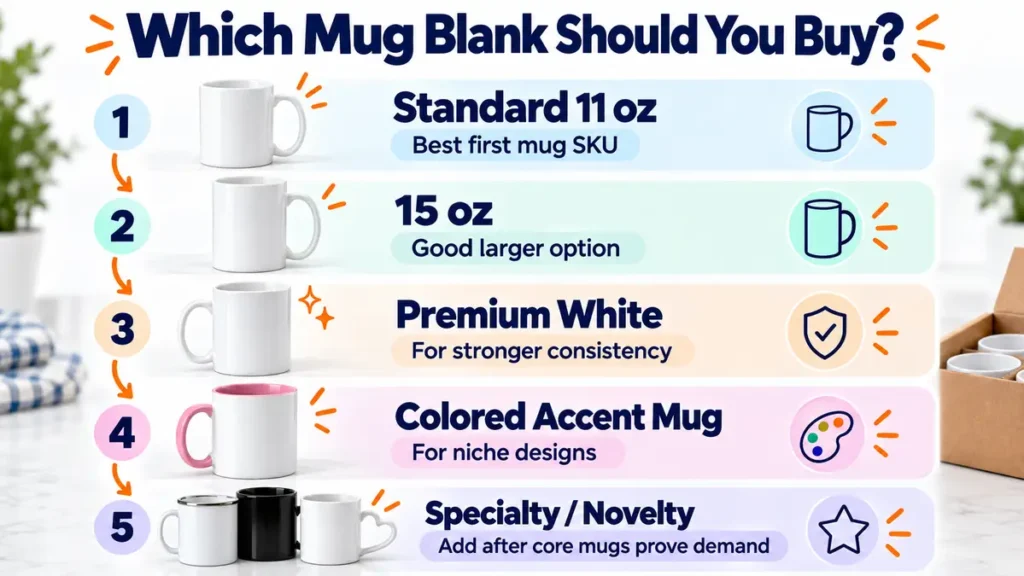
Your first mug SKU should solve the largest number of orders with the least inventory complexity.
Choose a standard white 11 oz mug if:
- You are starting your mug catalog.
- Demand is still being tested.
- One versatile SKU is enough.
- Storage is limited.
- You want to establish a repeatable workflow first.
Add a 15 oz mug if:
- Customers ask for larger mugs.
- You want another price tier.
- The blank fits your press.
- You can support a second template and SKU.
- Its usable cost fits your pricing.
Consider a more premium blank if:
- Consistency matters more than the lowest purchase price.
- Repeat orders justify tighter product specifications.
- Supplier documentation is better.
- Packaging reduces losses.
- You can reorder the same product reliably.
Add novelty mugs if:
- Your standard mug line already sells.
- The specialty effect fits a real customer niche.
- You can manage more inventory.
- Test results show acceptable consistency.
Bottom line: Add complexity only when the next mug type solves a real sales or production need.
Mug Blank Buying Checklist
Run through this list before placing a case order.
- Specifically labeled for sublimation
- Exact capacity confirmed
- Outside diameter checked
- Height checked
- Body profile checked
- Handle clearance checked
- Printable area documented
- Mug press compatibility checked
- Oven compatibility checked if relevant
- Supplier application instructions available
- Pack or case quantity confirmed
- Packaging method reviewed
- Damage or replacement policy reviewed
- Shipping cost included in comparison
- Sample quantity tested
- Usable landed cost calculated
- Reorder availability acceptable
Frequently Asked Questions
Are all 11 oz sublimation mugs the same size?
No. Capacity describes how much liquid the mug holds, not its exact outside diameter, height, handle location, or printable area. Check the dimensions and template for the specific mug you plan to buy.
Are 11 oz and 15 oz mugs pressed with the same heating element?
Sometimes, but not always. It depends on the dimensions supported by the press or heating element. Compare the mug’s diameter and height with the equipment manufacturer’s specifications before ordering a case.
Can you sublimate any ceramic mug?
No. The mug needs a sublimation-compatible coating. A plain ceramic mug may look similar to a sublimation blank but does not automatically have the surface needed to receive sublimation dye.
What coating should a sublimation mug have?
Look for mugs specifically documented as sublimation-compatible or poly-coated for dye sublimation. Judge a product by the supplier’s specifications and application instructions rather than an undefined marketing grade.
Are cheaper sublimation mugs lower quality?
Not automatically. Purchase price alone does not tell you coating consistency, packaging quality, equipment fit, defect rate, or usable-unit cost. Test the actual SKU before making a large commitment.
How many sublimation mugs come in a case?
It varies by supplier and mug style. Standard ceramic products may be packed in larger uniform cases, while specialty shapes can use different quantities. Check the exact product listing before comparing case prices.
Should beginners buy mug blanks by the case?
Usually not before testing them. Start with a smaller quantity when possible, confirm press fit and coating consistency, then compare the usable cost of moving to case quantities.
Can sublimation mug blanks go in a convection oven?
Some can, but follow the blank supplier’s supported application method. Oven workflows can also require a suitable wrap or shrink sleeve, so compatibility should be confirmed before ordering.
How do I calculate the true cost of a mug blank?
Add the landed cost of the order, then divide it by the number of usable mugs you actually received. Do not calculate your production cost from the advertised unit price alone.
Should I test mug blanks before buying in bulk?
Yes. Test several pieces from a new SKU so you can evaluate dimensions, coating consistency, press fit, finished print quality, packaging, and usable cost before committing to a larger order.
Choose a Mug by Fit, Consistency, and Usable Cost
The best sublimation mug blank for your shop is the one that fits your equipment, arrives consistently, gives you enough usable pieces, and can be reordered without disrupting production.
Use this decision order: size → actual dimensions → coating → equipment fit → packaging → usable cost.
An 11 oz white mug is a sensible core SKU for many new product lines. Add 15 oz or specialty mugs after demand supports the extra inventory. Before committing to a case, test the actual mug and calculate its true sublimation blank cost. That gives you a stronger purchasing decision than comparing catalog prices alone.