Print Shop Cash Flow Calculator: Why Profitable Orders Still Drain Cash

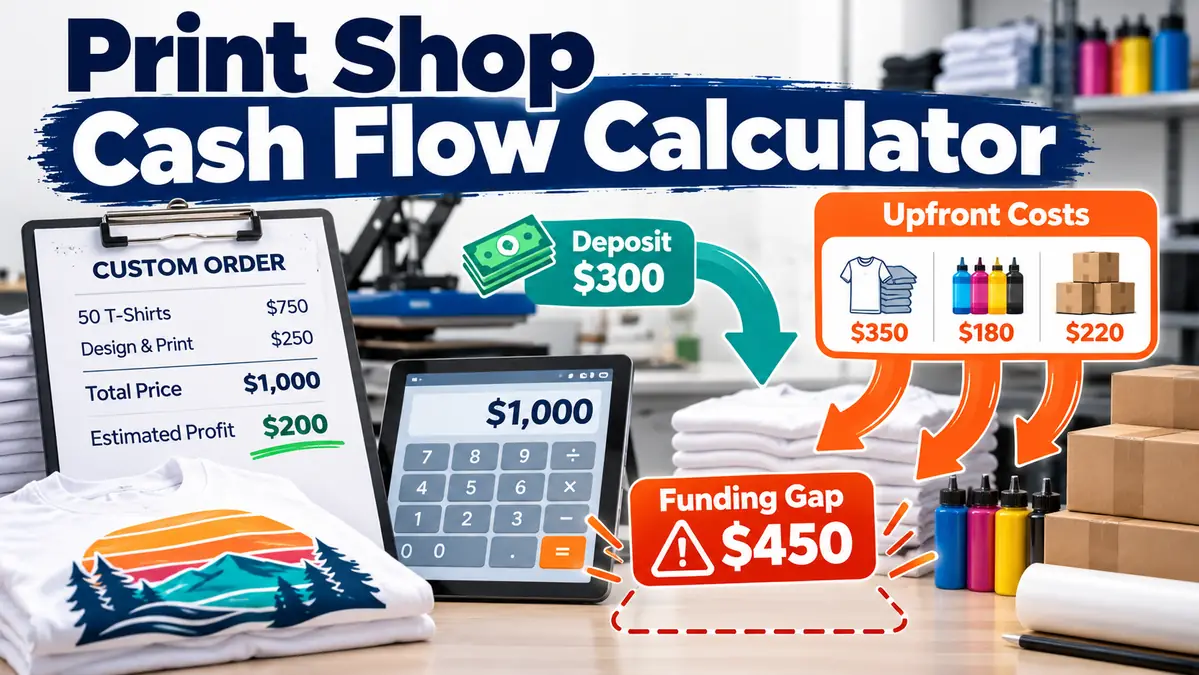
A profitable print order can still leave your bank account short of cash. The problem is timing: you may need to buy shirts, blanks, transfers, packaging, freight, and labor before the customer pays the remaining balance.
Use this print shop cash flow calculator to estimate the cash required before final payment, the amount covered by the customer deposit, and the funding gap your shop must carry until more cash arrives.
Planning rule: profit tells you if the order makes money. Cash flow tells you if the business can fund production under the current payment terms.
Use the Custom Order Cash Flow Calculator
Enter one customer order at a time. Replace the sample numbers with your quote, customer deposit, supplier costs, labor timing, and other cash expenses.
Custom Order Cash Flow Calculator
Estimate how much cash a print order needs before the customer’s final payment arrives. Replace the sample figures with your own quote, deposit, and production costs.
Order cash-flow result
| Deposit scenario | Deposit amount | Funding gap | Cash surplus before final payment | Customer balance |
|---|
Planning tool only. It is not accounting, tax, legal, lending, or credit advice. Use your own order costs, customer terms, and supplier payment dates.
The most important result is the funding gap. A positive number means the shop must use its own cash before the final customer payment arrives. A zero gap means the entered deposit covers the pre-production cash requirement.
The Excel workbook includes the order cash-flow calculator, deposit scenarios, an order timeline, and a short usage guide so you can save each job’s numbers offline.
How a Profitable Custom Order Can Still Create a Cash Shortage
Profit and cash flow answer different questions. A job can finish with a healthy profit while forcing the shop to spend hundreds or thousands of dollars before the customer pays the balance.
| Order item | Hypothetical amount |
|---|---|
| Customer price | $1,800 |
| Total job costs | $1,150 |
| Estimated job profit | $650 |
| Pre-production cash required | $950 |
| 30% customer deposit | $540 |
| Cash funding gap | $410 |
The order earns an estimated $650 after all listed job costs, but the shop must spend $950 before the final payment. A 30% deposit provides only $540, so $410 must come from existing business cash.
Bottom line: check when the money moves, not only how much profit remains after the job is complete.
Profit Margin vs Cash Flow for a Print Order
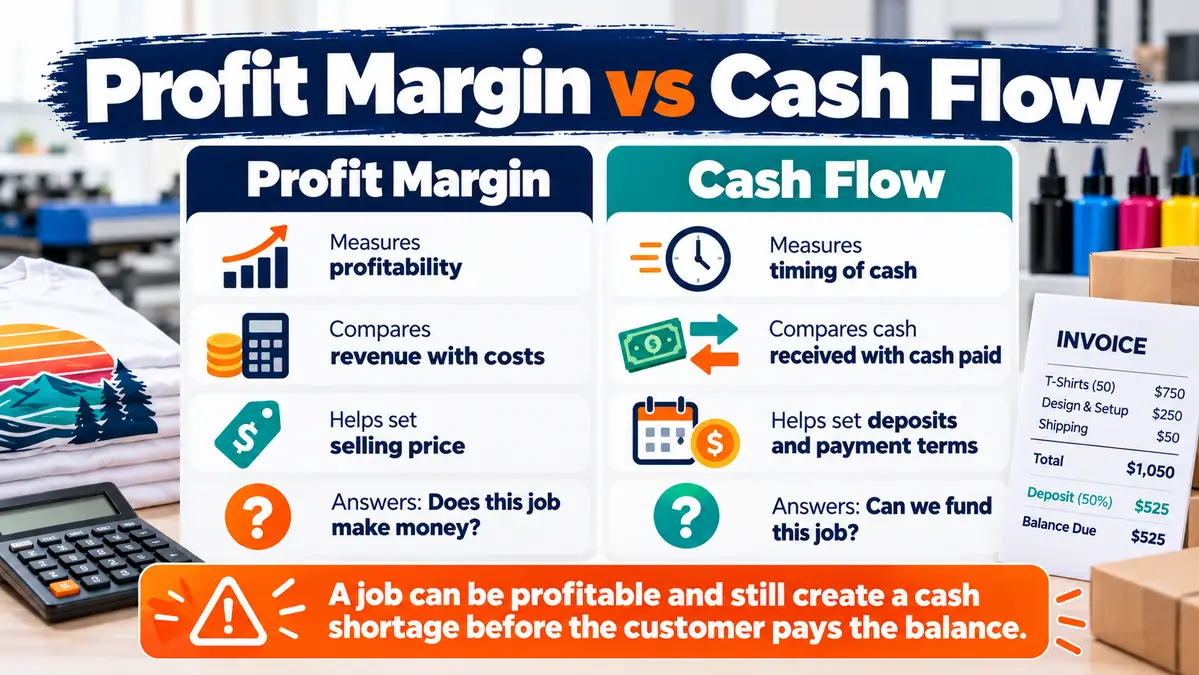
Profit margin measures pricing performance. Cash flow measures whether enough money is available when bills must actually be paid.
| Profit margin | Cash flow |
|---|---|
| Measures profitability | Measures movement and timing of cash |
| Compares revenue with costs | Compares cash received with cash paid |
| Helps set selling prices | Helps set deposits and payment terms |
| Can be positive before payment arrives | Can become negative during a profitable order |
| Answers “Does this job make money?” | Answers “Can we fund this job?” |
Use the Sublimation Profit Margin Calculator to test whether the selling price leaves enough profit. Then use this page to check whether the payment schedule creates a cash gap.
Calculate How Much Cash the Order Ties Up
Count the expenses that must be paid before the next customer payment. The timing matters more than the accounting label.
- Blank garments, mugs, tumblers, metal, or other substrates
- Supplier freight and rush freight
- DTF transfers, embroidery, engraving, or contract production
- Ink, paper, tape, pretreatment, vinyl, packaging, and other consumables
- Labor that must be paid before final customer payment
- Replacement materials or job-specific setup costs
For blanks, use delivered cost rather than the supplier’s displayed unit price. The Sublimation Blank Cost Calculator helps account for freight, fees, and unusable pieces.
Pre-production cash requirement formula
Pre-production cash required = materials + inbound freight + consumables + labor due before final payment + outsourced work + other upfront costs
Then subtract the customer cash already received. If upfront costs are $2,400 and the customer has paid $1,500, the funding gap is $900.
How Much Deposit Should a Print Shop Require?
There is no universal deposit percentage that fits every print business. Base the decision on the actual cash exposure created by the order, then adjust for the customer relationship, supplier terms, order risk, and your written policies.
Minimum cash-safe deposit = pre-production cash requirement ÷ order total × 100
Using the hypothetical $1,800 order with $950 in pre-production cash needs, the cash-safe percentage is about 52.8%. That does not mean every order should use a 52.8% deposit. It shows how much cash would cover the entered pre-production requirement in that specific example.
30%, 50%, or Full Payment: Compare the Cash Effect
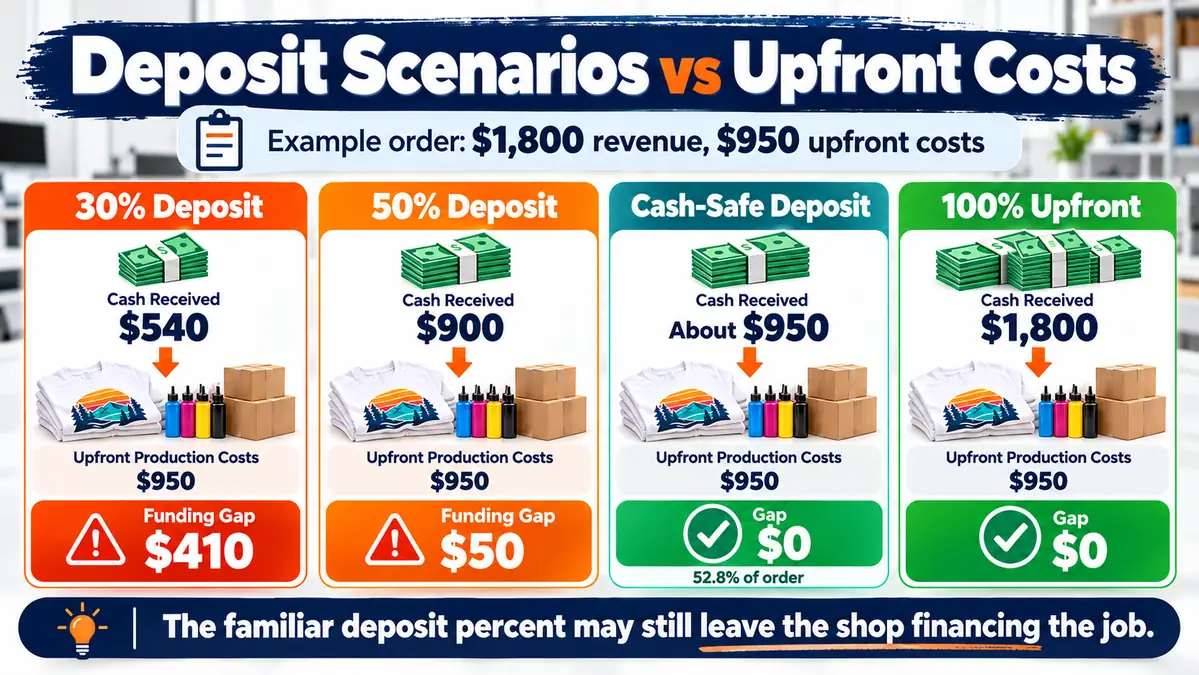
A familiar deposit percentage can still leave the shop financing the job. Compare the payment structure against the actual upfront cash requirement.
| Payment structure | Cash received before production | Pre-production cost | Cash gap |
|---|---|---|---|
| 30% deposit | $540 | $950 | $410 |
| 50% deposit | $900 | $950 | $50 |
| 52.8% deposit | About $950 | $950 | $0 |
| 100% upfront | $1,800 | $950 | $0 |
The 50% option is much safer than 30% in this example, but it still leaves a small gap. A business with strong reserves may accept that intentionally. A shop with tight working cash may change the terms.
Large Orders Can Make the Cash Problem Worse
A larger order can create more profit and more cash pressure at the same time. Materials, freight, labor, outsourced work, packaging, and replacement stock can all increase before the customer balance is due.
- More inventory must be purchased at once
- Freight or pallet costs can rise
- Extra labor or overtime may be needed
- Outsourced production may require prepayment
- The final customer payment may still arrive only after completion
This is one reason sales growth can feel cash-constrained. Revenue may be increasing while more business cash is tied up between supplier payment day and customer payment day.
Supplier Terms Can Reduce the Cash Gap
A supplier that is slightly more expensive can still create a safer order if its payment timing, warehouse location, or freight structure reduces the amount of cash your shop must commit before customer payment.
- Account payment terms
- Freight thresholds
- Quantity breaks
- Warehouse location
- Split-shipment costs
- Local pickup
- Stock availability
- Negotiated account pricing
Once purchasing becomes consistent, review both price and terms. The guide to negotiating wholesale apparel pricing covers that supplier conversation in more detail.
Customer Payment Terms That Protect Cash Flow
Payment terms work best when customer cash arrives before or close to the dates your shop must pay major production costs. The right structure depends on the order and the customer.
Deposit before ordering materials
Collecting a deposit before placing non-returnable or expensive supplier orders reduces the amount your shop must finance. The deposit should be compared with the whole pre-production requirement, not only the cost of the blanks.
Milestone payments
Large jobs can be divided into payment stages tied to approval, material purchase, production completion, or delivery. Milestones can reduce the maximum amount of business cash tied up at one time.
Balance before pickup or shipment
Collecting the remaining balance before releasing finished custom goods reduces accounts-receivable exposure. Your quote and written terms should state when the payment is due.
Net terms for qualified customers
Net 15, Net 30, or similar terms can shift the cash gap past production and into accounts receivable. Before offering terms, check the customer payment history, order size, outstanding balances, and the effect on payroll and other supplier obligations.
Should the Deposit Cover the Cost of the Blanks?
Covering the material purchase is a useful starting point, but blanks may represent only part of the upfront cash requirement.
If blanks cost $700 but freight, outsourced transfers, labor, and packaging add another $480 before final payment, a $700 deposit still leaves a $480 gap. Calculate the whole pre-production cycle.
Should You Accept a Profitable Order You Cannot Cash-Flow?
A profitable order is not automatically a good order under the current payment terms. Use the cash gap alongside margin, customer reliability, and the effect on other jobs.
| Decision | Signs |
|---|---|
| Accept under current terms | Deposit covers most or all upfront costs; supplier stock is available; reserves remain comfortable; margin is acceptable |
| Change the terms | Order is profitable but creates a large temporary deficit; deposit or milestones can be adjusted; production can be staged |
| Reconsider | Customer refuses workable terms; order threatens payroll or supplier payments; profit is too small for the cash exposure |
Track the Maximum Cash Tied Up, Not Just the Final Balance
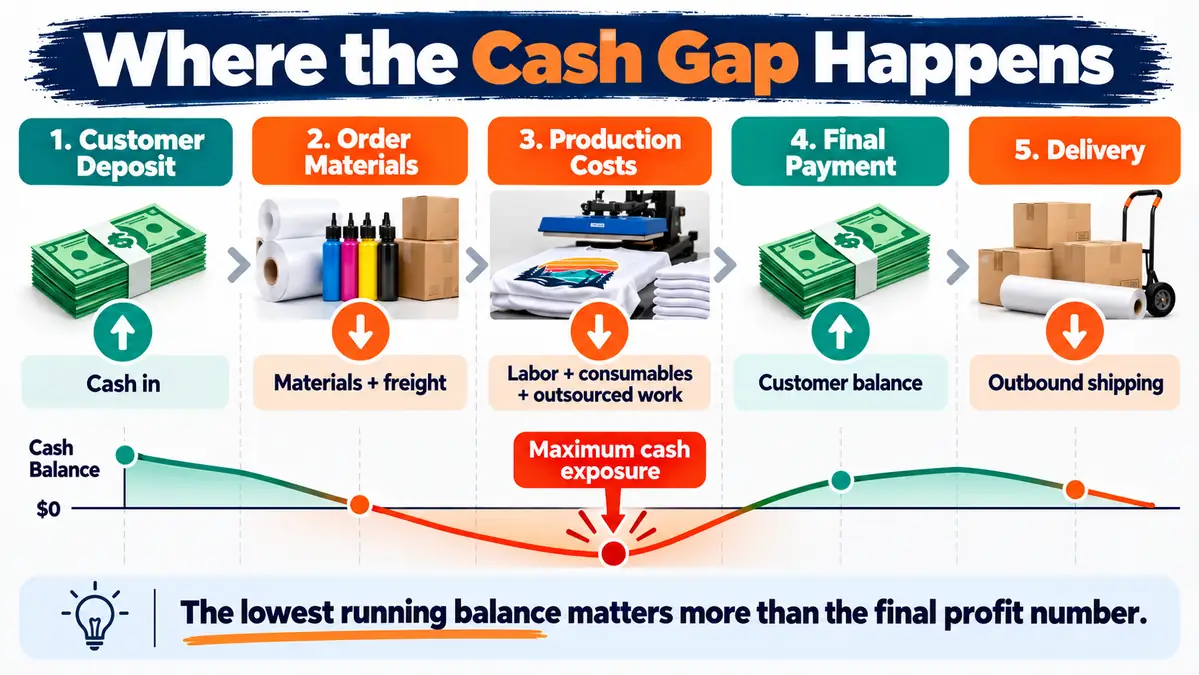
The most useful cash-flow number is often the lowest point during the order. Build a simple timeline showing when each deposit, supplier payment, labor payment, final invoice, and shipping cost occurs.
| Stage | Cash in | Cash out |
|---|---|---|
| Customer deposit | Deposit amount | |
| Order materials | Materials + inbound freight | |
| Production | Labor + consumables + outsourced work | |
| Final payment | Customer balance | |
| Delivery | Outbound shipping or delivery cost |
The most negative running balance is the maximum cash exposure. This becomes more important when several large jobs overlap and their supplier payments fall in the same week.
Compare Several Print Orders Competing for the Same Cash
When working cash is limited, revenue alone is a poor way to prioritize orders. Compare the amount of cash tied up, how long it stays tied up, and the profit created by that cash exposure.
| Metric | Why it matters |
|---|---|
| Order revenue | Shows sales size, not funding burden |
| Expected profit | Shows the expected financial return |
| Upfront cash required | Shows the amount due before later customer payment |
| Deposit collected | Shows customer cash already available |
| Funding gap | Shows how much the shop must finance |
| Days until final payment | Shows how long the exposure lasts |
| Profit per dollar of cash tied up | Helps compare jobs using scarce working cash |
Use Cash Flow With Your Quote Before Sending It
Run the cash check before the customer approves the quote. Changing payment terms after the shop has already committed materials is harder.
- Calculate materials and production costs.
- Set the selling price.
- Check expected profit.
- Estimate the cash required before final payment.
- Calculate the funding gap.
- Adjust the deposit or payment milestones when needed.
- Send the final quote with clear payment terms.
If quoting is becoming difficult to manage manually, compare your workflow against the best quoting software for wholesale apparel orders.
Keep an Order Cash-Flow Record
Save the actual timing after each meaningful job. Your own records are more useful than a generic deposit rule because they show how your customers, suppliers, and production process really behave.
- Quote date and order value
- Deposit percentage and deposit date
- Supplier order and payment date
- Freight and outsourced production costs
- Labor payment dates
- Final invoice and payment dates
- Delivery date
- Maximum cash tied up
- Estimated profit and actual profit
After several orders, patterns become easier to see. A particular customer may pay slowly, one product may require too much inventory, or one supplier may create a bigger cash gap because of freight and payment timing.
Build a Cash Buffer for Orders That Do Not Follow the Plan
The calculator estimates the expected requirement, but production can change. Out-of-stock sizes, damaged blanks, reprints, rush freight, customer changes, and extra labor can all increase the cash needed before final payment.
Leave enough room in your payment terms and working cash so one small production problem does not create a larger business problem. The appropriate buffer depends on the job and your own risk tolerance.
Frequently Asked Questions
Can a profitable print shop have negative cash flow?
Yes. Profit measures revenue after expenses, while cash flow tracks when money enters and leaves the business. A shop can earn a profit on an order while temporarily spending more cash on materials, labor, and freight than it has collected from the customer.
How much deposit should a print shop require?
There is no universal percentage. Calculate the cash required before the next customer payment and compare it with the planned deposit. Larger material purchases, outsourced production, or longer payment delays can require different terms.
Should a customer deposit cover the cost of blanks?
Covering blank costs can reduce risk, but blanks may be only part of the upfront requirement. Include freight, consumables, outsourced work, labor, packaging, and other costs that must be paid before the final customer payment.
Is a 50% deposit enough for custom apparel orders?
It depends on the order. If 50% covers the pre-production cash requirement, it may be enough. If expensive garments, freight, or outsourced work require more cash upfront, the shop will still finance the difference.
What is a cash-flow gap?
A cash-flow gap is the difference between cash that must be paid and cash already received during a period. For a print order, it often appears after materials are purchased but before the customer pays the remaining balance.
Should print shops offer Net 30 terms?
Net 30 can work for qualified business customers when the shop has enough working cash to finance the order while waiting for payment. Review payment history, order size, outstanding invoices, and the effect on other obligations before extending credit terms.
How do large orders affect print-shop cash flow?
Large orders usually require larger material purchases, more labor, and higher freight costs. If the customer balance is paid after production, the amount of shop cash tied up can increase even when the job is profitable.
Is profit the same as money in the bank?
No. Profit measures financial performance after revenue and expenses. The bank balance reflects actual cash movement, including customer deposits, supplier payments, inventory purchases, unpaid invoices, and other timing differences.
Check Cash Before You Say Yes to the Order
Price the job first, but do not stop at the profit number. Calculate the expected profit, total the cash required before final payment, subtract the customer deposit, and identify the funding gap.
If the gap is larger than the business can comfortably carry, change the payment terms, stage the order, improve supplier terms, or reconsider the job before production begins.