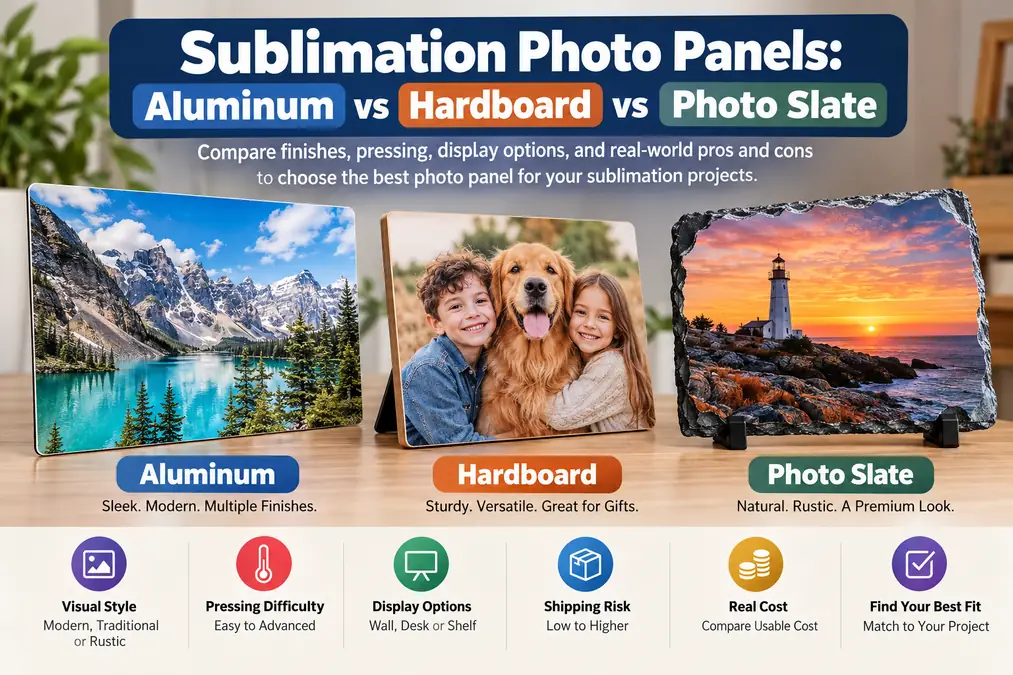
Sublimation Photo Panels: Aluminum vs Hardboard vs Photo Slate

Sublimation photo panels can turn a photograph into wall art, a desktop display, a memorial piece, or a premium personalized gift. The harder decision is choosing the right panel material.
For most shops, the choice comes down to aluminum, hardboard, or photo slate.
Aluminum gives you a thin, modern photo display with several finish options. Hardboard provides a thicker, rigid panel that works well for desktop and decor products. Photo slate creates a natural stone presentation with irregular edges, but it normally requires a much longer and more specialized pressing process.
The best choice depends on the finished look you want, your heat press, production speed, display method, shipping plan, and actual cost per sellable panel.
| If you need… | Start with… |
|---|---|
| Sleek modern wall art | Aluminum |
| Desktop or shelf photo display | Hardboard |
| Rustic or memorial-style product | Photo slate |
| Faster production | Aluminum or hardboard |
| Natural stone edges | Photo slate |
| Multiple finish choices | Aluminum |
| Simpler repeat production | Hardboard or aluminum |
| A distinctive premium gift | Photo slate |
Aluminum vs Hardboard vs Photo Slate at a Glance
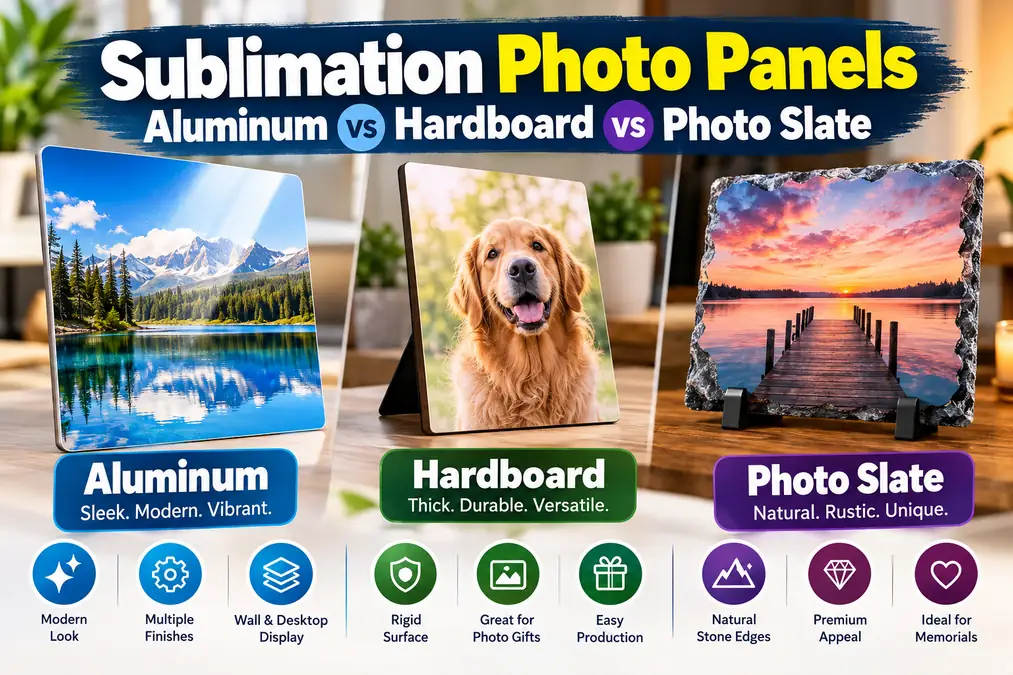
The three materials can all produce photo products, but they should not be treated as interchangeable blanks.
| Factor | Aluminum | Hardboard | Photo slate |
|---|---|---|---|
| Visual style | Modern and thin | Solid, traditional panel | Natural and rustic |
| Edge appearance | Clean manufactured edge | Visible board edge | Irregular natural edge |
| Surface options | Multiple finishes on some lines | Usually coated white photo surface | Coated face over natural stone |
| Typical display | Wall, easel, floating mount | Desktop, wall, decor | Desk, shelf, mantel |
| Production speed | Relatively short cycle | Relatively short cycle | Much longer cycle |
| Surface consistency | Highly uniform | Uniform manufactured surface | Natural variation |
| Press setup | Flat press | Flat press | Flat press plus suitable pressure pad on many products |
| Handling concern | Surface scratches, thin-panel handling | Edge and surface damage | Stone breakage and edge damage |
| Batch production | Good fit | Good fit | Slower |
| Best business use | Photo art, signage, premium displays | Gifts, desktop decor, general photo products | Memorials, weddings, keepsakes, premium gifts |
This table is a purchasing framework, not a universal settings chart. Coatings, thicknesses, panel dimensions, printer type, press design, and manufacturer instructions can all change the required production setup.
Aluminum Sublimation Photo Panels
Aluminum is the strongest starting point when the finished product needs a clean, contemporary photo-print appearance.
Purpose-made sublimation aluminum is not bare sheet metal. The printable side has a coating designed to receive sublimation dye. If you need the broader process for preparing and pressing coated metal, use the site’s sublimation metal blanks guide. This page focuses specifically on choosing photo-panel material.
What aluminum photo panels look like
One advantage of aluminum is the range of surface treatments available.
ChromaLuxe currently lists indoor aluminum photo-panel finishes including gloss white, semi-gloss white, matte white, gloss clear, semi-gloss clear, and matte clear. Its standard indoor aluminum panels are listed at 0.045 inch, or 1.14 mm, thick. See the current ChromaLuxe panel specifications.
A white coating gives the image a neutral background and is the safer choice when accurate whites and predictable color reproduction matter.
A clear coating allows the metal underneath to remain visible in lighter areas of the image. That can create a more metallic effect, but it also changes how the artwork looks compared with printing on a white base.
Where aluminum works best
- family and portrait photography
- wedding photography
- landscape prints
- wall art
- commercial displays
- business signage
- gallery-style products
- premium photo gifts
It also gives you more presentation options than a simple tabletop product. Current ChromaLuxe mounting systems include easels, hanging mounts, shadow mounts, mounting blocks, and French-cleat systems. Review the current mounting options.
Aluminum pressing considerations
Do not create one universal aluminum photo-panel setting and use it for every size.
For example, ChromaLuxe currently specifies 385°F / 195°C for its small-format aluminum photo panels, but the listed time changes with panel size.
| Current ChromaLuxe example | Temperature | Listed time |
|---|---|---|
| Panels up to 11.5 in | 385°F | 1:30 to 1:35 |
| Panels from 11.5 to 20 in | 385°F | 1:45 to 2:00 |
Those values apply to the manufacturer’s specified products and workflow, not every aluminum panel sold online. ChromaLuxe also calls for strong pressure and instructs users to remove the protective film before pressing. Check the manufacturer’s current instructions.
The practical lesson is simple: panel size can change press time even when the material and nominal temperature remain the same.
Main disadvantages of aluminum
- panel finish
- thickness
- corner style
- protective film
- supported press orientation
- mounting hardware
- packaging
- surface protection during shipping
- replacement availability
A thin panel also needs a different fulfillment plan from a thick desktop blank. Do not choose the panel without deciding how the finished product will be displayed and protected.
Hardboard Sublimation Photo Panels
Hardboard photo panels are purpose-made rigid boards with a sublimation-ready printable surface. They should not be confused with a random piece of unfinished fiberboard from a hardware store.
Manufacturers such as ChromaLuxe and Unisub currently provide dedicated hardboard photo panels and product-specific sublimation instructions.
Why hardboard works well for photo products
Hardboard is useful when you want a substantial panel without the natural variation of slate.
- desktop photos
- family gifts
- office displays
- shelf decor
- personalized plaques
- small wall tiles
- event photographs
Its manufactured shape makes repeat production easier than a natural-edge stone product. Some desktop products also integrate the display method into the blank itself, which can simplify the finished SKU.
Hardboard pressing considerations
Hardboard is another good example of why the exact SKU matters.
ChromaLuxe currently lists 385°F / 195°C for 1:05 to 1:25 on its hardboard photo-panel instructions. Unisub’s hardboard desktop photo-panel instructions also use 385°F / 195°C but list 1:20 to 1:30 for that product. See ChromaLuxe instructions and Unisub’s current panel instructions.
Those differences are normal. Blank construction, thickness, coating, equipment, and production method can change the starting point. Do not average two manufacturers’ settings together. Use the instructions for the exact blank you bought.
Hardboard limitations
Hardboard does not give you the metallic surface effects of aluminum or the natural edge of slate.
- edge color and finish
- panel thickness
- one-sided or two-sided coating
- protective film
- display hardware
- maximum usable print area
- orientation
- carton packaging
Hardboard often makes sense when production consistency matters more than creating a specialty substrate effect.
Sublimation Photo Slate
Photo slate is the most visually distinctive of the three materials.
A sublimation slate blank uses natural stone with a prepared printable face. JPPlus currently describes its photo-slate tablets as natural slate with a dye-sublimation coating on one side, a natural back, unique edge texture, and a two-piece standing base. See the current JPPlus product details.
Because the substrate itself is part of the appearance, slight variation between pieces is expected.
Where slate works best
- memorial photos
- family portraits
- wedding images
- anniversary gifts
- awards
- pet memorials
- shelf displays
- mantel decor
- premium personalized gifts
A customer choosing slate is often buying more than an image. The irregular stone edge is part of the presentation.
Why photo slate is harder to press
Slate has a very different thermal and pressure requirement from thin aluminum.
JPPlus currently requires a suitable pad for its slate products, listing a Nomex felt pad, green sponge heat pad, or two white silicone pressure pads as supported options. Its technical guide shows that press time changes substantially according to slate size, thickness, and pad type. Review the current JPPlus slate guide.
For roughly 5/16-inch slate, current examples range from about 6 minutes with some Nomex setups to 12 or 13 minutes with certain silicone-pad setups, depending on product size. JPPlus also instructs users to add time for thicker slate.
That is dramatically longer than the aluminum and hardboard examples above. Do not convert that into a universal “press slate for X minutes” rule. Follow the technical sheet supplied for your exact slate blank.
Natural variation affects layout
A rectangular aluminum panel gives you a predictable edge. Slate does not.
The irregular perimeter means artwork needs more breathing room. Fine text, faces, logos, or important design elements should not sit too close to the edge. Build your design around a safe central area instead of forcing a perfectly rectangular composition across an uneven stone outline.
Breakage deserves more attention
Slate is natural stone, so the shipping plan deserves more scrutiny than it would for a flexible textile blank.
- individual protection
- carton dividers
- corner protection
- base or stand packaging
- replacement policy
- damaged-item claim process
The purchase price means little if too many panels arrive chipped or broken.
Which Material Produces the Best-Looking Photo?
There is no single material that produces the “best” photo for every image. The substrate changes the presentation.
Aluminum
Aluminum gives you the most modern visual style. White finishes support a conventional photographic look, while clear finishes can let the metallic surface influence lighter portions of the design.
Hardboard
Hardboard gives the photo a substantial plaque-like appearance. It works well when the buyer wants a physical decor object rather than a thin metal print.
Photo slate
Slate makes the substrate visible. The irregular edge frames the image naturally, which can work especially well for memorials, rustic designs, family photographs, and sentimental gifts.
Color can also shift depending on the substrate and surface finish. The site’s sublimation color shift chart explains why the same file can look different after being pressed onto different materials.
Pressing Difficulty: Aluminum vs Hardboard vs Slate
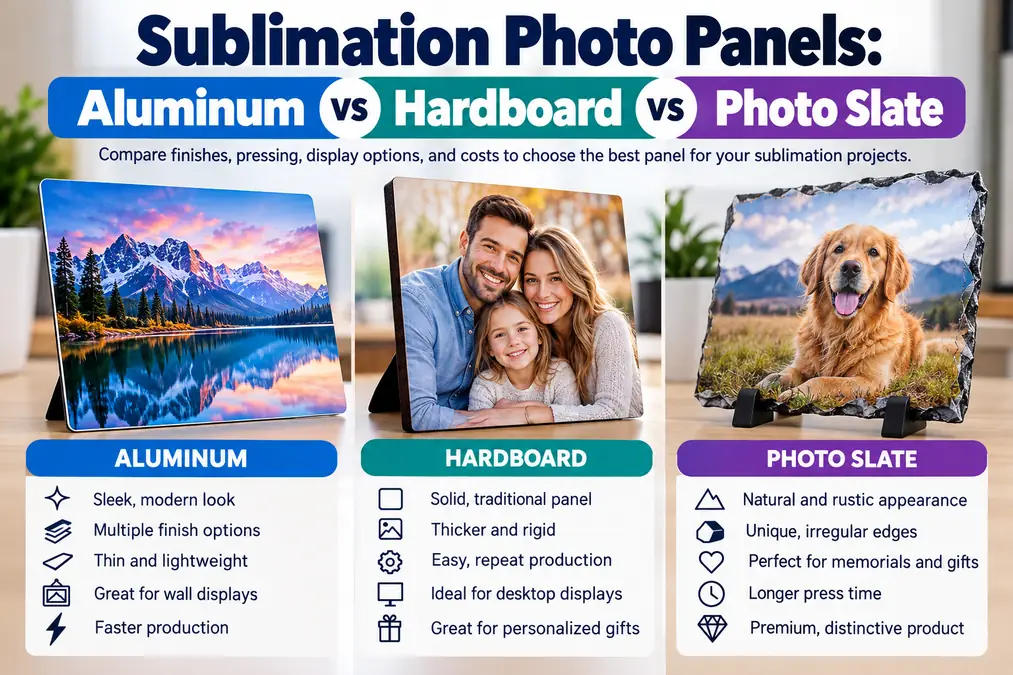
For a small shop choosing what to add first, production difficulty matters as much as appearance.
| Production factor | Aluminum | Hardboard | Photo slate |
|---|---|---|---|
| Typical manufacturer example cycle | Short | Short | Long |
| Flat press required | Yes | Yes | Yes |
| Product-specific pad | Usually not the main requirement | Usually not the main requirement | Commonly required |
| Surface shape | Uniform | Uniform | Naturally variable |
| Edge alignment | Predictable | Predictable | Irregular |
| Batch speed | Higher | Higher | Lower |
| Beginner complexity | Lower | Lower | Higher |
Current manufacturer instructions make the difference clear. ChromaLuxe’s cited aluminum and hardboard examples use cycles measured in roughly one to two minutes, while the JPPlus slate guidance uses multi-minute cycles that depend on pad type and size.
This does not mean aluminum and hardboard always use the same settings. It means slate normally requires a different production plan.
For broader substrate starting points, use the site’s heat press temperature for sublimation chart, then return to the blank manufacturer’s instructions before production.
Display Options Matter Before You Buy
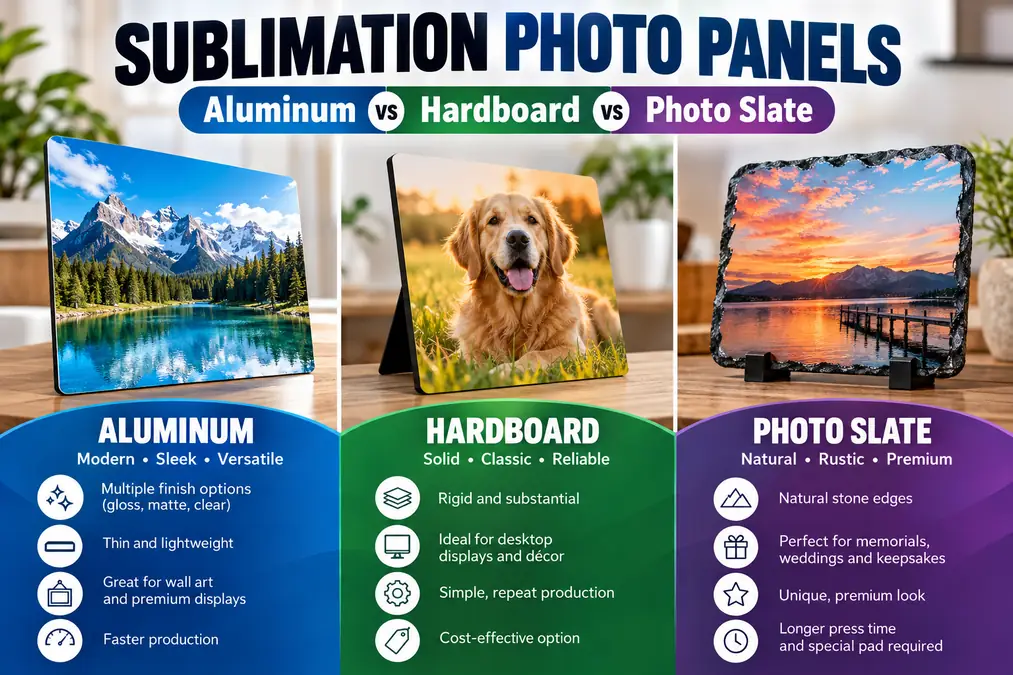
The blank itself is only one part of the finished product. A photo panel also needs a way to stand, hang, or mount.
Desktop displays
- built-in or adhesive kickstand
- small easel
- interlocking feet
- two-piece stone stand
- slotted support
Wall displays
- adhesive hanging mounts
- shadow mounts
- mounting blocks
- French cleats
- frames
Why this affects your buying decision
- Is the hardware included?
- Is it sold separately?
- Does it work in portrait and landscape orientation?
- How much does it add to unit cost?
- Does it require assembly?
- Will adhesive hardware survive your shipping process?
- Does the package still fit your planned shipping box?
A cheap blank can become an awkward product if the mounting solution is expensive or difficult to source consistently.
Shipping and Breakage Risk for Sellers
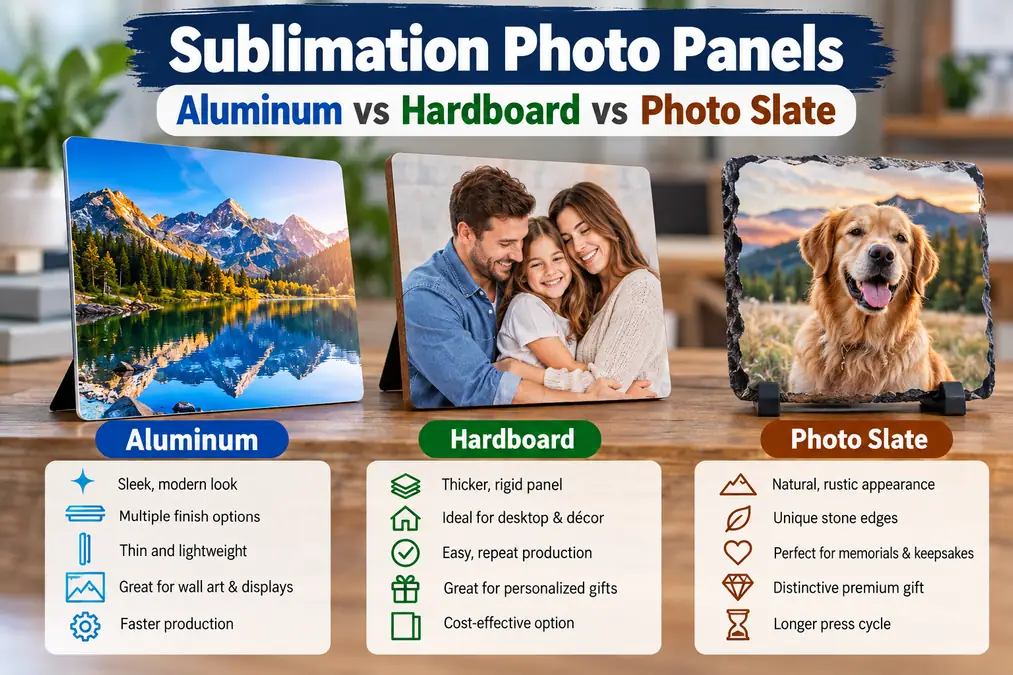
Photo panels are sold as finished display products, so packaging needs to protect both the image and the substrate.
Aluminum
- surface scratches
- bent corners
- rubbing between panels
- damage to attached mounts
Hardboard
- corners
- coated face
- exposed edges
- stands or attached hardware
Slate
- irregular edges
- corners
- stone face
- included stand pieces
- neighboring slate pieces in multi-unit shipments
If you plan to sell slate online, test the finished shipping package, not just the blank. A product that survives shipment from your supplier may still fail when you repackage and ship it to your own customer.
Calculate the True Cost per Sellable Photo Panel
The catalog price is not your real blank cost.
- blank price
- inbound freight
- mounting hardware
- stands
- protective packaging
- damaged units
- coating defects
- unusable prints
- replacement components
True sellable panel cost = total landed product and hardware cost ÷ sellable panels produced
Suppose a carton gives you 20 panels but one arrives damaged and another becomes unusable during testing. Your usable cost should be based on 18 sellable panels, not 20.
Use the site’s sublimation blank cost calculator to compare suppliers using actual landed cost instead of the advertised blank price.
Which Sublimation Photo Panel Should You Buy?
Choose aluminum if:
- you want a modern photographic finish
- wall art is a major product category
- customers may want gloss, matte, or metallic effects
- thin and lightweight presentation matters
- you plan to offer multiple mounting choices
- faster batch production matters
Choose hardboard if:
- you want a rigid desktop or decor product
- straightforward repeat production matters
- a thicker panel suits the design
- the exposed edge works with your product
- you want a simple alternative to metal
Choose photo slate if:
- the natural stone appearance adds value
- you sell memorials or sentimental gifts
- irregular edges fit the design
- customers are paying for a specialty presentation
- your press can handle the required production method
- you can accept longer press cycles
Stock more than one material when:
Customer demand justifies the additional inventory. Adding all three at once means managing three production records, different settings, different packaging, different hardware, different design templates, and different damage risks.
If you are still deciding which blank type fits a project, the sublimation material and product selection calculator can help narrow the substrate choice.
What to Check Before Ordering a Case
- Specifically designed for sublimation
- Substrate confirmed
- Exact dimensions
- Panel thickness
- Surface finish
- White or clear base where applicable
- Protective film requirements
- Manufacturer pressing instructions
- Recommended press orientation
- Required pad or cushion
- Printable area
- Portrait and landscape compatibility
- Stand or mounting hardware included
- Hardware replacement availability
- Case quantity
- Individual packaging
- Supplier damage policy
- Inbound shipping cost
- Test quantity available
- Final usable-unit cost
Save those specifications with your production record instead of relying on memory.
Common Sublimation Photo Panel Problems
Faded or incomplete aluminum image
- protective film removed
- coated side correctly identified
- transfer fully contacting the panel
- actual press temperature
- pressure distribution
- correct time for the panel size
Do not automatically add more heat. ChromaLuxe notes that time, pressure, heat distribution, humidity, altitude, room conditions, press type, and printer can all influence results. Review the manufacturer’s current guidance.
Hardboard ghosting
Ghosting normally means the transfer moved while the dye was still active. Secure the paper before pressing and remove the panel and transfer according to the blank manufacturer’s process.
Slate has dull or uneven spots
Check the pressure pad, heat distribution, transfer contact, and product-specific instructions before changing settings. A naturally uneven substrate requires a more forgiving pressing stack than a thin flat aluminum panel.
Slate cracks
Stop production and review the blank’s complete pressing instructions. Confirm the correct pad, pressure, panel thickness, time, temperature, and handling procedure. Do not use generic ceramic or aluminum settings on slate.
Panel warps
Warping can indicate too much thermal stress, pressure, or inappropriate handling for that blank. Follow the manufacturer’s cooling and pressing instructions. Test one unit before committing an entire batch.
Paper sticks to the slate
Do not pull aggressively across the coated surface. Allow the product to reach the removal stage specified by the supplier and inspect whether the press stack, moisture, time, or temperature needs correction.
White border around a slate image
The irregular stone edge makes exact full bleed difficult. Extend the artwork beyond the intended visible image area while keeping faces, text, and other critical elements farther inside the safe zone.
Frequently Asked Questions
What are sublimation photo panels?
Sublimation photo panels are coated rigid blanks designed to receive dye-sublimation images under heat and pressure. Common substrates include coated aluminum, hardboard, and natural photo slate.
Is aluminum or hardboard better for sublimation photos?
Aluminum is usually the stronger choice for thin, modern wall art and multiple finish options. Hardboard works well for thicker desktop displays, plaques, and general decor products. The better material depends on the finished product rather than image quality alone.
Can you sublimate on ordinary aluminum?
Not directly with the standard process used for photo panels. The aluminum needs a compatible sublimation coating. Use a blank specifically manufactured for dye sublimation.
Does hardboard need a sublimation coating?
Yes. Buy a hardboard product designed for sublimation rather than untreated construction or craft hardboard.
Is photo slate harder to sublimate?
Usually. Current slate instructions can require special pressure pads and press cycles several minutes longer than typical aluminum or hardboard photo panels.
Do you need a special pad for photo slate?
It depends on the product. JPPlus currently specifies a Nomex felt pad, green sponge heat pad, or two white silicone pressure pads for its referenced slate products. Follow your exact blank’s instructions.
Can sublimation photo panels be used outdoors?
Do not assume every panel is outdoor-rated. Some manufacturers sell separate outdoor panel products. Verify the coating and environmental rating for the exact SKU before selling it for exterior use.
Which photo-panel material is easiest for beginners?
Aluminum or hardboard is usually easier to integrate into a basic flat-press workflow because the surfaces are manufactured flat and the press cycles are comparatively short. Slate adds natural surface variation and a more demanding press setup.
Which material is safest to ship?
There is no universal winner because size, thickness, packaging, carrier handling, and mounting hardware all matter. Slate deserves extra protection because it is natural stone. Test your finished shipping package before scaling online orders.
What size heat press do I need for sublimation photo panels?
The press platen needs to support the panel and the manufacturer’s required pressing method. Large photo panels can require equipment beyond a standard small craft press. Match your maximum planned panel size to your press before buying inventory.
Choose the Panel Around the Finished Product
Use the decision in this order: appearance → display method → press capability → production time → shipping risk → true usable cost.
Choose aluminum when you want a thin, modern photo display with flexible finish and mounting options.
Choose hardboard when you want a rigid, predictable decor or desktop product with straightforward repeat production.
Choose photo slate when the natural stone presentation is part of what the customer is paying for and the slower production cycle makes sense for the selling price.
Before buying a full case, order a small test quantity, press more than one panel, test the finished display hardware, pack a sample the way you would ship it to a customer, and calculate the cost of the units you can actually sell.