UV DTF vs Sublimation for Tumblers: Materials, Cost & Care

A customer wants a bright logo on a black powder-coated tumbler. Your sublimation printer is ready, but the tumbler is not labeled for sublimation. That is the point where the decoration method matters more than the artwork.
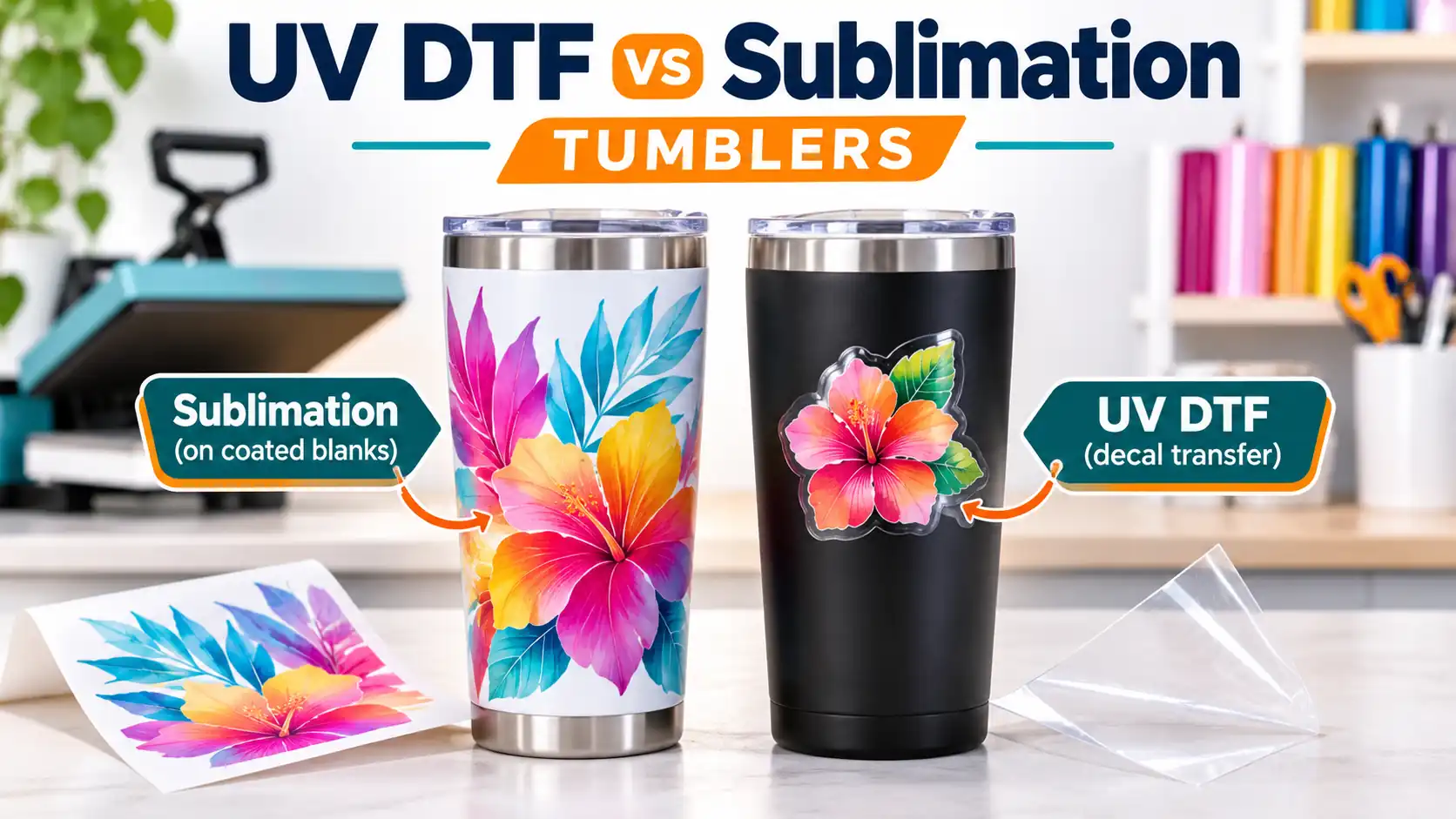
Choose sublimation for compatible, light-colored polymer-coated tumblers when you want the print to become part of the coating. Choose UV DTF for selected hard, smooth tumblers when you need an applied full-color decal without a heat press. Neither method is suitable for every finish, and neither has a universal dishwasher-safe claim.
| Decision factor | Sublimation | UV DTF transfer |
|---|---|---|
| What holds the design | Dye enters a suitable polymer coating | UV-cured printed layer adheres to the outside |
| Blank requirement | Explicitly sublimation-ready coating | A compatible hard, smooth, clean surface; sample test required |
| Dark or colored body | Limited by the base color; standard sublimation does not print white | Can show light artwork if the selected transfer includes a white layer |
| Application | Specialized ink, paper and a suitable press or oven | Applied by hand with pressure; no heat press for the transfer |
| Finished feel | Usually smooth with no raised decal edge | Slightly raised edge or texture is possible |
| Main production risk | Incompatible coating, uneven heat, shifting paper | Poor adhesion, trapped air, edge lifting |
| Care | Follow the actual blank maker’s instructions | Follow transfer supplier; hand washing is a safer default unless explicitly rated otherwise |
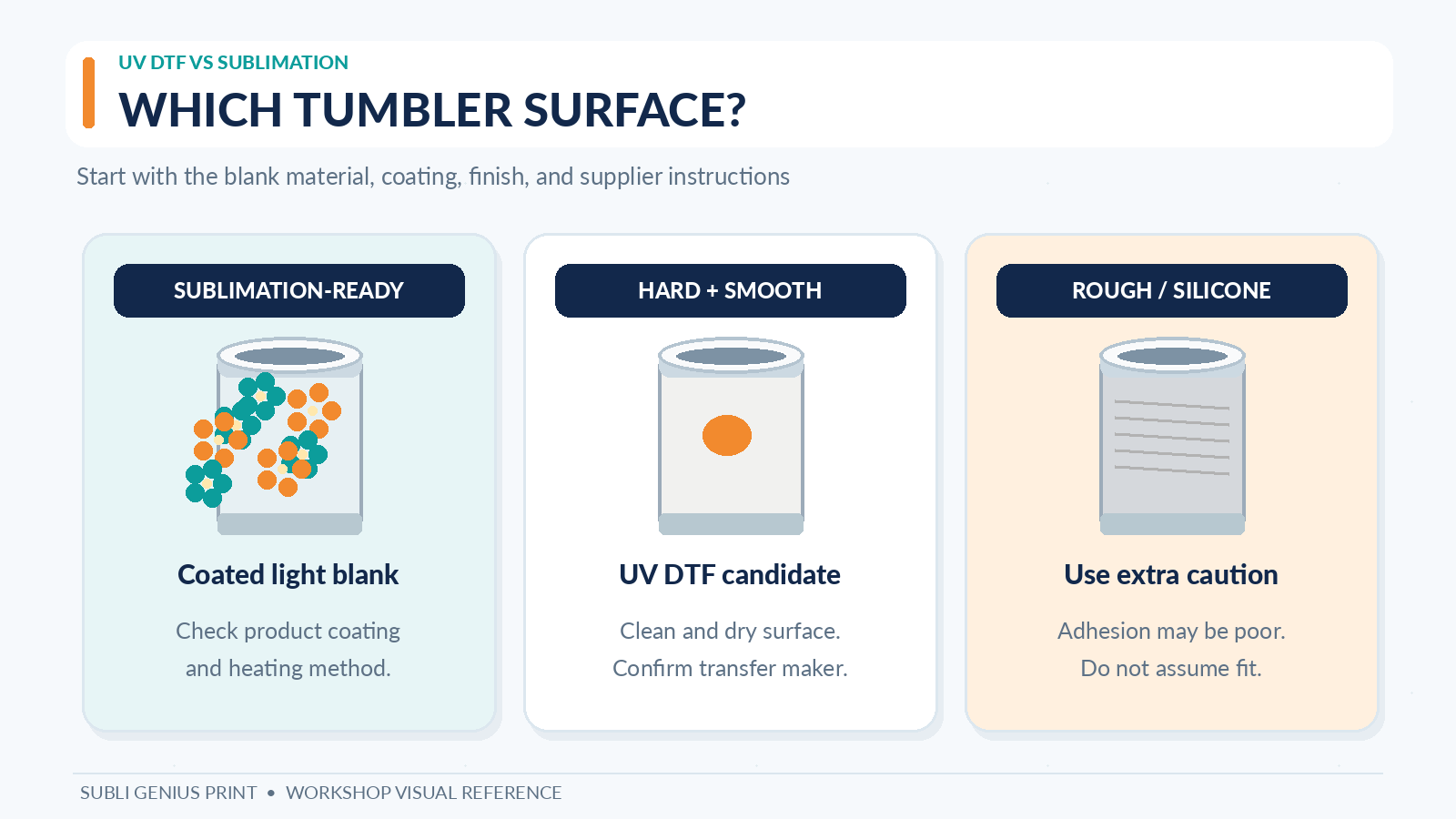
Start with the tumbler surface, not the artwork
A plain stainless-steel cup and a white coated sublimation cup can look similar in a product listing. They do not behave the same when heated. For normal dye sublimation on a hard item, the receiving surface needs a compatible coating. Color and surface texture matter too.
Use this quick selection table before buying supplies:
| Tumbler or surface | Sublimation decision | UV DTF decision | First check |
|---|---|---|---|
| White or light, confirmed sublimation-coated tumbler | Candidate | Candidate if smooth and supplier-approved | Compare desired full wrap versus applied logo |
| Plain stainless steel with no sublimation coating | Not a standard sublimation blank | Possible if clean, smooth and transfer-approved | Verify surface finish and test adhesion |
| Black powder-coated tumbler | Only if a specific sublimation-ready coating and process are documented; ordinary black coating is not enough | Often a candidate for a white-backed UV DTF transfer | Sample test on the exact powder coat |
| Textured or rubberized exterior | Do not infer compatibility | Often poor for adhesion | Ask supplier and test an actual blank |
| Ceramic mug | Only if sublimation-coated | Possible on suitable smooth glazed exterior | Confirm heat compatibility or decal care |
| Silicone grip or flexible part | Not a normal coated sublimation target | Generally unsuitable for rigid-surface UV DTF transfers | Choose another decoration approach |
Practical decision: if a product listing does not identify the coating or permitted printing method, treat that as missing information, not permission to experiment on a customer order. Our sublimation tumbler blanks buying guide explains why coating, size and equipment fit must be checked together.
What each transfer looks and feels like
Sublimation gives a smooth finish on a suitable coated blank
Sublimation artwork starts as dye on transfer paper. Heat moves the dye into compatible polyester or a polymer coating. The printed result generally feels smooth because there is no separate cut decal sitting on top. That makes the process useful for large artwork, gradients and full-body designs when the blank and heating equipment support them.
The limitation is the blank. A standard sublimation ink set cannot print opaque white. If you put a light-colored design onto a dark surface, the background shows through rather than behaving like white ink on top.
UV DTF adds a printed layer to a hard surface
A UV DTF transfer carries UV-cured printed ink and adhesive. It is applied to a clean, compatible surface by firm rubbing or squeegee pressure. A white underlayer may allow a supplier’s full-color design to stand out on dark tumblers. This is UV DTF for hard goods, not the heat-applied DTF transfer process commonly used for shirts.
The design can have a discernible edge and may not conform well over deep curves, seams, handles or heavily textured finishes. Before taking a bulk order, apply the exact design to one blank from the intended supplier and follow that transfer maker’s curing and care instructions.
Which process costs less per saleable tumbler?
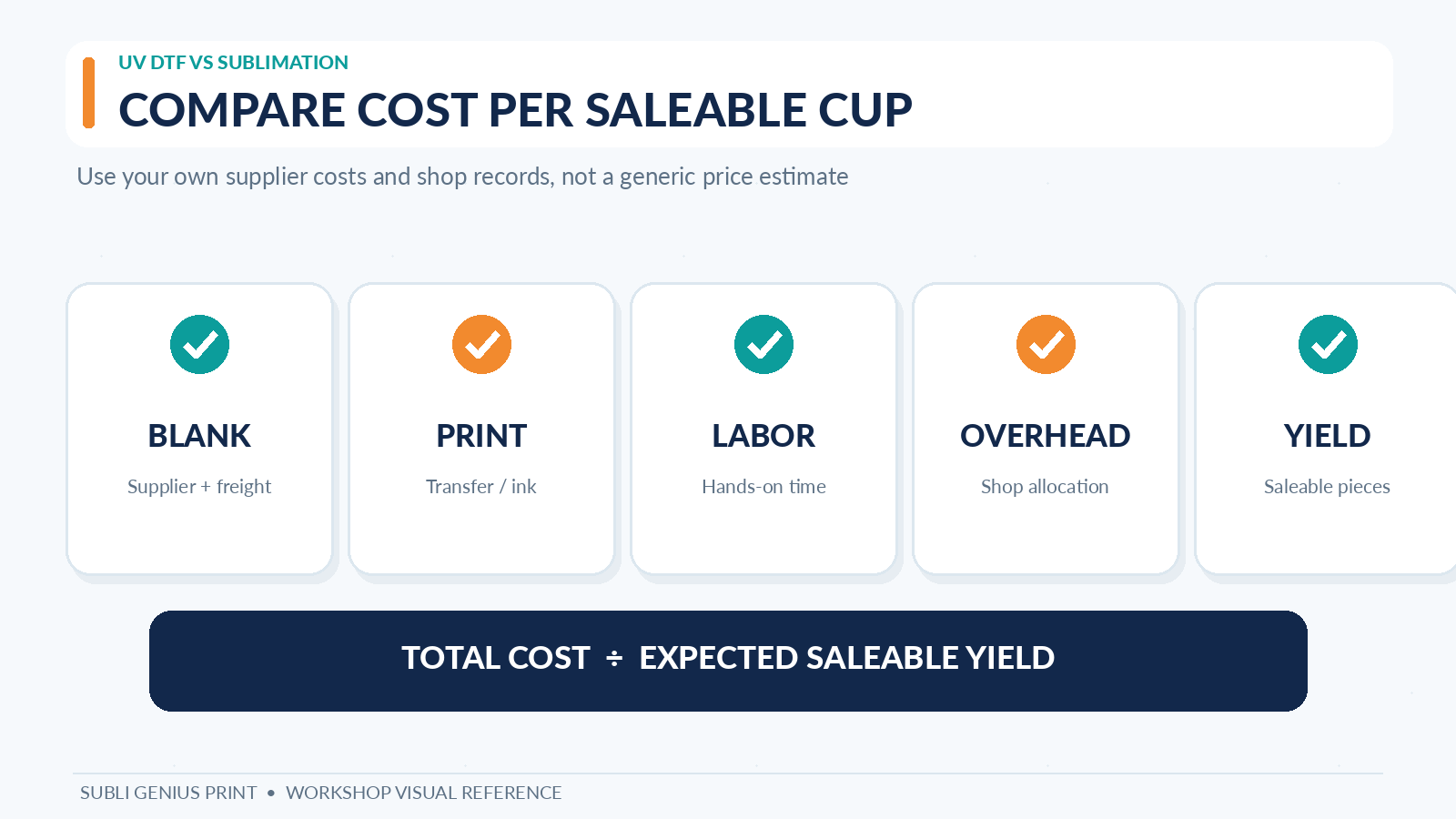
The lower blank price is not automatically the lower finished-product cost. Include transfer supplies, active labor, equipment occupancy, allocated overhead and the cost of failed pieces. A quote based only on the blank and ink leaves out real costs.
Editable formula:
Cost per saleable tumbler = (blank + transfer/ink/paper + other consumables + active labor + allocated overhead) / expected saleable yield
If 95 out of 100 attempted tumblers are acceptable, the saleable yield is 0.95. This is a planning input based on your records, not an industry failure-rate claim.
Here is an illustrative example only, using hypothetical US-dollar inputs, not live supplier prices:
| Per attempted tumbler | Sublimation | UV DTF |
|---|---|---|
| Blank | $7.50 | $6.50 |
| Print/transfer | $0.85 | $2.80 |
| Other consumables | $0.25 | $0.10 |
| Active labor | $2.10 | $1.40 |
| Allocated overhead | $1.00 | $0.90 |
| Cost before rejects | $11.70 | $11.70 |
| Hypothetical saleable yield | 95% | 93% |
| Cost per saleable tumbler | $12.32 | $12.58 |
Those assumptions deliberately show similar base costs with a different yield. In your shop, any row can change the result. For example, a full-wrap UV DTF transfer can cost differently from a small name decal, while a sublimation oven batch may have a different labor and equipment cost from a single tumbler press.
Use a spreadsheet or cost worksheet to enter your own material costs, labor rate, minutes, overhead and expected rejects for both methods. How to price sublimation tumblers explains selling price and margin; the blank cost calculator helps when freight and damaged inventory affect the true blank cost.
Compare the production workflows before choosing equipment
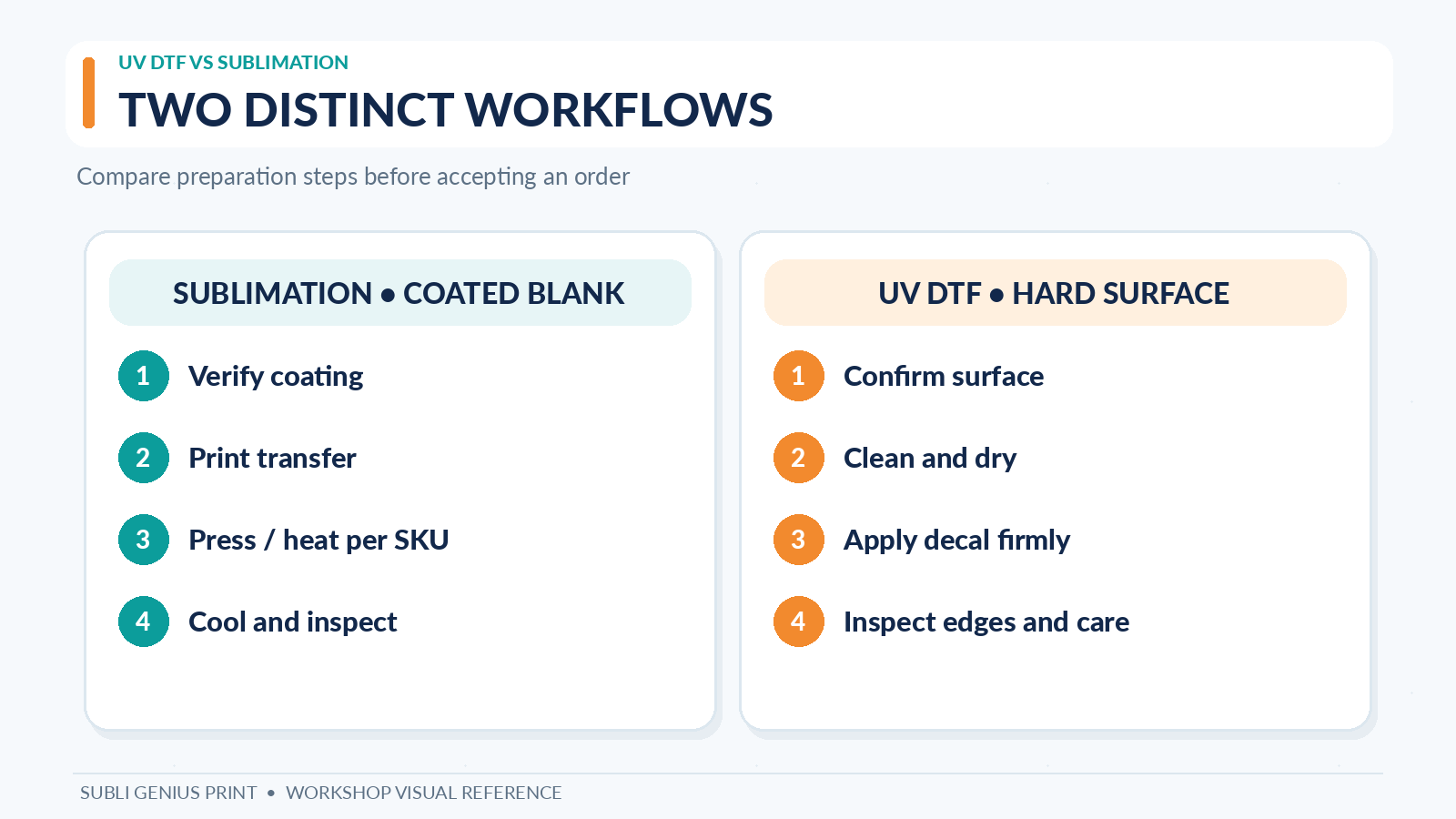
Sublimation workflow for a verified blank
- Obtain the exact sublimation-ready tumbler SKU and its manufacturer’s heating, handling and cooling instructions.
- Print a properly sized transfer using the correct sublimation printer, ink and paper workflow. Confirm whether mirroring is needed.
- Clean and dry the blank, secure the artwork and protect the heating equipment as directed.
- Use the specified press or oven setup and the manufacturer’s time, temperature and pressure. Do not copy a shirt or mug setting onto a tumbler.
- Allow the product to cool as specified, remove the transfer, then inspect the seam, edges and color before approving a production batch.
For curved drinkware, the choice between equipment matters. See mug press versus convection oven before purchasing a separate heating setup.
UV DTF workflow for a suitable hard surface
- Confirm the chosen transfer is suitable for the tumbler material and finish. Keep printed decoration away from drinking lips and any food-contact interior.
- Clean and dry the exterior as the transfer supplier directs. Avoid touching the prepared area.
- Align one edge carefully. Once the adhesive contacts the surface it may not be repositionable.
- Apply even pressure from the center outward, working around the curve and away from air pockets.
- Peel the carrier slowly. If an edge starts to lift, set the carrier back down and reapply pressure according to the supplier’s instructions.
- Observe the supplier’s settling time and wash-care rules before delivering the tumbler.
Avery’s UV DTF application guide recommends cleaning and firm application pressure. Its specific cup-transfer instructions call for hand washing, not dishwasher use. Do not transfer that advice to a different vendor’s product without checking its documentation.
Durability and customer-care instructions
A sublimated image relies on the coating and the manufacturer’s permitted use. Some blanks have published dishwasher guidance; others require hand washing. A UV DTF decal is an applied layer, so abrasion, edges and cleaning products can become different failure points. No single wash-cycle number is reliable for every supplier and blank combination.
| Question for the supplier | Why it matters |
|---|---|
| Is this exact blank or transfer dishwasher rated? | Avoid promising durability unsupported by a product specification |
| Must the decorated tumbler be hand washed? | Prevent a customer-care mismatch |
| Are there restrictions on soaking, heat or abrasive scrubbing? | Protect coatings and applied edges |
| How long after applying a decal should the tumbler rest? | Some adhesive systems require a settling period |
| Where is the decoration permitted? | Keep external artwork away from food-contact surfaces |
For Avery UV DTF stickers specifically, the manufacturer’s FAQ says exterior decoration only and recommends hand washing. For sublimation, refer to the individual blank manufacturer rather than claiming all coated tumblers are microwave- or dishwasher-safe.
Choose by order type
One black tumbler with a customer logo: A white-backed UV DTF transfer may be a practical option if the finish passes a supplier-approved adhesion test. It avoids buying a specialty sublimation blank for that one order.
A batch of white sublimation-ready tumblers with full-wrap photos: Sublimation is a strong candidate if you already own a compatible setup, can consistently position wraps and have a verified blank supplier. A color-shift chart can help explain why a pressed proof may differ by substrate.
A mixed order of several finishes: Do not assume one process works on every item. Separate the order by surface and test any unfamiliar combination.
A gift order requiring machine-wash claims: Obtain the exact blank and decoration supplier’s care instructions before promising dishwasher performance. If neither supplier provides support, offer a care instruction you can substantiate or use another process.
Common questions
Is UV DTF the same as DTF for shirts?
No. UV DTF is a pressure-applied transfer intended for suitable hard surfaces. Apparel DTF uses a different ink-and-adhesive workflow and typically needs heat to attach to fabric. Do not use apparel-press settings for UV DTF tumbler decals.
Can UV DTF go on any stainless tumbler?
No universal guarantee is possible. Smooth stainless and coated finishes may be candidates, but texture, oils, curves and transfer chemistry affect adhesion. Test the actual product and follow the transfer supplier’s guidance.
Can sublimation decorate a plain black tumbler?
Not by normal dye sublimation alone. You need a receiving surface intended for the process, and standard sublimation ink does not create an opaque white layer over dark coloring.
Which method is cheaper for 10 tumblers?
Calculate both with your real blank cost, transfer size, handling time, overhead and reject rate. A small mixed order can favor an outsourced UV DTF transfer; a regular full-wrap sublimation line can favor your existing press workflow. Neither outcome is universal.
What to do before accepting the order
Ask for a photo or SKU of the blank, confirm the intended finish and how the customer will wash it, then price a sample. Save one approved proof and its instructions. The right method is the one you can repeat on the actual tumbler, not the method with the most attractive generic product photo.