Sublimation Paper Sizes Explained: 8.5×11, A4, 11×17, 13×19 and Tumbler Sizes

A print that comes out slightly too small rarely looks like a sizing problem at first. The colors are fine, the image is sharp, and everything seems normal until you wrap it around a tumbler and find a bare stripe down the back, or press it onto an adult shirt and watch it float in the middle of the chest like a pocket print. For a measured full-wrap template, use the tumbler wrap size calculator before choosing your paper.
Sublimation paper sizes come down to two separate questions, and mixing them up is where most of the waste happens. The first is what your printer can physically feed. The second is what your blank actually needs. A sheet can be perfect for one and useless for the other.
Sublimation Paper Sizes at a Glance
Five sheet formats cover almost every project in a home or small shop setup. The column that matters most is the third one, because buying paper your printer cannot feed is the single most expensive sizing mistake there is.
| Size | Inches | Millimetres | What it needs | Typical use |
|---|---|---|---|---|
| Letter | 8.5 x 11 | 216 x 279 | Any desktop sublimation printer | Mugs, tumblers, youth shirts, pocket prints |
| A4 | 8.27 x 11.69 | 210 x 297 | Any desktop printer set to A4 | The same jobs, standard outside the US |
| Legal | 8.5 x 14 | 216 x 356 | Extendable tray | Tall wraps, long banners, stacked designs |
| Tabloid | 11 x 17 | 279 x 432 | Wide carriage printer | Adult front prints, small gang sheets |
| Super B / A3+ | 13 x 19 | 330 x 483 | 13 inch printer or bypass tray | Full adult prints, larger gang sheets |
8.5 x 11 Inches (US Letter)
This is the workhorse and the size you should default to while you are learning. It handles every mug, every standard tumbler wrap, youth apparel, coasters, keychains, and left chest prints. Nearly all sublimation paper is sold in this size, so you get the widest brand choice and the lowest cost per sheet.
The practical limit is width. After you allow for printer margins, the usable printing area is closer to 8 inches across, which is not enough for a full adult front print.
A4 (210 x 297 mm)
A4 is the international equivalent and the default in the UK, Europe, Australia, and most of Asia. It is slightly narrower than Letter and noticeably taller, which matters more than the numbers suggest once you start printing.
If you buy sublimation paper online, check the listing carefully. Plenty of sellers ship A4 stock to US buyers without flagging it, and plenty of US-made paper turns up on European storefronts.
8.5 x 14 Inches (Legal)
Legal is the size people forget exists, and it solves problems that neither Letter nor Tabloid handle well. The extra three inches of length suit tall tumblers, water bottle wraps, and vertical banner designs without forcing you into a wider printer.
Several popular sublimation printers top out here, including the Epson SureColor F170 and the North American version of the Sawgrass SG500, both of which handle sheets up to 8.5 by 14 inches.
11 x 17 Inches (Tabloid)
Tabloid is the first size that genuinely opens up adult apparel. With margins accounted for, you get around 10.5 inches of printable width, which covers a standard adult front print on most sizes up to large.
It also makes gang sheets worthwhile. Printing four mug wraps or six coaster designs on one sheet cuts your paper cost per item and reduces the number of press cycles you run.
13 x 19 Inches (Super B / A3+)
Sometimes listed as Super B, A3+, or 13×19, this is the largest sheet format most desktop setups will ever handle. Usable width lands near 12.5 inches, which covers oversized adult prints and larger gang layouts.
Two common routes to this size are a 13 inch wide printer such as a converted Epson EcoTank ET-15000, or a Sawgrass SG1000 fitted with the optional bypass tray. The SG1000 handles up to 11 by 17 from its main tray, and the bypass tray extends that to 13 by 19.
Rolls and Custom Lengths
Above 13 inches you are into large format territory. The Epson SureColor F570 takes rolls up to 24 inches wide, which is what all-over apparel prints and banner work require.
Custom lengths are also possible on some desktop machines. A Sawgrass bypass tray accepts custom sheets up to 51 inches long, which is how people produce long wraps and banner strips without a roll printer.
Letter vs A4: Which One Should You Actually Buy?
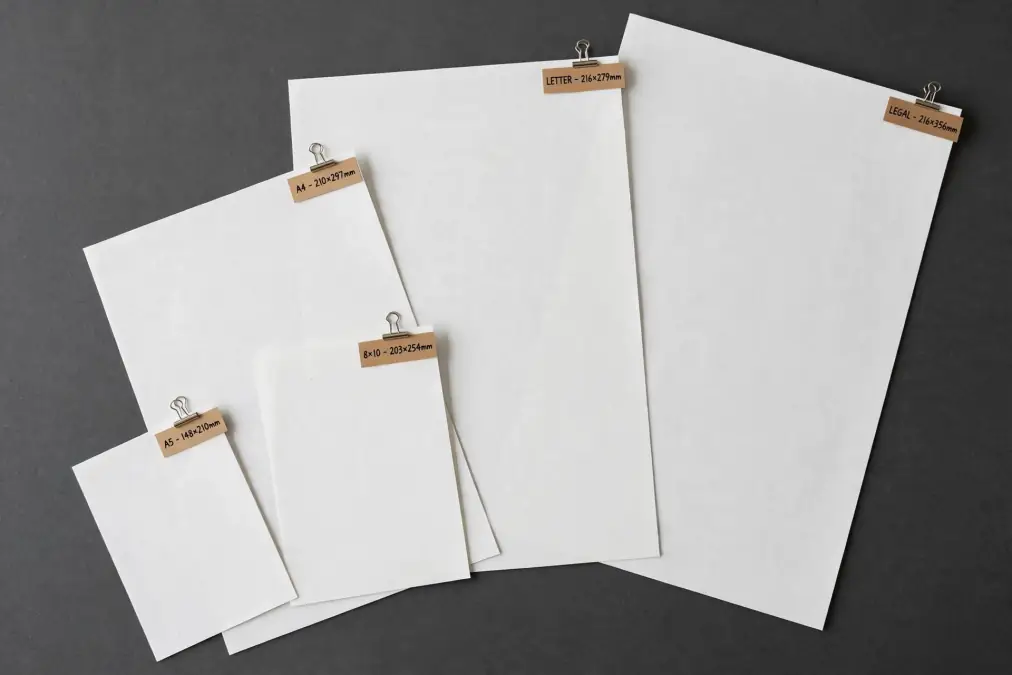
The gap looks trivial on paper. A4 is about 0.23 inches narrower and 0.69 inches taller than Letter. In practice that difference is enough to ruin a print run, and the failure is easy to misdiagnose because the print itself looks fine.
When your printer driver is set to Letter and you load A4, the driver assumes an 11 inch page and stops printing there. You lose the bottom of the design without any error message. Load Letter while the driver expects A4 and the extra width can trigger feed misalignment or a crooked print.
Watch out: The worst version of this problem is silent. If “fit to page” or “scale to fit” is enabled, the driver quietly shrinks your design to match whichever size it thinks is loaded. Your tumbler wrap comes out a few percent small, which is enough to leave a visible white gap at the seam.
Pick one and standardize on it. If you sell, buy templates, or follow tutorials from US creators, Letter keeps everything aligned. If you are in a region where A4 is the default and your blanks and printers are sourced locally, stay with A4 and adjust template sizes once rather than fighting the mismatch on every job.
What Size Paper Do You Need for a 20 oz Tumbler?
Ounce ratings describe how much liquid the blank holds. They say nothing about the shape of the wrap, which is what your paper actually has to cover. Two tumblers both sold as 20 oz can differ by two or three tenths of an inch in circumference, and that is enough to leave a bare line down the back.
Measuring takes about thirty seconds and beats guessing every time. Wrap a strip of scrap paper around the widest point, mark where it overlaps, and lay it flat. That measurement is your design width. Then measure the height you want covered and add a small overlap at top and bottom for the fold.
20 oz Skinny Tumblers
The most common blank in sublimation, and the one people size wrong most often. A full wrap runs approximately 9.3 inches wide by 8.2 inches tall at 300 DPI.
That width will not fit across a portrait Letter sheet, so print landscape. Turned sideways, an 8.5 by 11 sheet gives you 11 inches of width, which leaves room for the wrap plus a trim margin.
Larger Tumblers and Quencher Styles
Once you move past 20 oz, a standard sheet stops being reliable. A tumbler with a 3.85 inch top diameter has a circumference of roughly 12.1 inches, which exceeds the 11 inch dimension of a Letter sheet entirely.
For those blanks you need 11 x 17, 13 x 19, or a seam design that is intended to leave a deliberate gap. Measure first, then decide, because guessing at this size wastes a full sheet and a blank at the same time.
11 oz and 15 oz Mugs
Mugs are far more forgiving because the walls are straight. A full wrap for an 11 oz mug sits around 3.5 by 9.125 inches, and a 15 oz mug needs closer to 4 by 9.5 inches. Both are sold as pre-cut mug paper in exactly those dimensions.
You do not have to buy pre-cut stock. Three mug wraps fit comfortably on one Letter sheet, and cutting them yourself after printing costs nothing extra. Setting a custom paper size in your driver is the only extra step.
Why Ounces Do Not Tell You the Print Size
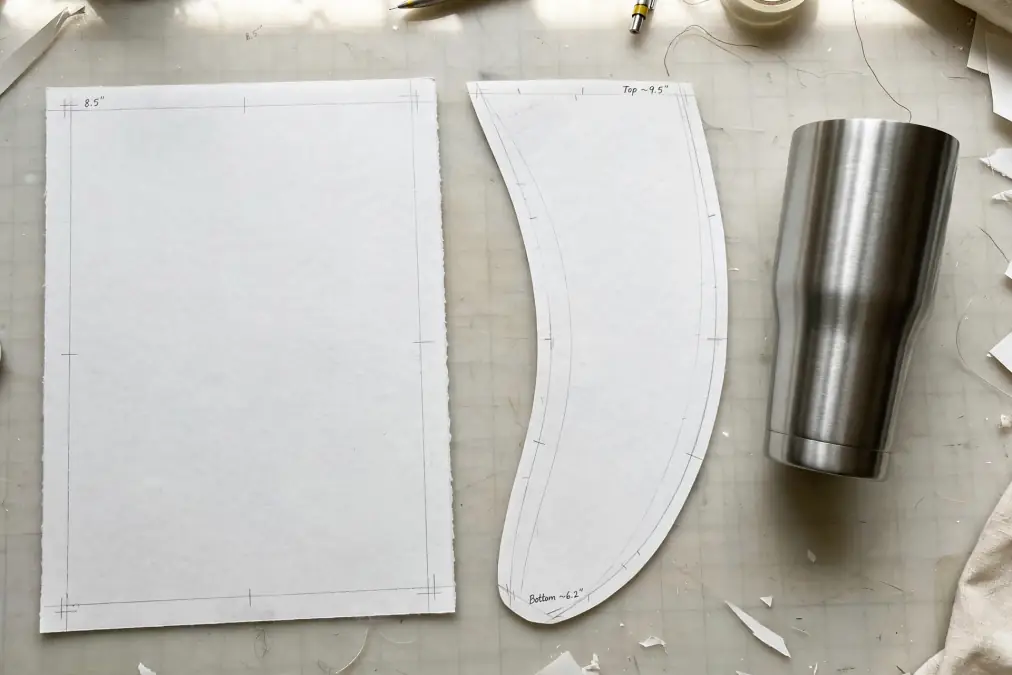
Most tumblers are tapered, wider at the top than the bottom. When you unroll a tapered cylinder flat, you get a curved panel rather than a rectangle. Printing a plain rectangle on a tapered blank creates a wedge shaped gap at the seam that no amount of pulling will close.
This is why tumbler templates look banana shaped. If your wraps keep failing at the seam even when the width is right, the taper is usually the reason. Correct pressing pressure matters too, and our guide to tumbler temperature settings covers the heat side of the same problem.
Tip: Do a dry fit before you commit sublimation paper. Print the design on cheap copy paper, wrap it, and check the seam. Copy paper costs a fraction of a sublimation sheet and catches every sizing error before it costs you a blank. The right wrapping tools make the difference between a tight seam and a visible one.
Matching Paper Size to Shirt and Tote Designs
Apparel is where sheet size becomes a real constraint rather than a convenience. Design width is the deciding factor, and the usable print area is always smaller than the sheet because of printer margins.
| Design width | Typical placement | Sheet needed |
|---|---|---|
| 3 to 4 inches | Left chest, sleeve, pocket area | 8.5 x 11 (cut down) |
| Up to 8 inches | Youth front print, small adult centered design | 8.5 x 11 |
| 9 to 10.5 inches | Standard adult front print, tote bag | 11 x 17 |
| 11 to 12.5 inches | Oversized adult front, large back print | 13 x 19 |
The jump from youth to adult sizing is where most people discover the limit of an 8.5 inch printer. A design that looks generous on a youth medium reads as undersized on an adult large, and no amount of scaling fixes it once you have hit the sheet width. Our t-shirt setup guide covers placement measurements alongside the equipment side.
Do You Need 11×17 or 13×19?
Larger sheets are tempting, and for a lot of setups they are the wrong purchase. The paper is the cheap part. The printer that feeds it is not.
Size up when one of these applies to you:
- Adult apparel is a regular part of what you sell, not an occasional request.
- You are producing enough volume that gang sheets would cut your press cycles meaningfully.
- You are turning away orders for oversized prints you currently cannot fill.
Stay with 8.5 x 11 when any of these is true:
- Drinkware, coasters, and small blanks make up most of your output. A 20 oz wrap never needs more than a Letter sheet.
- You are still dialing in color and pressing. Failed prints on 13 x 19 waste roughly two and a half times the paper of a failed Letter print.
- Adult apparel is rare enough that ordering a few transfers from a print partner costs less than a new printer.
Which Printers Handle Each Size
Sheet capacity is fixed by the machine, so this is worth checking before you buy either the printer or the paper.
| Printer | Maximum sheet |
|---|---|
| Epson SureColor F170 | 8.5 x 14 |
| Sawgrass SG500 (North America) | 8.5 x 14, or 8.5 x 51 with bypass tray |
| Sawgrass SG1000 | 11 x 17, or 13 x 19 with bypass tray |
| Epson EcoTank ET-15000 | 13 x 19 |
| Epson SureColor F570 | Rolls up to 24 inches wide |
Converting an inkjet to sublimation ink voids the manufacturer warranty, which is a real cost to weigh against the lower purchase price.
If you are still choosing a machine, it is worth reading through the common mistakes people make when picking a sublimation printer and comparing against Canon options for sublimation ink before committing.
Printer Settings That Undo the Size You Chose
Buying the right sheet does not help if the driver overrides it. Four settings account for nearly every sizing failure that is not a measurement error.
Paper size in the driver. Set this to match the sheet physically loaded, every time. For mug wraps and custom cuts, create a custom size rather than printing a small design on a full sheet and trimming, which wastes paper and shifts your registration.
Scale. Print at 100 percent. Turn off “fit to page”, “scale to fit”, and “shrink oversized pages”. These options exist for documents, where a small automatic reduction goes unnoticed. On a tumbler wrap, even a small reduction is the difference between a closed seam and a white stripe.
Mirror. Sublimation transfers flip when pressed face down, so text and logos must be mirrored before printing. This does not change your dimensions, but it wastes an entire correctly sized sheet when it is missed.
Orientation. Landscape gives you the full 11 inches of width on a Letter sheet, which is what makes tumbler wraps possible on standard paper. Portrait gives you 8.5 inches. Check this before every wrap print.
Our full walkthrough of sublimation printer settings covers the color side of the same menu, and ready-made templates remove the sizing guesswork entirely for common blanks.
Sizing Mistakes That Waste Paper
Five errors account for most of the paper that ends up in the bin.
- Scaling to fit instead of printing at 100 percent. The design prints cleanly, just slightly small, so the fault gets blamed on the template or the blank.
- Treating a tapered blank as a rectangle. The width is correct at the top and short at the bottom, producing a wedge shaped gap.
- Buying A4 for a Letter tray, or the reverse. Feed problems and cropped designs follow, usually without a warning from the driver.
- Trimming too close before pressing. A little overhang protects your edges and gives you something to tape. Cutting flush to the design leaves nothing to work with and risks a pale border.
- Ordering bulk paper in a size the printer cannot feed. The most expensive of the five, and completely avoidable with one check of your printer’s maximum sheet size.
That last one is worth extra care on large orders. Before committing to a case of paper, it is worth knowing how to vet a sublimation paper supplier, since size mislabeling is one of the more common problems with unfamiliar sellers.
Frequently Asked Questions
What size sublimation paper do I need for a 20 oz tumbler?
A standard 8.5 x 11 inch sheet, printed in landscape orientation. The full wrap design measures roughly 9.3 inches wide by 8.2 inches tall, which fits across the 11 inch dimension with room to trim. Measure your specific blank first, because suppliers vary by a few tenths of an inch.
Can I use A4 sublimation paper in a US printer?
Yes, provided you change the paper size in your printer driver to A4 before printing. The sheet is narrower and taller than Letter, so leaving the driver on Letter will cut off the bottom of your design or shrink it if scaling is enabled.
Is 13×19 sublimation paper worth it for a home setup?
Only if you print adult apparel regularly or run gang sheets. It requires a 13 inch capable printer, and a failed print wastes considerably more paper than the same failure on a Letter sheet. Most hobbyists working with drinkware and small blanks never need it.
What size paper do I need for an 11 oz mug?
About 3.5 by 9.125 inches for a full wrap. Pre-cut mug paper is sold in this exact size, though you can fit three wraps on a single Letter sheet and cut them yourself. A 15 oz mug needs closer to 4 by 9.5 inches.
Can I cut larger sublimation paper down to size?
You can, and it is a practical way to use up offcuts. Cut before printing rather than after, and set a matching custom paper size in the driver so the design lands where you expect. Watch that the cut sheet is not narrower than your printer’s minimum feed width, which is usually around 3.5 inches.
Does paper size affect transfer quality?
Not directly. Quality comes from the coating, the ink, and the press settings rather than the dimensions. Size affects quality indirectly when a sheet is too small and the design gets scaled down, or when trimming too close leaves a pale edge on the transfer.
Getting the Size Right the First Time
Two checks prevent almost every sublimation paper sizing problem. Confirm what your printer can feed before you buy paper in bulk, and measure your blank rather than trusting the ounce rating on the listing.
For most people the answer stays simple. An 8.5 x 11 sheet handles mugs, tumblers, youth apparel, and small blanks, which is the majority of what a home setup produces. Move up to 11 x 17 or 13 x 19 when adult apparel becomes a regular order rather than an occasional one.
With the size settled, the next decision is which paper to put in the tray. Our sublimation paper buying guide covers brands and coatings, and the paper comparison guide breaks down how different types perform on fabric versus hard substrates.